Article Summary
- The new G65 X5 grows to 196.8 inches on a 119.5-inch wheelbase, narrowing the size gap to the X7 while dropping its third-row option entirely.
- The X5 now offers five powertrain types, including a PHEV and a full EV, while the current X7 remains gasoline-only with no plug-in option.
- U.S. X5 pricing starts at $71,250, roughly $13,000 to $14,000 less than the X7's starting price of $86,700-plus.
BMW just revealed the fifth-generation X5, and it changes the math on this comparison more than anyone expected. The G65 X5 is bigger, more expensive to option out, and loaded with tech the current X7 doesn’t have. It’s also, for the first time in nearly two decades, a strictly two-row SUV. Meanwhile the X7 you can buy right now is entering its final year on the outgoing G07 platform, with the G67 replacement confirmed for 2027. Here’s how the two actually stack up while both are on sale at the same time.
The X5 Grew, But It Also Lost Something

Start with the number everyone will ask about first. The new X5 is longer than the outgoing G05 by about 2.3 inches, landing at 196.7 to 196.9 inches depending on trim, and BMW stretched the wheelbase by 2.4 inches to 119.5 inches. Against the X7’s 203.6-inch length and 122.2-inch wheelbase, the size gap that used to separate these two SUVs by close to nine inches of overall length is now under seven. The wheelbase gap, which matters more for rear legroom, shrank from 5.1 inches to 2.7 inches.
That’s the growth half of the story. The other half is that BMW eliminated the X5’s optional third row (they did it years ago actually) and its signature split tailgate at the same time. Every G65 X5 ships as a two-row, five-seat SUV with a conventional one-piece liftgate. Anyone who bought a seven-seat X5 for a third row of occasional-use jump seats now has exactly one place to go in BMW’s lineup: the X7.
Interior Space and Cargo: The X5 Gained Size But Not Cargo Room

Here’s a detail worth sitting with. Despite the larger footprint, the new X5’s official cargo figures from BMW USA are 27.3 cubic feet behind the rear seats and 67.7 cubic feet with them folded. The outgoing G05 X5 40i is rated at 33.9 cubic feet and 72.3 cubic feet in the same measurements. A bigger SUV with less usable trunk space isn’t the kind of thing BMW highlights in a press release, but it’s the number that will actually matter to someone loading a stroller or a set of golf clubs. It’s likely a byproduct of PHEV and EV battery packaging shared across the lineup, plus a more sharply raked liftgate, but the result is the result.
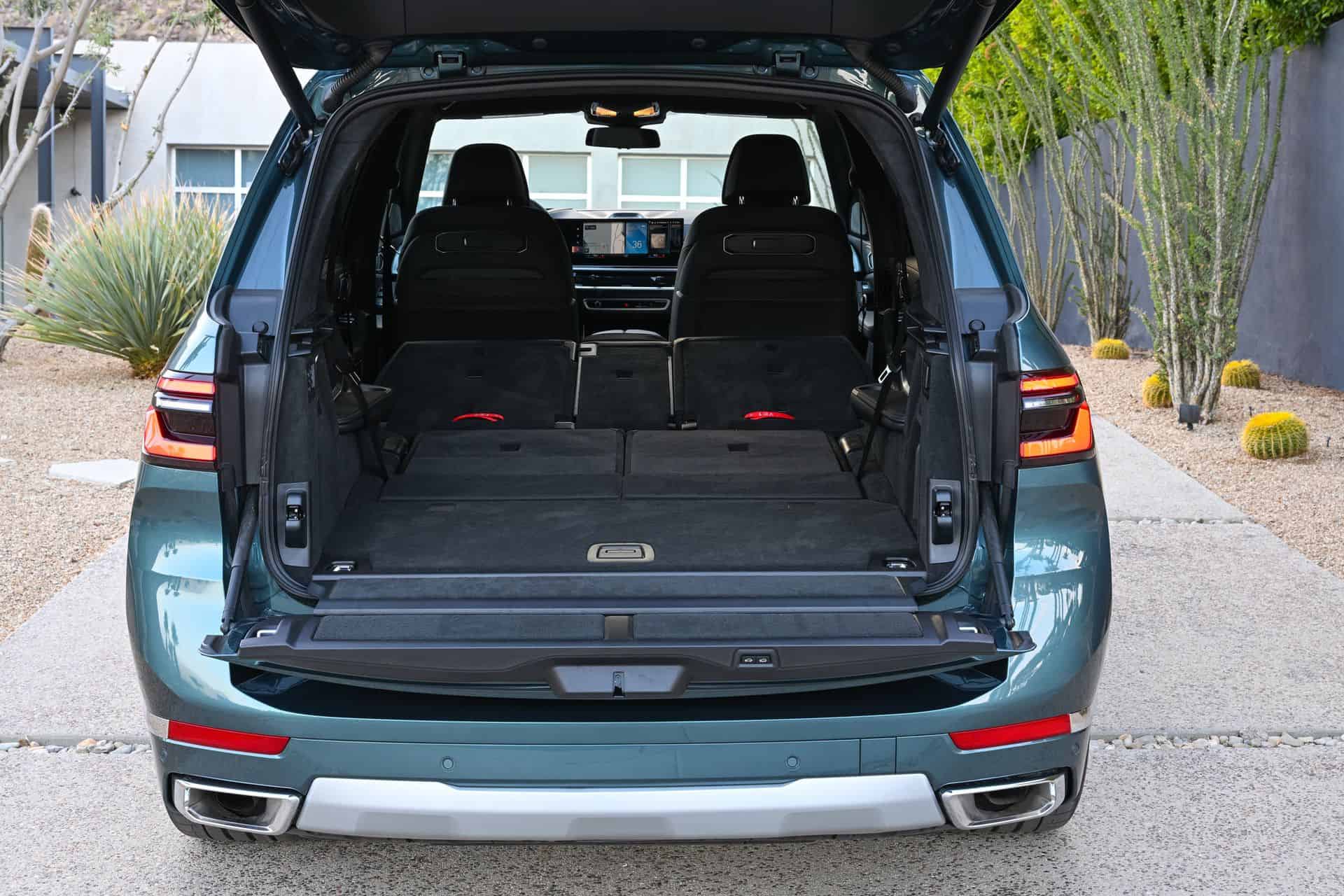
The X7 isn’t close on cargo regardless. With the third row folded, it offers 48.6 cubic feet, and with both rear rows down, that number jumps to 90.4 cubic feet, the most of any BMW SUV. Behind an occupied third row, there’s still 12.8 cubic feet, enough for a few soft bags but not much else. Second-row legroom on the X7 comes in at 37.6 inches with 39.9 inches of headroom, while the third row gets 33.3 inches of legroom and 36.6 inches of headroom. That third row is tight by full-size SUV standards and best reserved for kids, but it exists, and now it’s the only place in BMW’s SUV range where it does.
| Spec | BMW X5 (G65) | BMW X7 (G07) |
|---|---|---|
| Length | 196.7-196.9 in | 203.6 in |
| Width | 78.7 in (87.2 in w/ mirrors) | 87.3 in |
| Height | 68.9 in | 72.2 in |
| Wheelbase | 119.5 in | 122.2 in |
| Ground clearance | 8.9 in | ~8.7 in |
| Seating | 2 rows, 5 seats | 3 rows, 6-7 seats |
| Cargo (seats up) | 27.3 cu ft | 48.6 cu ft (3rd row folded) / 12.8 cu ft (3rd row up) |
| Cargo (max, seats folded) | 67.7 cu ft | 90.4 cu ft |
| 2nd row legroom | Increased vs. G05 (exact figure TBD) | 37.6 in |
| 3rd row legroom | Not available | 33.3 in |
| Base price (US) | $71,250 | $86,700-$87,500 |
| Top price (US) | $81,250 (iX5 60, at launch) | $156,000-$157,175 (ALPINA XB7) |
| Powertrain types offered | Gas, diesel (EU), PHEV, EV, hydrogen (2028) | Gas only |
The X5 Actually Has Newer Tech Than the X7 Right Now

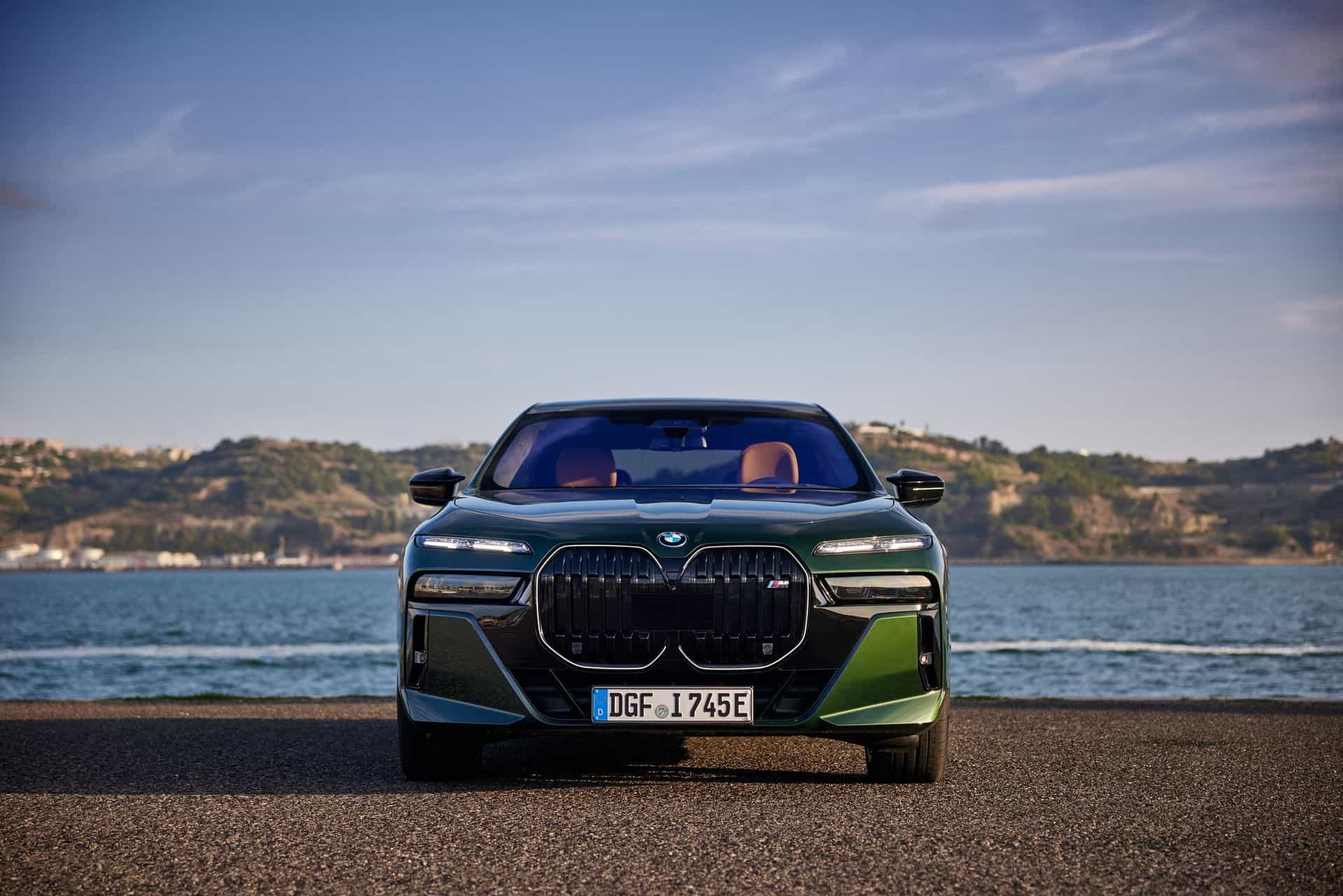
This is the part that will surprise X7 shoppers. The G65 X5 launches with BMW’s Neue Klasse interior architecture: a 17.9-inch central touchscreen running iDrive X, no rotary iDrive controller, and Panoramic Vision, a windshield projection system that replaces the digital instrument cluster entirely.
An optional 14.6-inch passenger display, carried over from the 7 Series, adds independent video streaming and gaming for the front passenger, with an interior camera that dims the screen if it catches the driver glancing over. The door handles are gone too, replaced by BMW Winglets integrated into the pillars, paired with an optional automatic door function that’s a first for any BMW SUV. Slate makes its debut as an interior material, alongside glass detailing and X-pattern stitching, with 23-inch wheels available for the first time on an X5.

The X7 you can order today runs BMW’s older curved display setup, a 14.9-inch touchscreen paired with a 12.3-inch digital cluster, not the Panoramic Vision setup or iDrive X. It still has real buttons, five-zone climate control on higher trims, standard air suspension, and available massage seats front and back, and none of that is a knock against it. But the newer tech, the more distinctive materials, and the more modern cabin architecture currently belong to the smaller, cheaper SUV. That flips back the other way once the G67 X7 arrives in 2027 on the same platform language, but for the next model year, the X5 is the more current-feeling interior of the two.
Drivetrain Options: The X5 Has Five, the X7 Has One

This is where the gap is largest, and it isn’t close. The X7 on sale right now offers exactly one type of powertrain: gasoline, with 48-volt mild-hybrid assistance across all three trims. The xDrive40i uses a 3.0-liter turbocharged inline-six making 375 horsepower and 398 lb-ft, the M60i steps up to a 4.4-liter twin-turbo V8 at 523 horsepower and 553 lb-ft, and the ALPINA XB7 tunes that same V8 to 631 horsepower and 590 lb-ft. There is no plug-in hybrid X7, no electric X7, and no diesel X7 in the U.S. market. BMW never brought a PHEV version of this generation to market, which is notable given that the smaller X5 has offered a plug-in hybrid variant for years.
The G65 X5 flips that completely. BMW is offering five separate powertrain types on a single nameplate for the first time in its history: gasoline, diesel (Europe only), plug-in hybrid, full electric, and eventually hydrogen. The gas-only X5 40 and 40 xDrive use an updated B58 inline-six at 394 horsepower and 428 lb-ft.
The X5 50e xDrive plug-in hybrid combines that engine with an electric motor for 483 horsepower and 516 lb-ft, using a 26.5-kWh battery good for an EPA-estimated 44 miles of electric range. The iX5 60 xDrive is a dual-motor EV making 570 horsepower and 593 lb-ft, with a 141-to-144-kWh battery (the same pack, measured under different regional standards) targeting roughly 435 miles of EPA range and 460-kW peak DC fast charging, enough for a 10-to-80-percent charge in about 22 minutes.

The X5 M60e, a 603-horsepower PHEV flagship, launches in Europe first; American buyers will instead get a V8-powered M Performance model in 2027, alongside a planned electric M Performance iX5. A hydrogen fuel-cell version, co-developed with Toyota and rumored to carry the iX5 60h xDrive name, follows around 2028 with roughly 466 miles of range and sub-five-minute refueling.
None of that electrification touches the X7, at least not yet. The G67 replacement, officially confirmed for 2027, will presumably close that gap when it moves onto the same platform, but anyone buying an X7 today is buying into last-generation powertrain thinking regardless of trim.
Pricing: The Gap Is Real, But It’s Not What It Used to Feel Like
In the U.S., the 2027 X5 starts at $71,250 for the rear-wheel-drive X5 40, $73,550 for the X5 40 xDrive, $78,950 for the X5 50e plug-in hybrid, and $81,250 for the iX5 60 electric, all including destination. The X7 xDrive40i starts around $86,700 to $87,500 depending on the source and model-year update, the M60i lands between roughly $111,900 and $115,000, and the ALPINA XB7 tops out near $156,000 to $157,175.
Even comparing the cheapest xDrive versions of each, there’s about a $13,000 to $14,000 gap between the X5 40 xDrive and the X7 xDrive40i, which buys you the extra length, the third row, and the bigger cargo hold. That’s a real premium, but it’s a smaller one than the size difference alone would suggest, especially once you consider the new X5 now undercuts the X7 on tech rather than trailing it.
So Which One Actually Makes Sense Right Now
If you don’t need a third row, the G65 X5 is the easy answer. It’s newer, it’s better equipped with tech the X7 doesn’t have yet, it finally offers a real spread of powertrains instead of one flavor of gasoline, and it costs meaningfully less to get into. The tradeoff, and it’s a real one, is that BMW quietly took away the option some X5 buyers actually used. If you’ve been cross-shopping an X5 with a third row against a base X7, that comparison no longer exists.
The X7 still wins on the one thing it was built for: space for seven and a cargo hold that isn’t compromised by carrying them. It’s also, bluntly, a car in its last model year before a full redesign, which means BMW isn’t going to keep adding much to it and residual values on the outgoing G07 will likely soften once the G67 shows up. If you need three rows now, buy the X7 and don’t wait. If you don’t, the smart move in 2026 is the smaller, newer, more diversely powered SUV that happens to wear the cheaper badge.
P.S. The X7 still has plenty of physical buttons….