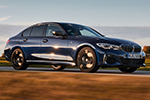
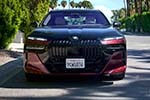
From the outside, the BMW 750iL High Security looks like the most respectable kind of late-’80s power move: a long-wheelbase E38 7 Series, squared-off and formal, the sort of car that blends into a line of black sedans outside a hotel without anyone giving it a second glance. That’s the first clue. The real genius of the High Security wasn’t that it was armored. It was that it was engineered to appear unarmored—because in the world it was built for, visibility can be vulnerability.
It was 2000 when BMW developed the 750iL High Security at a moment when the definition of “flagship” was shifting. A top-spec luxury sedan still had to be quiet, smooth, and prestigious, but for a certain class of customer—heads of state, diplomats, high-risk executives—it also had to be survivable. Not in the abstract “safer in a crash” sense, but in the literal sense: able to absorb a violent attack and keep moving afterward, all while protecting the people inside. The E38 High Security was BMW’s factory answer to that reality, using the 750iL’s long-wheelbase platform and V12 powertrain as the foundation for something that functioned as both limousine and car shelter.
Why Was The E38 750iL High Security Unique?

In Europe, BMW offered a high-security E38 7 Series variant with protection rated up to B6/B7, known internally as the 750iL S. The armor and supporting hardware added roughly 950 kg (2,094 lb) over a standard 750iL. Beyond ballistic protection, it included a range of emergency and defensive systems: a windshield designed for rapid removal to aid escape, hydraulically assisted windows, and a gas sensor that could detect irritants such as CS gas and automatically seal the cabin by shutting down the blower motor, closing the fresh-air flaps, and closing all windows.
A fire-suppression system could be activated manually or triggered automatically by extreme heat near the engine bay or fuel tank area. For situations requiring prolonged isolation, an optional breathing-air system supplied air from a cylinder mounted in the trunk. BMW also offered optional provisions such as secure firearms cases (including designs sized for an MP5K) and integrated door gunports.
What made the car unique begins with the way it was built. Unlike many armored conversions of the era, the High Security concept was designed as a complete package rather than a normal 7 Series that later had protection layered onto it. That distinction matters because armoring a car is not simply a matter of making the glass thicker and the doors heavier. Protection has to be continuous, and continuity is difficult in the places you rarely think about: the joints where the doors meet the pillars, the seams around window frames, the transitions between floor, firewall, and bulkheads.
Stopping Bullets and Blasts
The E38 750iL High Security was also unique because it treated mobility as part of protection. The obvious threats are bullets and blasts, but the most dangerous moment in an attack is often the second one—after the vehicle is immobilized. A punctured tire, a damaged fuel system, a blocked road: these are mundane failures in ordinary life and potentially fatal in a security incident. That is why factory protection cars tend to include measures aimed at keeping the vehicle rolling under abuse, even if it’s no longer “comfortable” in the way a standard 7 Series is comfortable.
A Command Center Inside The Cabin

Then there’s the cabin itself, which becomes a controlled environment. In a normal luxury car, the windows and ventilation are conveniences; in a security car, they are liabilities that need to be managed. Heavy ballistic glazing changes the logic of how windows can operate, and protection vehicles often minimize opening sections or treat them differently than a standard sedan. Ventilation and sealing also take on a different meaning when the passenger compartment is supposed to remain isolated from an external threat. Even simple interactions with the outside world—speaking to a guard, passing documents, dealing with a checkpoint—are handled differently when you don’t want to open a door or lower a window.

An Imposing and Beautiful Machine

The car’s character is defined by the tension between what it is and what it must pretend to be. The E38 7 Series was already an imposing machine in its day, and the 750iL sat at the top with V12 refinement and the kind of engineering confidence BMW projected in that era. The High Security version added mass and complexity, but it couldn’t afford to become clumsy or obviously modified. It still had to look like a credible executive sedan and drive like something that belonged on a fast motorway.
In that sense, the E38 High Security is one of the most revealing 7 Series variants BMW ever built. It strips luxury down to its most honest promise. Not speed, not comfort, not prestige—though it still delivered those—but the promise that, whatever is happening outside, the people inside remain protected and the car remains capable of carrying them away. It also led to the development of additional security limousines, and more recently protection SUVs as well.