Article Summary
- The 7 Series will retain its most controversial design cues: large kidneys and split headlights.
- BMW's update for the G70 will bring an evolutionary design and a dramatically different interior.
- The electric i7 will use a battery pack co-developed with Rimac.
It’s been four years since the G70 7 Series premiered, so the timing feels right for BMW to unveil the facelifted version. Ahead of its April 22 debut at the Beijing Auto Show, the updated flagship appears in a teaser video. Well, sort of. Admittedly, the clip is just an animated take on the original preview from a few weeks ago. Even so, we figured it was worth sharing.
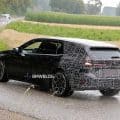
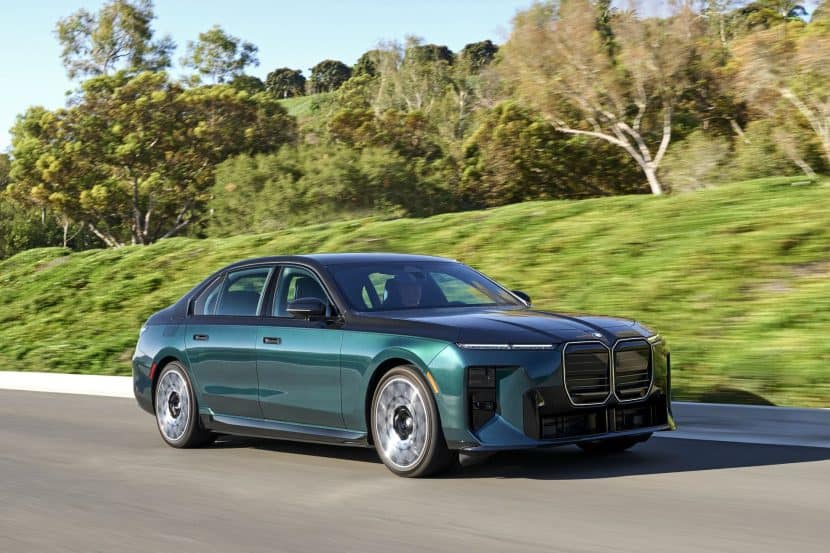
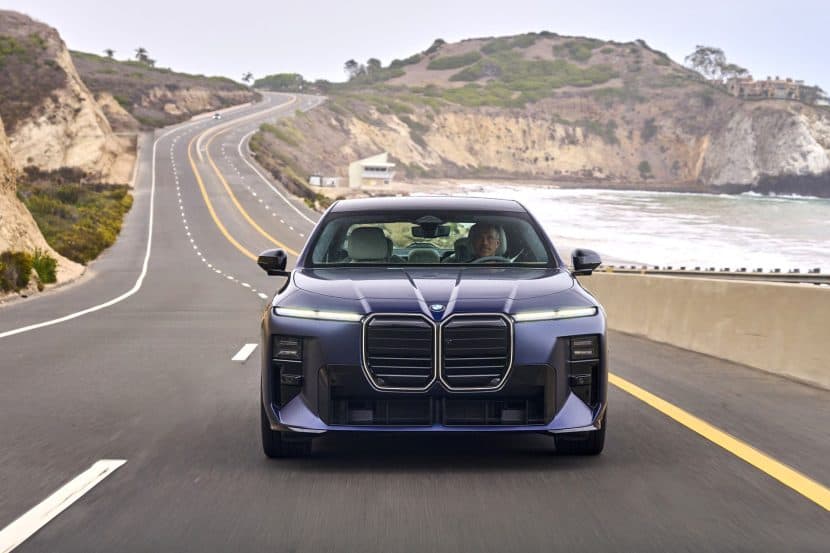
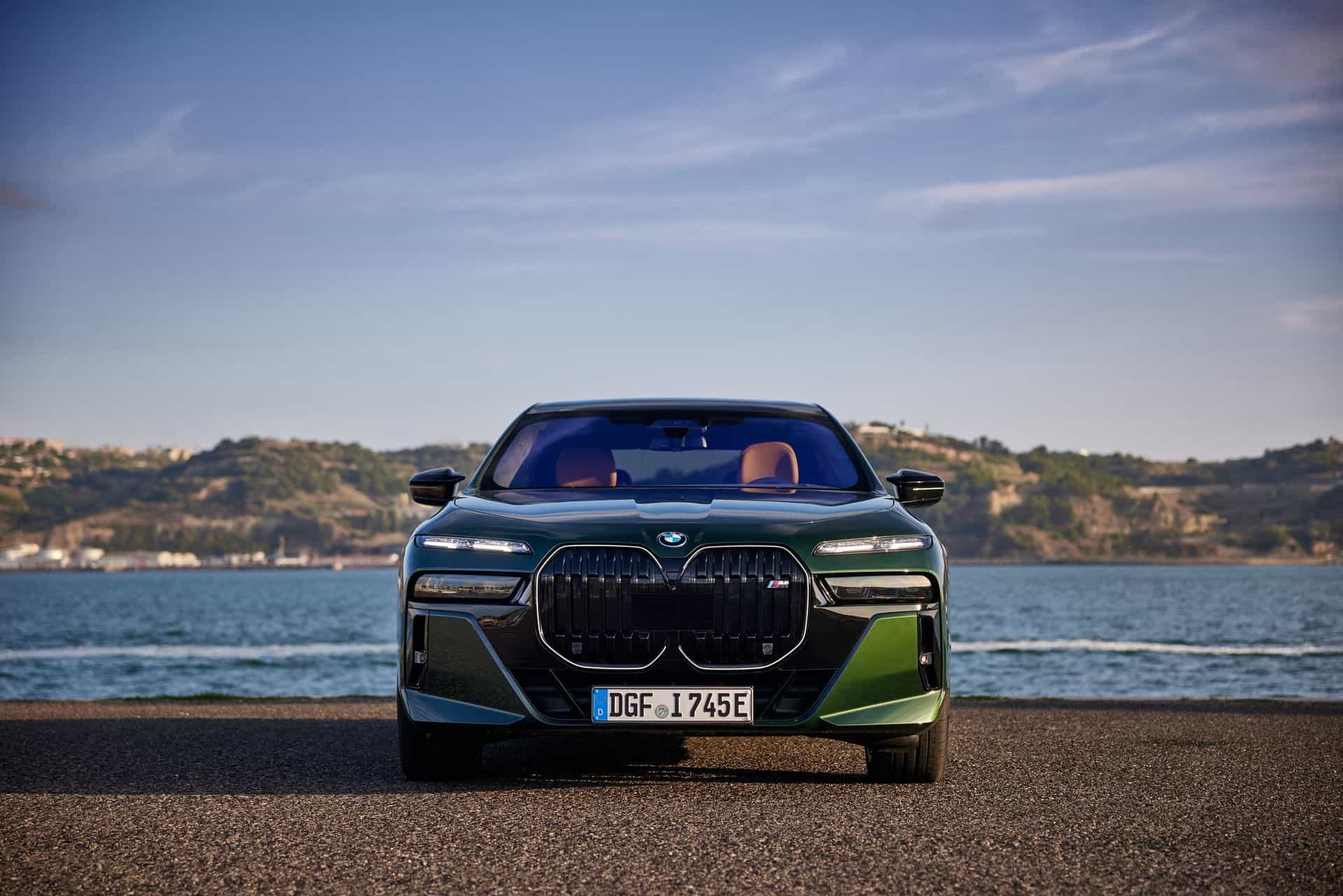
If you still had doubts about whether the striking front design would carry over, the short answer is “yes.” It won’t be identical, though. BMW is tweaking the 7 Series’ styling with a fresh take on the large kidney grilles. Camouflaged prototypes have led us to believe the split headlights will adopt a vertical layout for the main units.
The upper LED strip is already visible here and appears to feature a familiar crystal-like effect. Although the teaser doesn’t reveal much, it’s clear the 2027 7 Series won’t fully embrace the Neue Klasse styling of the smaller i3. BMW wants its range-topping model to stand out, and the large grille flanked by dual-layered headlights will ensure that. Similarly, the second-generation X7 arriving in 2027 is expected to retain its polarizing front fascia.
Since the G70 is receiving a mid-cycle facelift, no major changes to the profile are expected. BMW will likely introduce new wheel designs and fresh body colors, but the doors and fenders should remain unchanged. At the rear, the taillights are set to receive a new look and could extend further toward the center, echoing the i3 and iX3, where the BMW roundel nearly meets the inner edges of the light clusters.
While the exterior will be instantly recognizable as a facelift, the interior is set to feel next-generation. BMW is giving the 2027 7 Series its new iDrive X central touchscreen and a Panoramic Vision projection at the base of the windshield. Not only is the traditional instrument cluster going away, but so is the iDrive rotary controller. Although nothing is official, there are rumors of a passenger-side screen on the way, though it’s unclear whether the 7 Series will debut it.

Under the skin, the CLAR platform will remain for both combustion-powered 7 Series models and the fully electric i7. The former will adopt Euro 7-compliant gasoline and diesel engines, while the latter will transition to round battery cells. BMW has already confirmed it’s working with Rimac to pair Gen6 batteries with the Gen5 module-based technology.
Technical specifications for the 2027 BMW i7 haven’t been disclosed, but expect a notable increase over the current maximum charging rate of 195 kW. However, it won’t approach the 400 kW capability of the new i3. Why? The larger sedan will continue to use CLAR and not an 800-volt architecture. Driving range should also improve significantly beyond the current 625 km (WLTP), thanks to round cells offering roughly 20% higher energy density than the prismatic cells used today.
The updated 7 Series G70 is scheduled to go on sale later this year, with a more luxurious BMW ALPINA-badged version likely to follow in 2027 as the G72, targeting the Mercedes-Maybach S-Class.