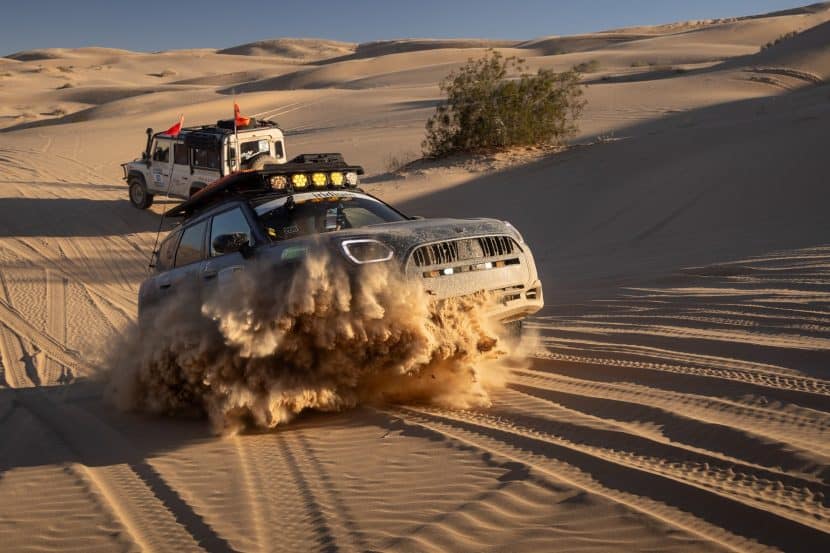
How big a deal is the Countryman for MINI? Looking at last year’s sales numbers, it’s safe to say the “U25” is a crucial model. Every third vehicle sold by the British marque last year was the not-so-mini crossover. Built at BMW’s Leipzig factory in Germany, the company’s largest vehicle ever accounted for 32.4% of total deliveries.
Demand for the electric E and SE ALL4 jumped by 81.8% year-over-year, and for 2026, MINI is upgrading both versions. As seen last year with the BMW i4 and i5, the Countryman also gets a new silicon carbide (SiC) inverter, enabling more efficient energy conversion while minimizing power losses.
Additionally, the battery’s net capacity is slightly increased, from 64.6 kWh to 65.2 kWh. Elsewhere, MINI fits new front-axle wheel bearings that reduce rolling resistance and further improve efficiency. Together, these changes result in a noticeable increase in range for both electric variants of the Countryman.

The front-wheel-drive E can now travel up to 311 miles (501 kilometers) on a single charge in the WLTP cycle. Previously, the entry-level electric Countryman was rated at a maximum of 287 miles (462 kilometers), representing a substantial gain of 24 miles (39 km).
Step up to the SE ALL4 and range rises to 290 miles (467 kilometers) without recharging. Its predecessor ran out of juice after 268 miles (432 kilometers), giving the updated model an extra 22 miles (35 km) on the same WLTP test cycle.

As before, both electric Countryman variants need 29 minutes to charge from 10% to 80% at a DC fast-charging station supporting up to 130 kW. That figure is starting to look dated now that the new BMW iX3 can handle an impressive 400 kW. Still, it will be some time before MINI benefits from the dedicated Neue Klasse platform. When it does, expect rear-wheel-drive EVs.
In the meantime, the updated Countryman E and SE All4 are scheduled to go on sale in Europe this March.