Article Summary
- Every row of cells is cooled on both sides, double the cooling of the regular i3, and the pack works as a shear plate tied to both axle carriers.
- A Track preset preconditions the battery and holds output steady for stints of two, eight or 15 minutes, with no power fade.
- If a motor fails, the M3 shuts down that axle and drives home on the other one, and BMW hasn’t ruled out a rear-drive version later.
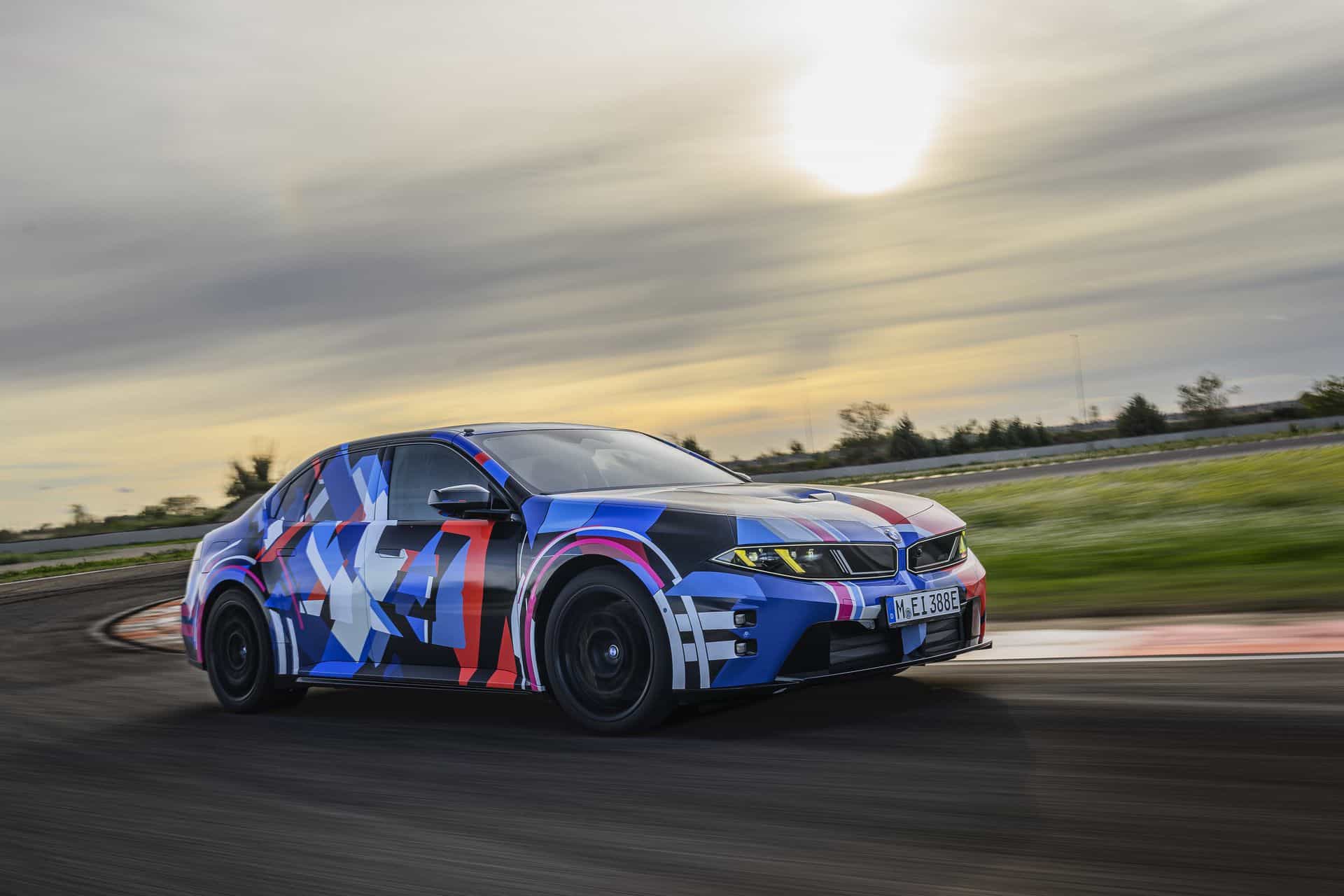
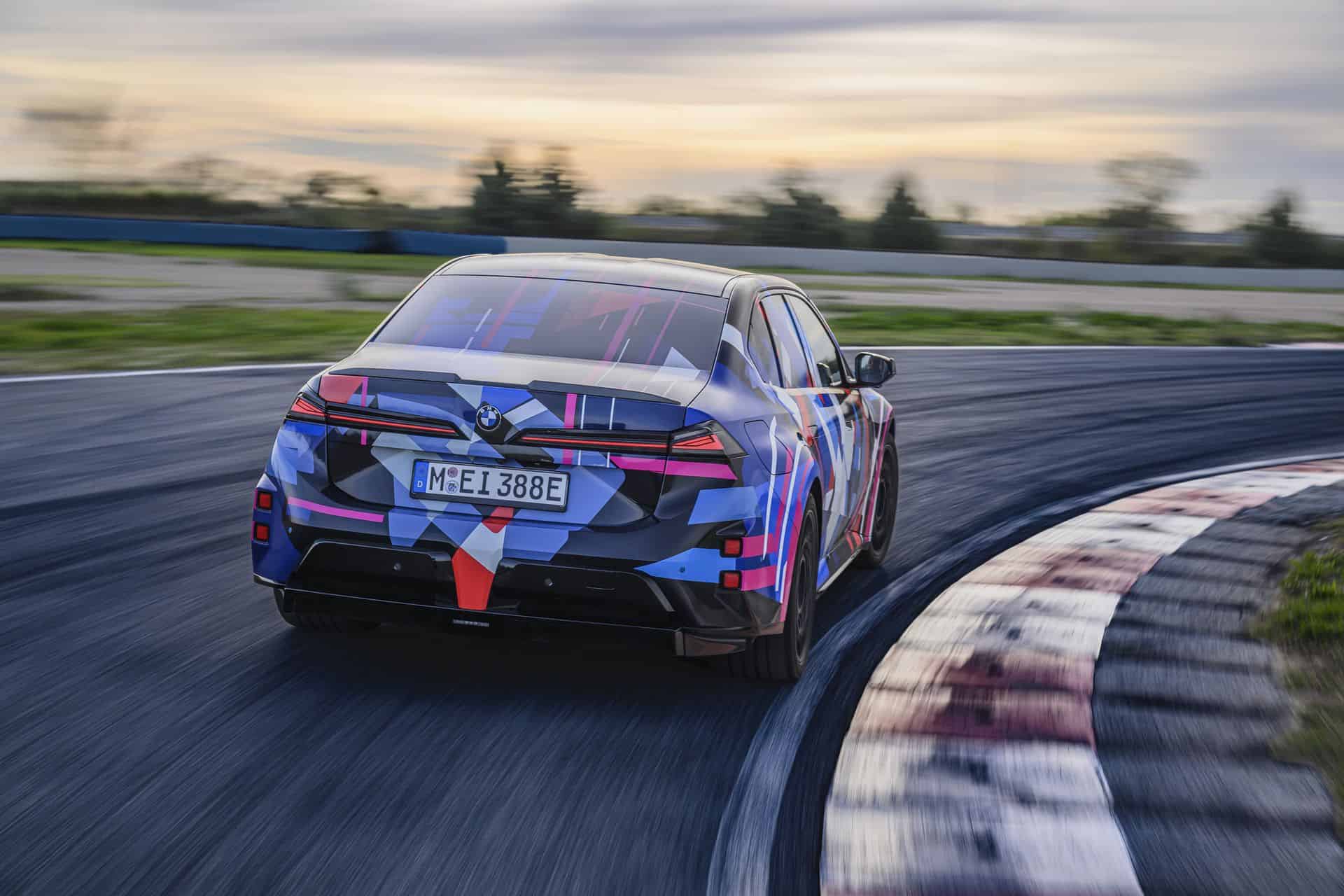
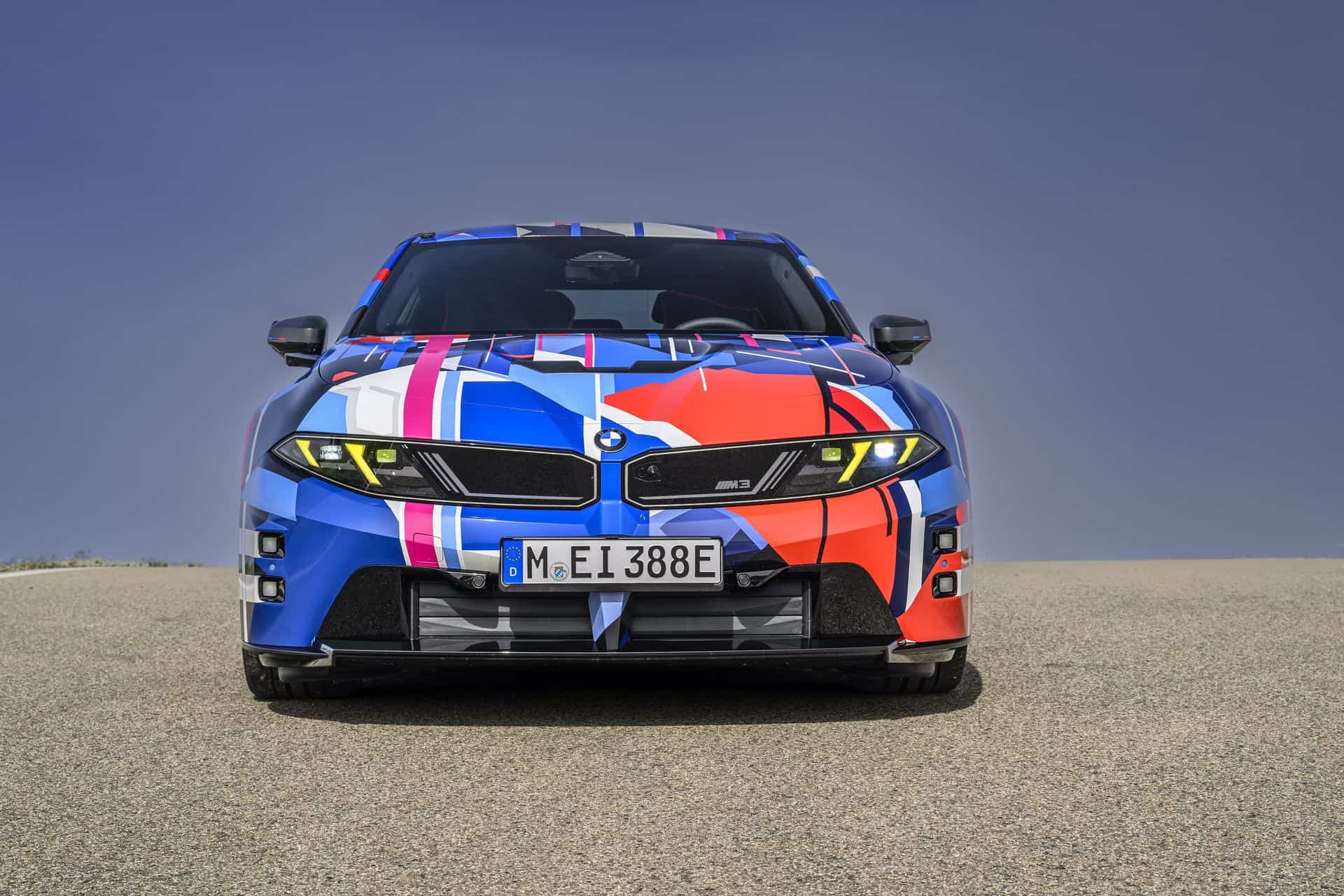
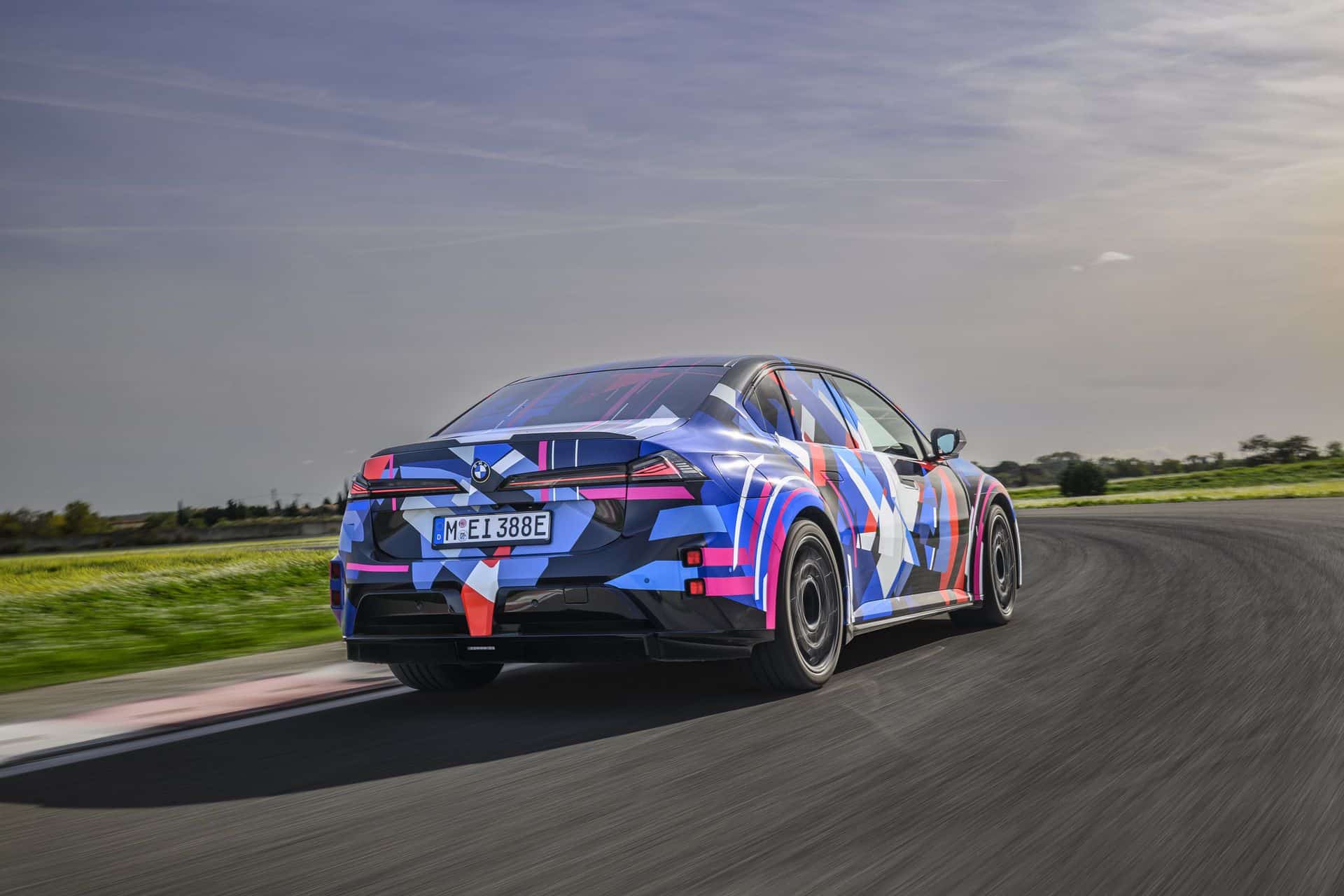
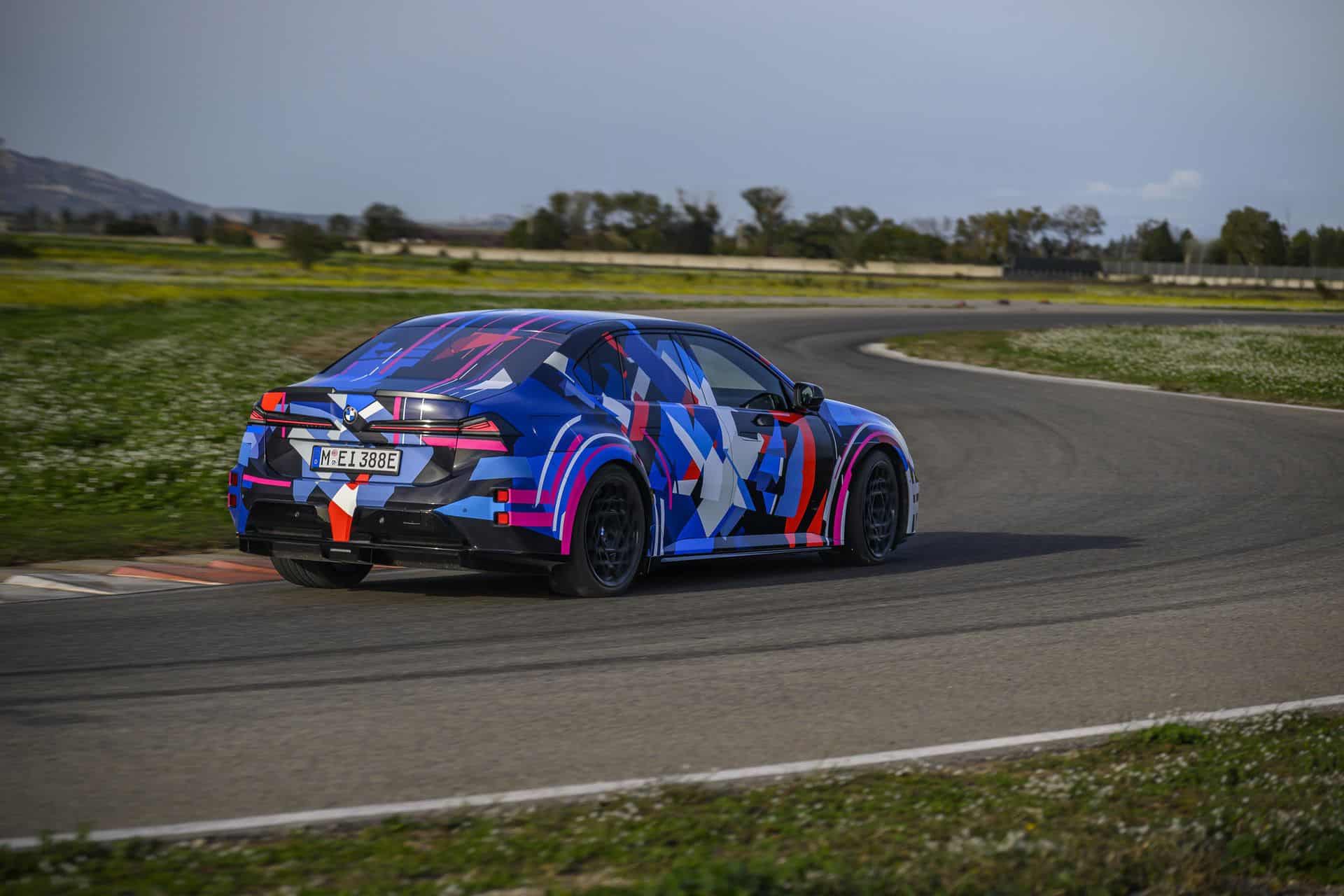
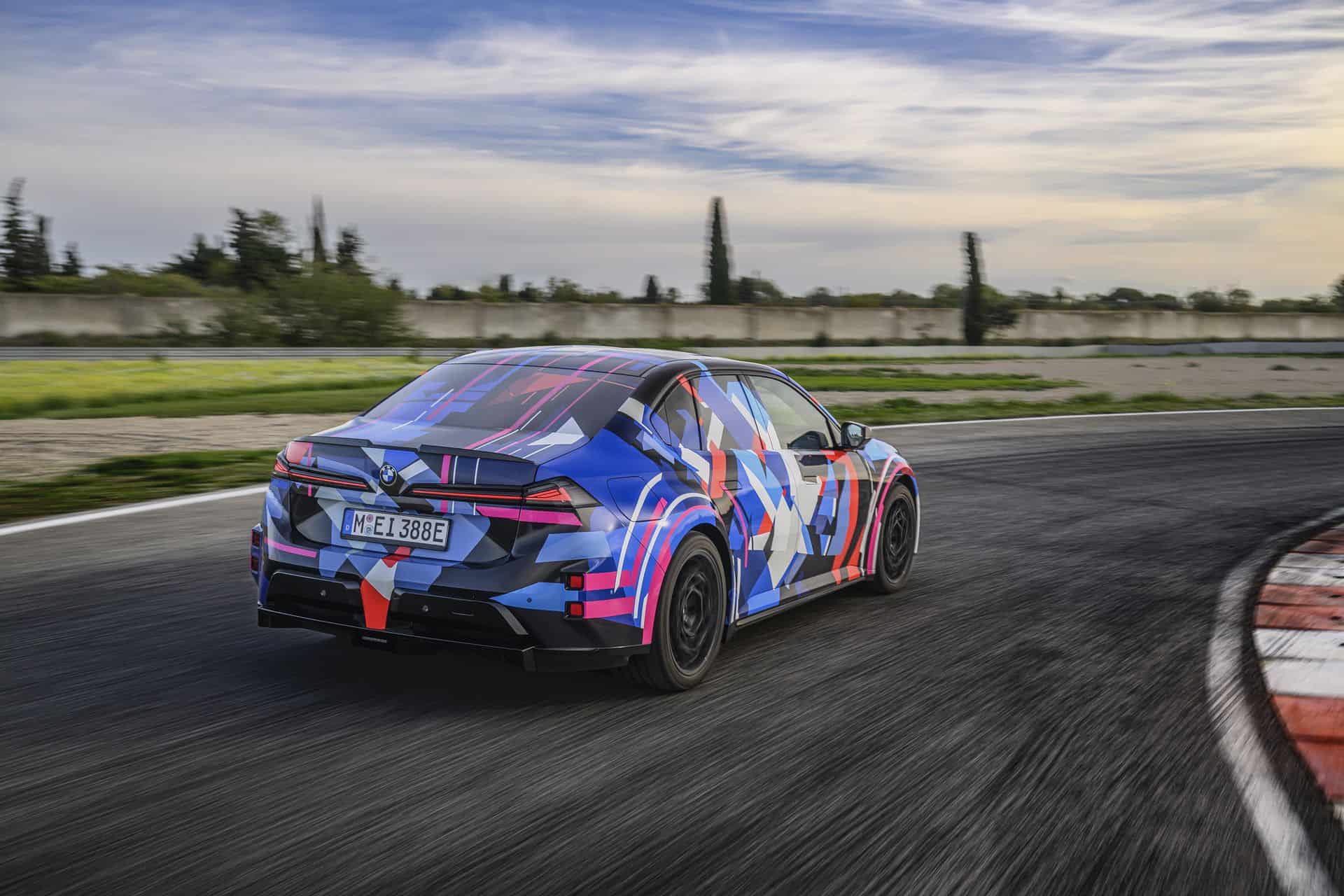
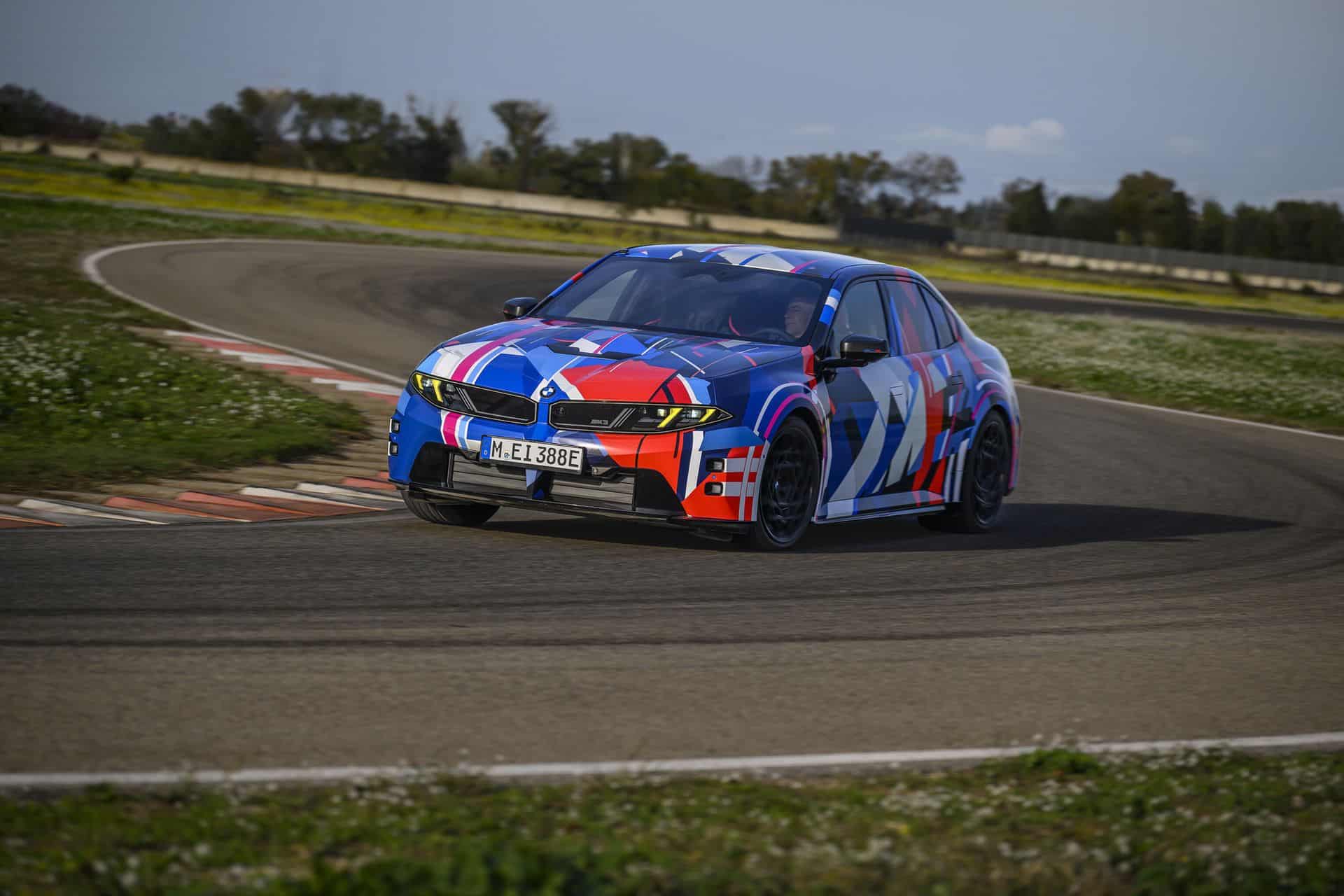
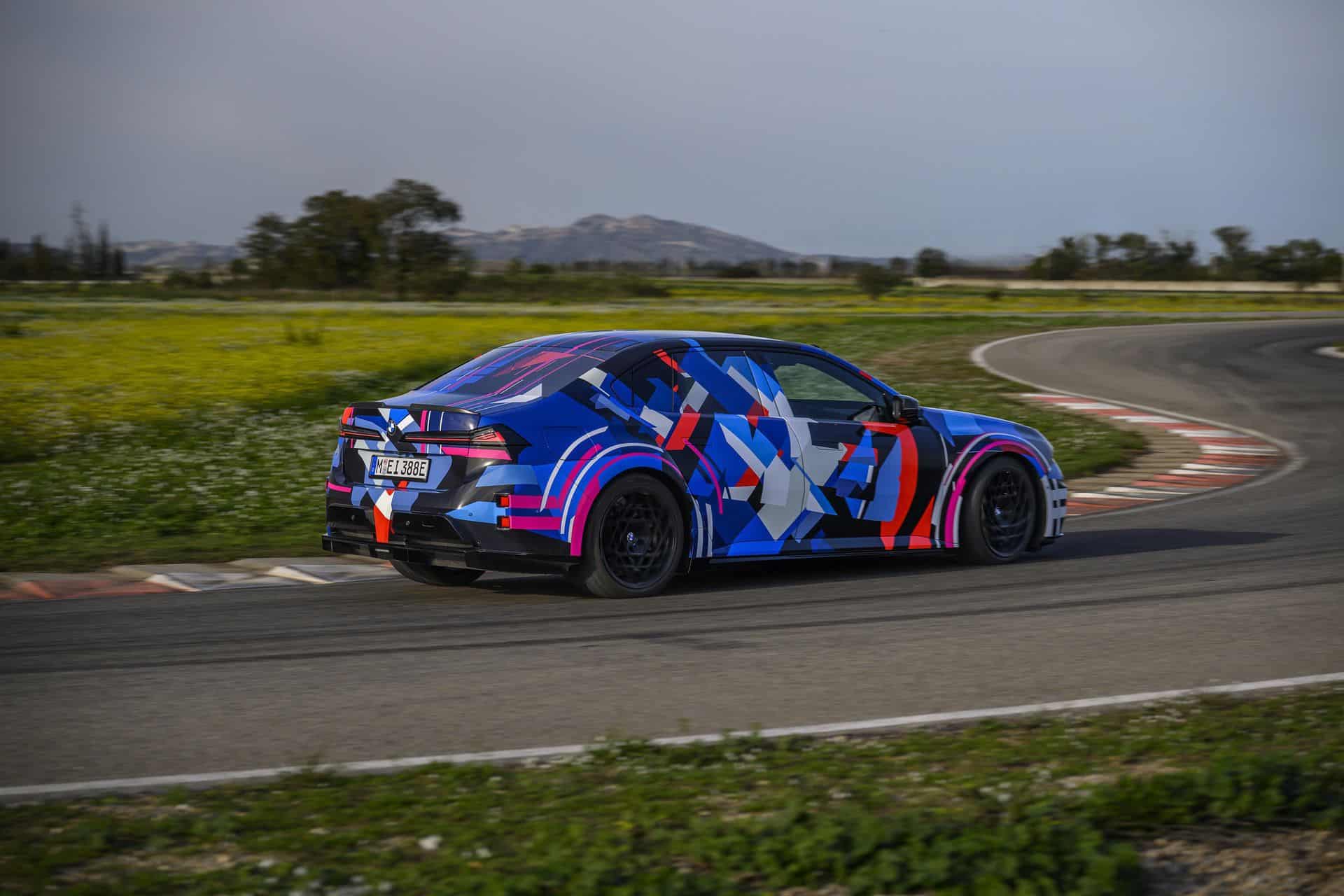
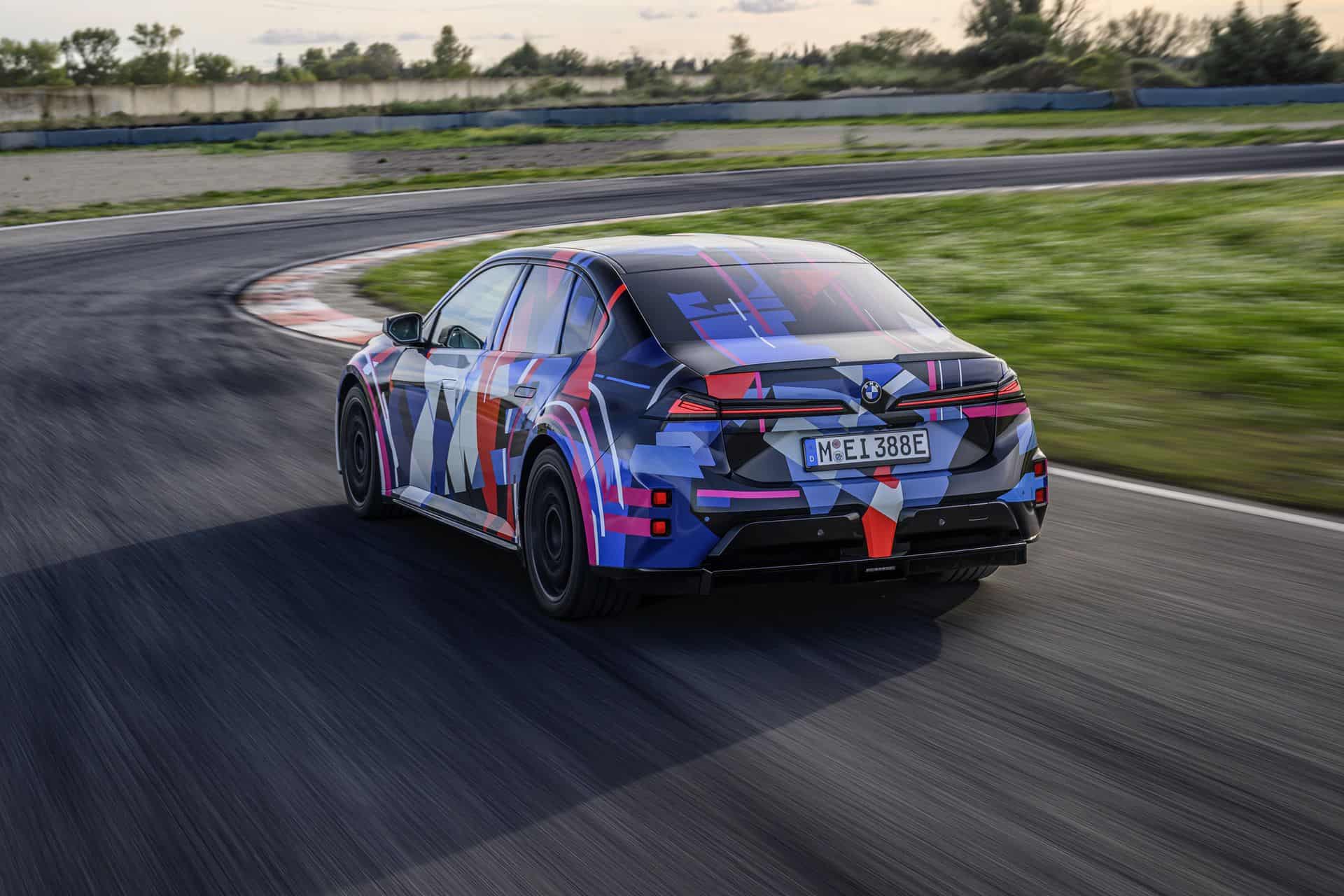
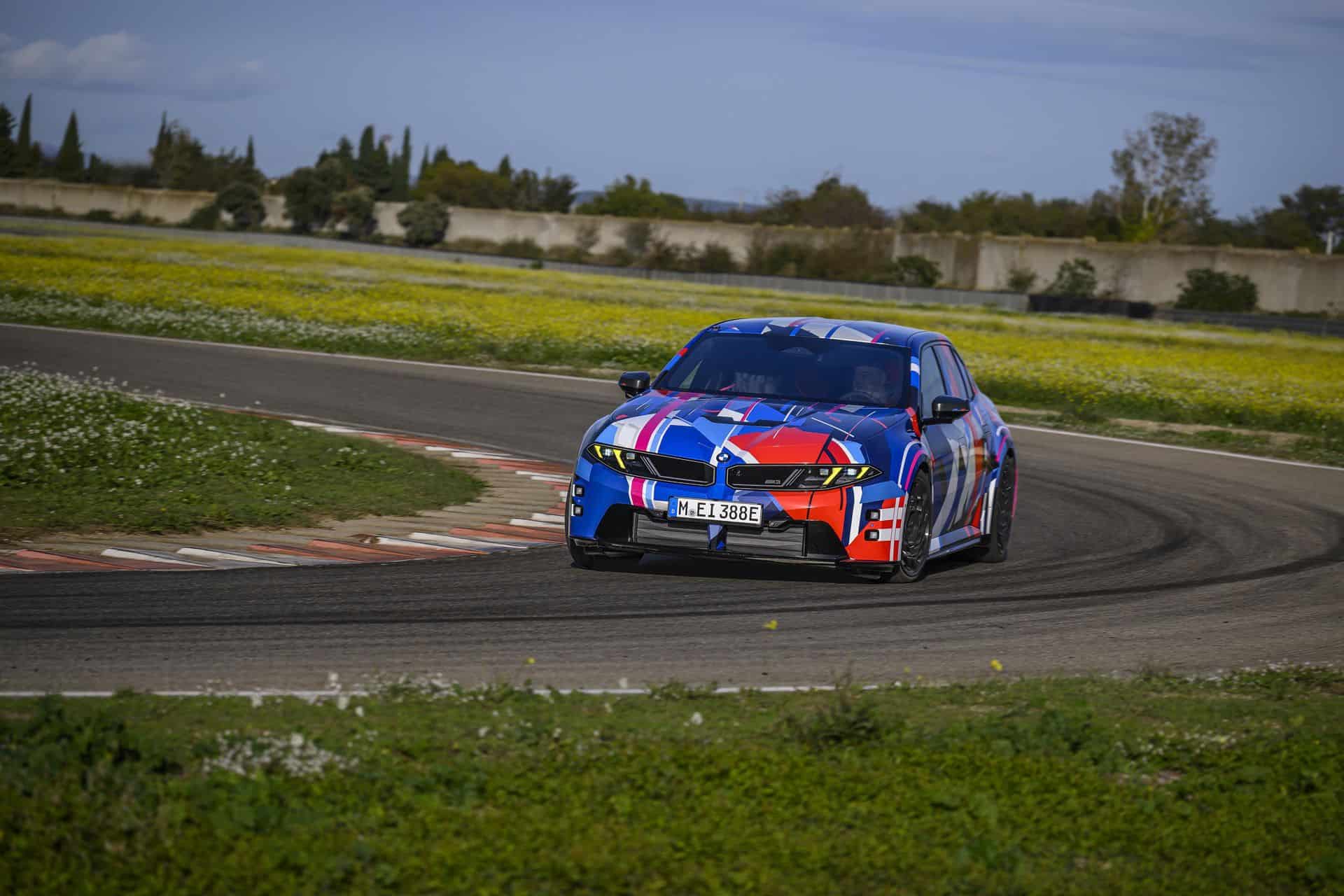
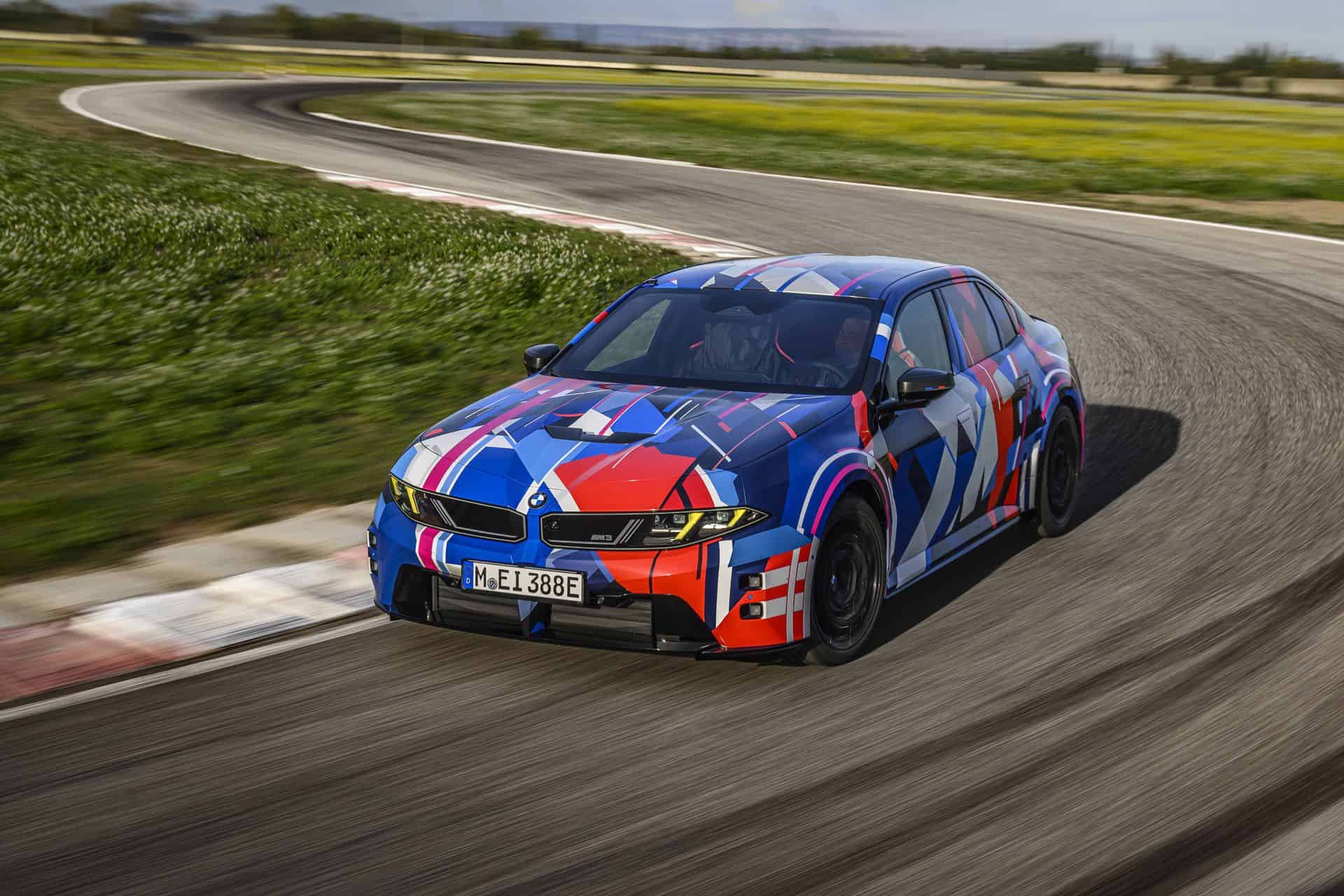
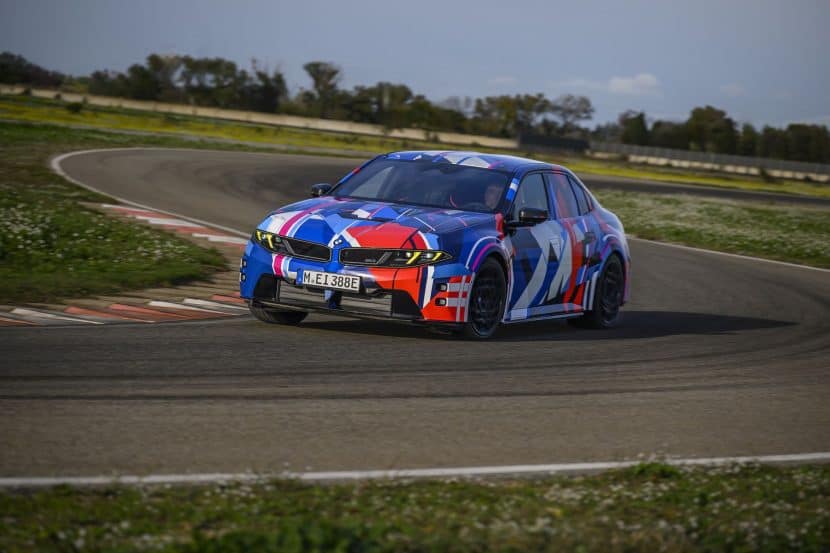
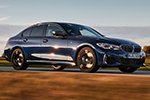
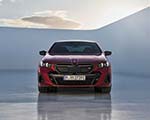
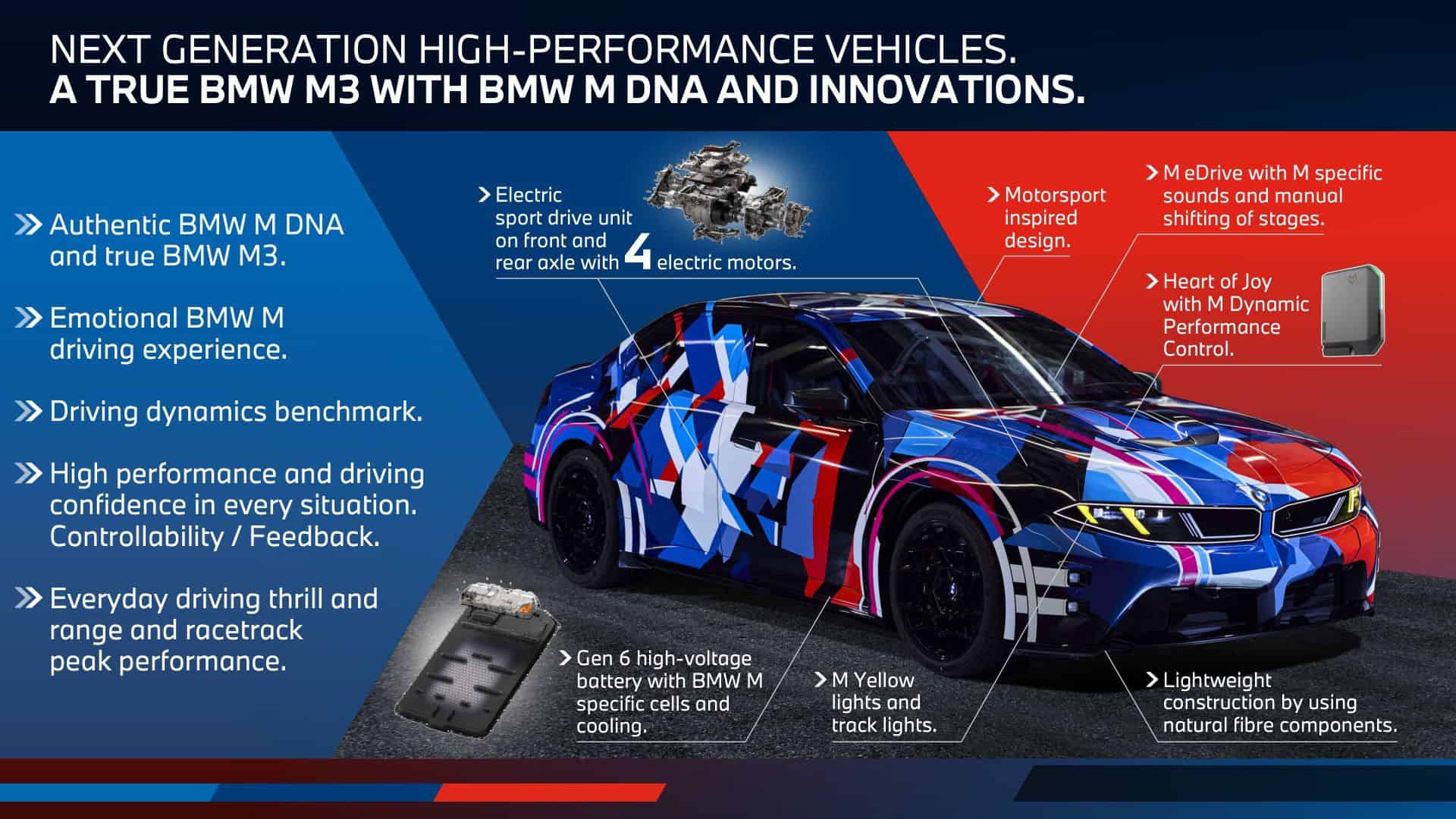
The electric BMW M3 makes roughly 838 hp (625 kW) and 1,200 Nm (885 lb-ft) from four electric motors, according to BMW’s preliminary figures, which makes it the most powerful M3 ever built. Before we drove prototypes at BMW’s Miramas proving ground in southern France, the BMW M engineers behind the car spent two hour-long workshops explaining how a four-motor sedan with a 100-kWh battery is supposed to feel like an M3.
Power took up the least time. Most of the discussion was about the structure that ties the battery to both axles, a central computer that decides what each wheel does every millisecond, and M eDrive, a six-stage system with shift paddles, shift lights and a limiter for a car that has no gears. Our driving impressions are in a separate review, so this story sticks to the hardware and software, explained largely by the people who developed them, and it goes deeper into the details than a launch story usually does.
Three engineers did most of the talking. Philipp Brunn has led the electric M3 project from the start, and before that he was responsible for the complete-vehicle concept of the current G80 M3, after earlier jobs in chassis testing, spring and damper development, and as head of tire testing. Stefan Erler is BMW M’s head of user and customer experience, and Andreas Bentenrieder is its expert for high-voltage battery development and charging.
The electric car, known internally as the ZA0, won’t replace the combustion M3. BMW has confirmed that a gasoline M3 (G84) will be sold alongside it. Miramas was a fitting place for the briefing. BMW bought the former 1924 racetrack in 1986 and turned it into a 4.7-square-kilometer (1.8-square-mile) proving ground with 20 tracks and about 60 km (37 miles) of test routes, where its test cars cover more than six million kilometers a year. 2026 marks 40 years of BMW at Miramas and 40 years of the M3.
Why BMW M Started The Electric M3 On A Clean Sheet
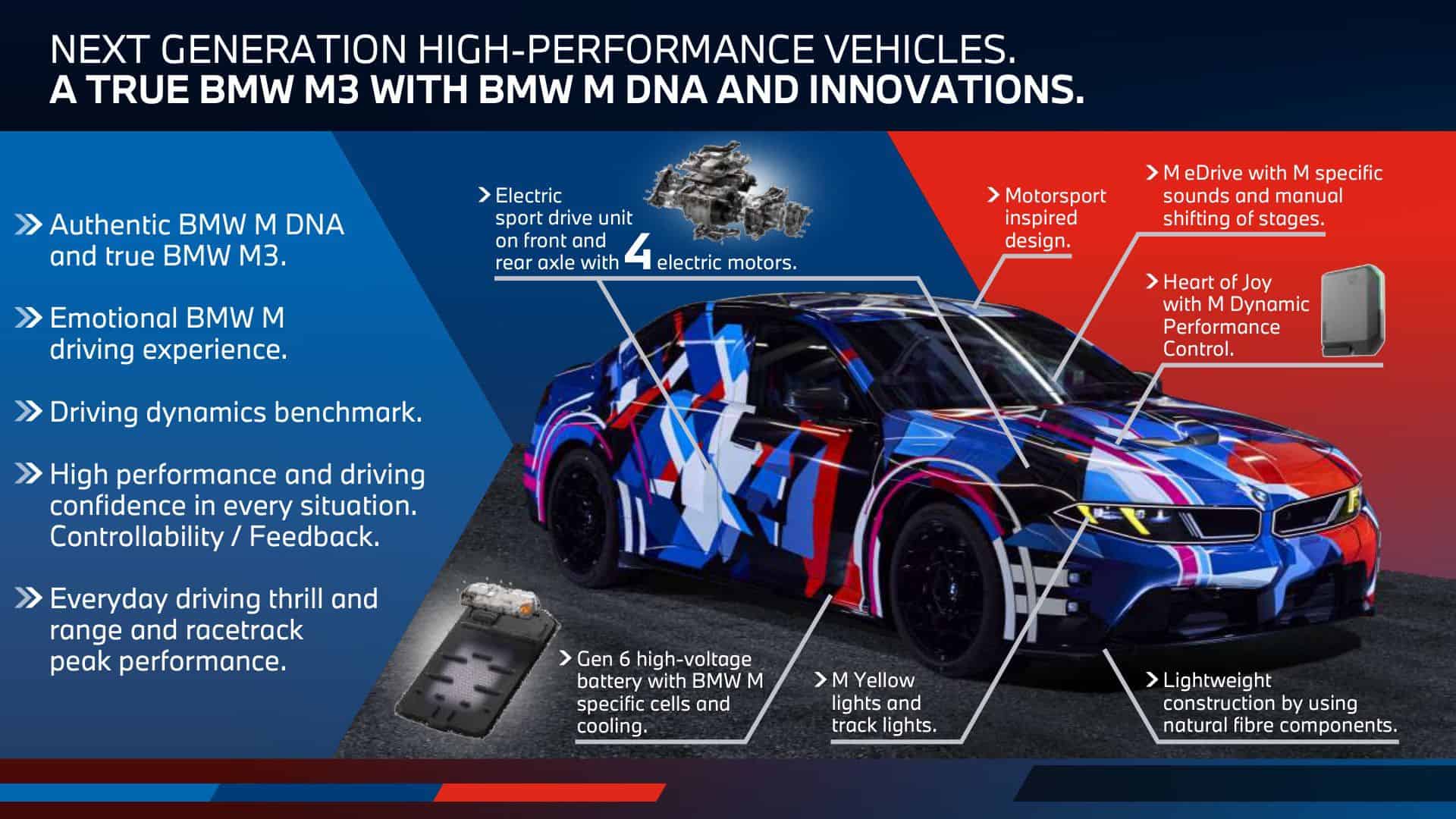
BMW M began the electric car a few months after Neue Klasse development started, around 2020, and Brunn said the early start was the whole point. “You can’t just wait for the things to evolve and then raise the hand and say, ‘Okay, I want to do an M3,'” he told us. Joining that early let BMW M shape the Neue Klasse architecture around an M car’s needs instead of adapting a finished platform later.
The drivetrain layout was one of the first decisions, because, as Brunn put it, it’s not something you want to change halfway through a project. Neue Klasse was always going to be an electric platform, so the team went through every topology: rear-wheel drive, all-wheel drive, and two, three and four motors. They chose four (more on why below).
Starting from nothing also changed how the car was engineered. With little carryover data, BMW M leaned on far more simulation and topology optimization than on earlier projects, both to map the loads going into the body and to keep every part as light as possible. It also meant constant negotiation with the team developing the regular i3. Every time BMW M found a weak spot, the two teams had to decide whether it was an M3-only problem or one the i3 shared. Sometimes the i3 team realized it had the same issue and the fix went into both cars. When it was M3-only, the solution had to be designed so it could be added to M3s without putting weight or cost on every i3. “More expensive doesn’t help the i3,” Brunn said.
How BMW M Packaged Four Electric Motors In The New M3
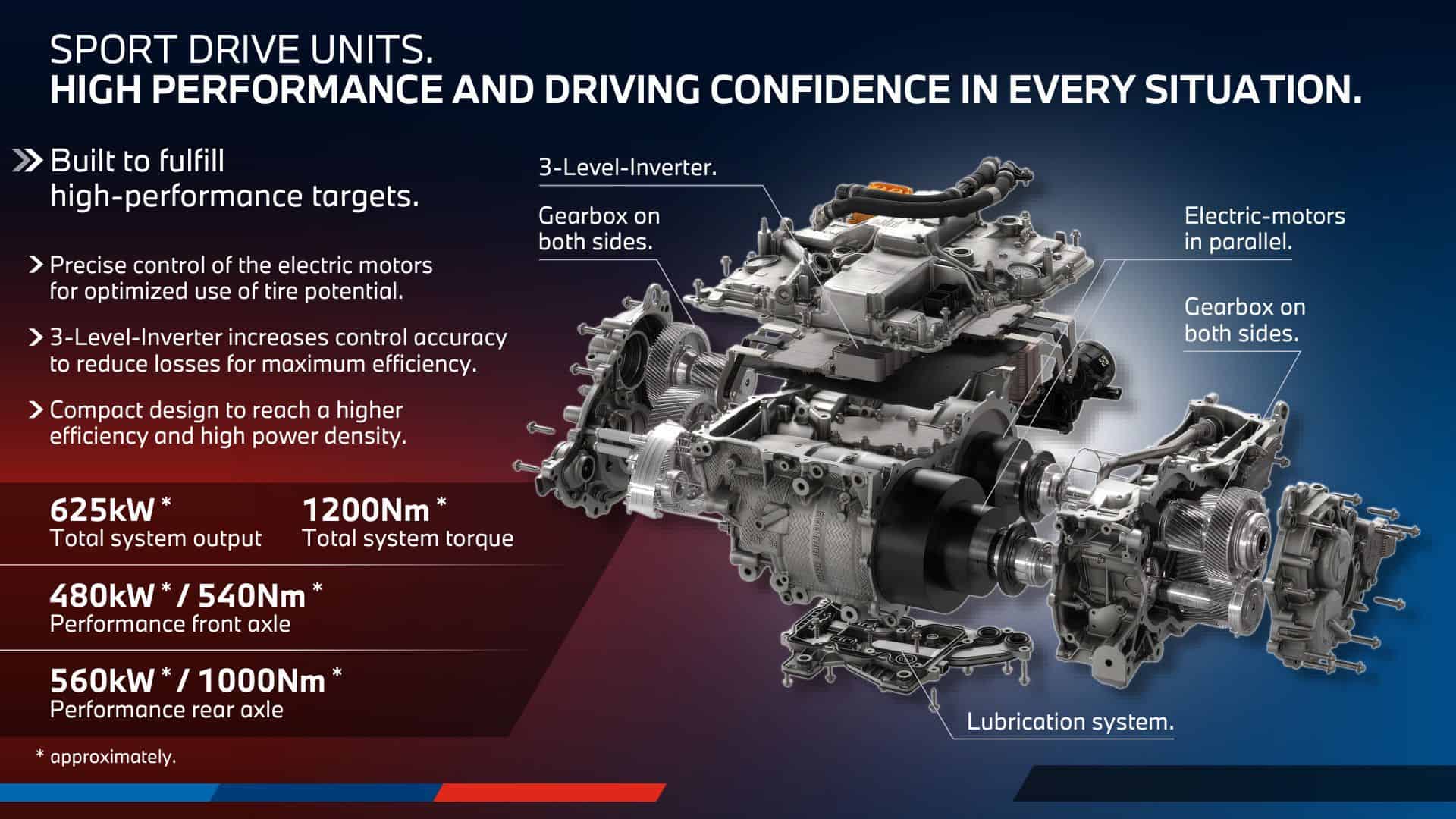
The four motors live in two “sport drive units,” one per axle. In each unit, two motors sit side by side in parallel, turned 180 degrees from each other, which keeps the unit compact. Each motor drives its wheel through its own single-speed gearbox, so there’s no shifting, and the two share a common lubrication system at the bottom of the housing. A 3-level inverter sits on top. Bentenrieder said the 3-level design gives more precise control of the motors and lower losses, and BMW’s goal for the motor control is to make better use of the tires’ grip.
BMW’s preliminary figures:
- Total system output: about 838 hp (625 kW)
- Total system torque: about 1,200 Nm (885 lb-ft)
- Front axle: about 644 hp (480 kW) and 540 Nm (398 lb-ft)
- Rear axle: about 751 hp (560 kW) and 1,000 Nm (738 lb-ft)
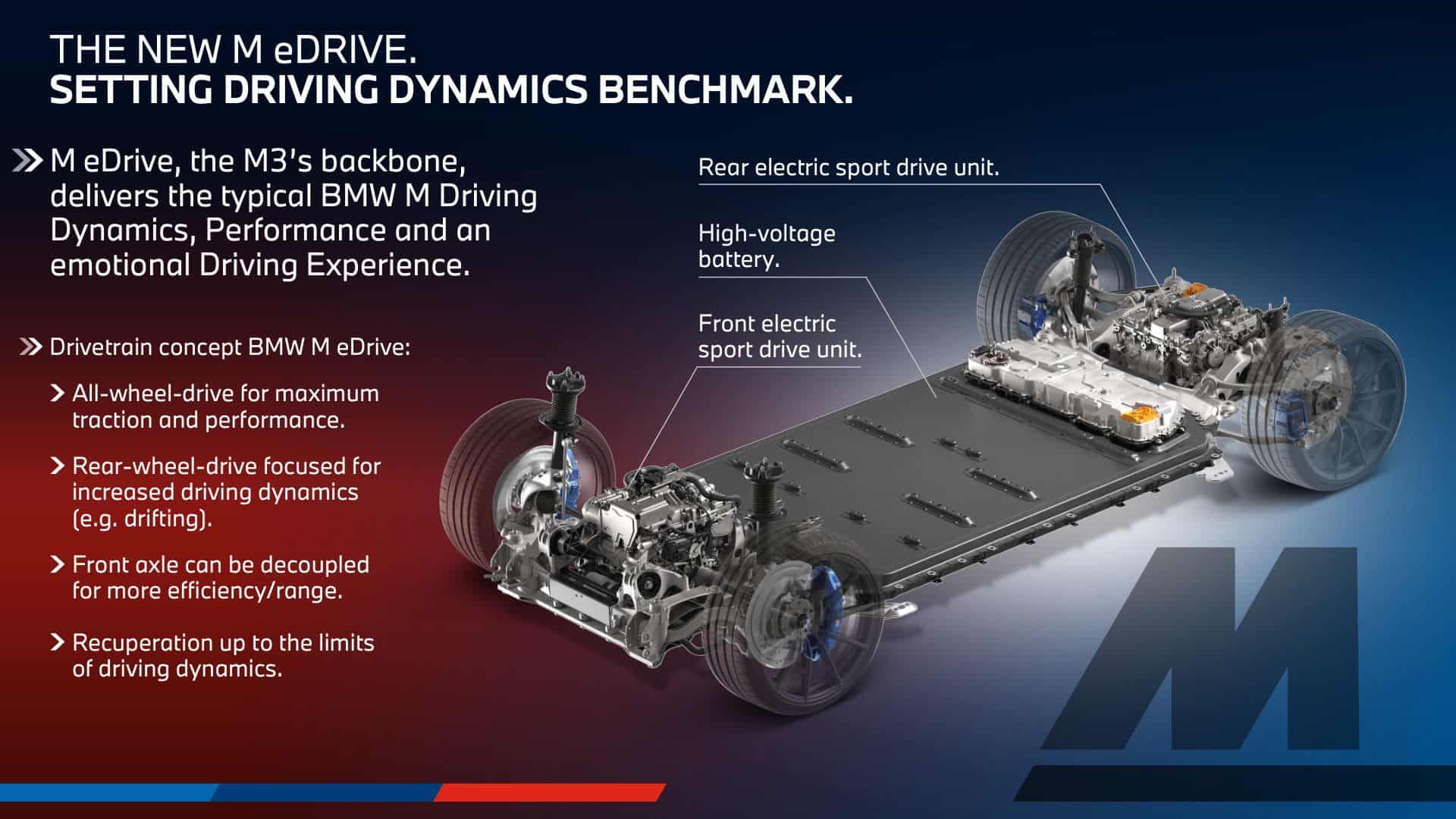
The rear axle gets nearly twice the torque of the front, and BMW calls the drivetrain rear-wheel-drive focused, with drifting given as an example on its own slide. Erler said the rear bias is also there to help the driver steer the car through the front axle.
The front axle can be disconnected by a decoupling unit. In Comfort, the M3 tries to run as efficiently as possible on its rear motors and only brings the front back in when it’s needed for regeneration, hard acceleration or cornering. Brunn said the decoupling unit engages very quickly, but in Sport and Sport Plus even that delay was too much for maximum control, so the front stays connected permanently and the car runs full-time all-wheel drive.
Brunn said four motors gives “the maximum amount of controllability and freedom” of any layout. He pointed out that a three-motor setup, with two motors at the rear and one at the front, is the more common choice among rivals. A motor at every wheel also lets the M3 run its ABS through the electric motors: the friction brake supplies the base braking torque, and the motors handle the rapid modulation, which they can do far faster than the hydraulic brakes. Brunn said that is also why the stability control doesn’t feel restrictive with DSC fully on, and why a driver can get on the power early in a corner.
With no mechanical differential, the M3 can’t shift torque from one side of an axle to the other if a motor fails, and driving only the left front wheel without the right isn’t an option. So if one motor fails, the car shuts down that whole axle and drives on the other one, with “enough power to have a quick ride home,” Brunn said. The team ran a full failure mode and effects analysis (FMEA) on what happens when one or more motors drop out.
Inside The M-Specific Battery With Double The Cooling
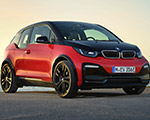
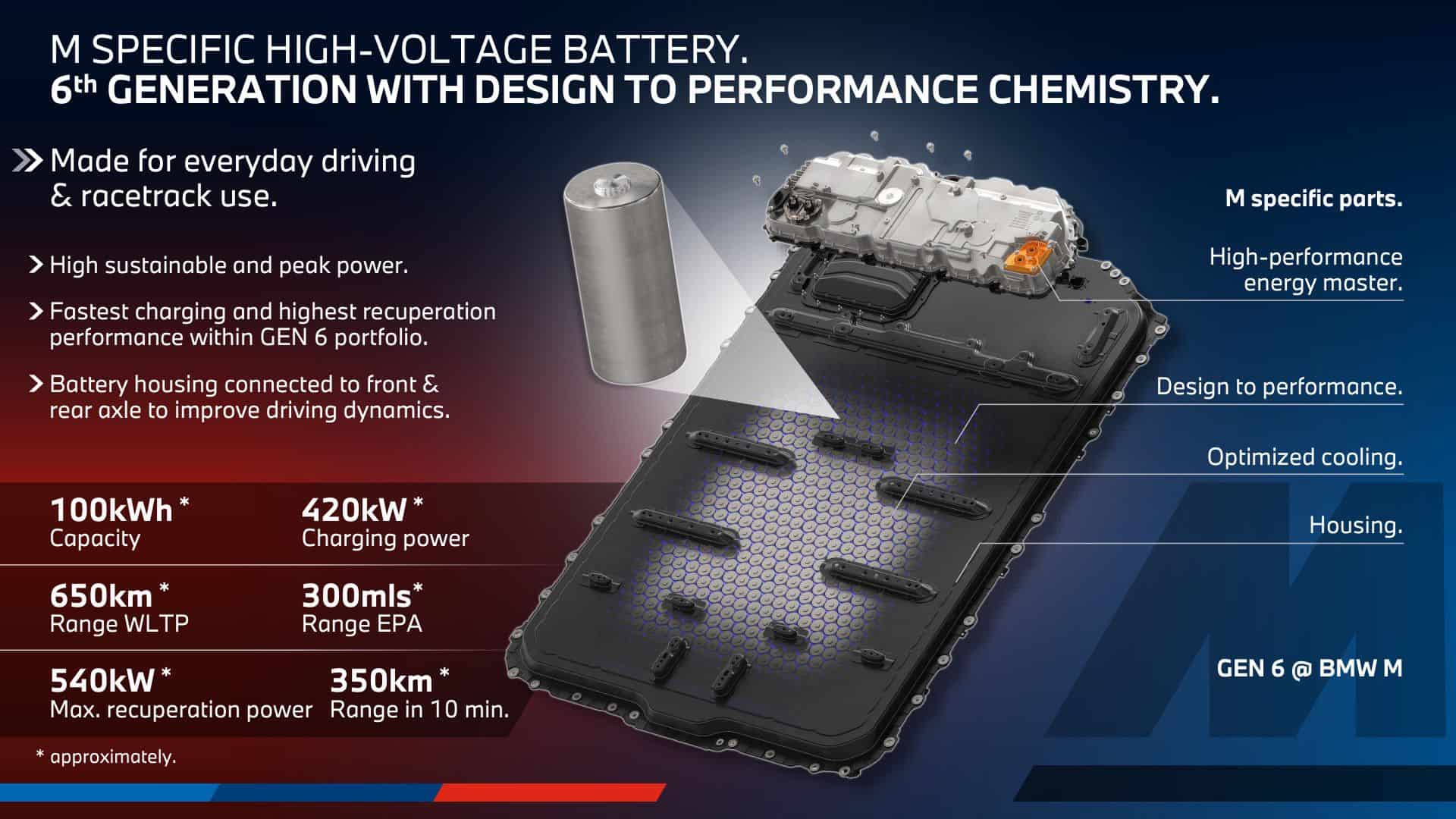
The battery is a sixth-generation (Gen6) pack with about 100 kWh of capacity, but its cells are not the ones in the Neue Klasse i3 (NA0) sedan. You can’t tell them apart from the outside: the format and height are identical. Inside, BMW M uses what it calls a “design to performance” cell. Bentenrieder said the difference is in the cell’s internal design rather than its chemistry. The electrodes have a larger surface area and are thinner, and the cell holds more electrolyte, all of which speeds up ion exchange. BMW says that gives the pack more sustained and peak power, which is what a car that has to survive a 15-minute track stint needs.
The bigger change is cooling. In the i3, every second row of cells is cooled. In the M3, every row is, so each cell gets cooling on both sides, which effectively doubles the pack’s cooling. Bentenrieder said that lets the system bring the cells to the right temperature much faster, and BMW fitted larger water pumps and much higher coolant flow to match. The Energy Master, the control unit that sits on the pack, is also an M-specific high-performance version.
The pack housing is the same one the i3 uses, with the same dimensions and mounting points. The difference is that in the M3, the housing is bolted to both axle carriers, which turns the battery into part of the chassis (more on that below).
BMW’s battery and charging figures, all preliminary:
- Capacity: about 100 kWh
- Peak DC charging: 420 kW
- Range added in 10 minutes: about 350 km (217 miles) [TK: confirm test cycle, likely WLTP]
- Range: about 650 km (404 miles) WLTP, about 300 miles EPA
- Maximum regeneration: 540 kW
That puts the electric M3 at about 650 km (404 miles) WLTP and about 300 miles EPA. BMW also claims the M3 has the fastest charging and the highest recuperation of any Gen6 model, though it didn’t give a 10 to 80 percent charging time. The 540 kW regeneration peak isn’t available just by lifting off the accelerator; Bentenrieder said it also counts the regeneration that happens when the driver presses the brake pedal.
How Long Can The Electric M3 Run On A Racetrack?
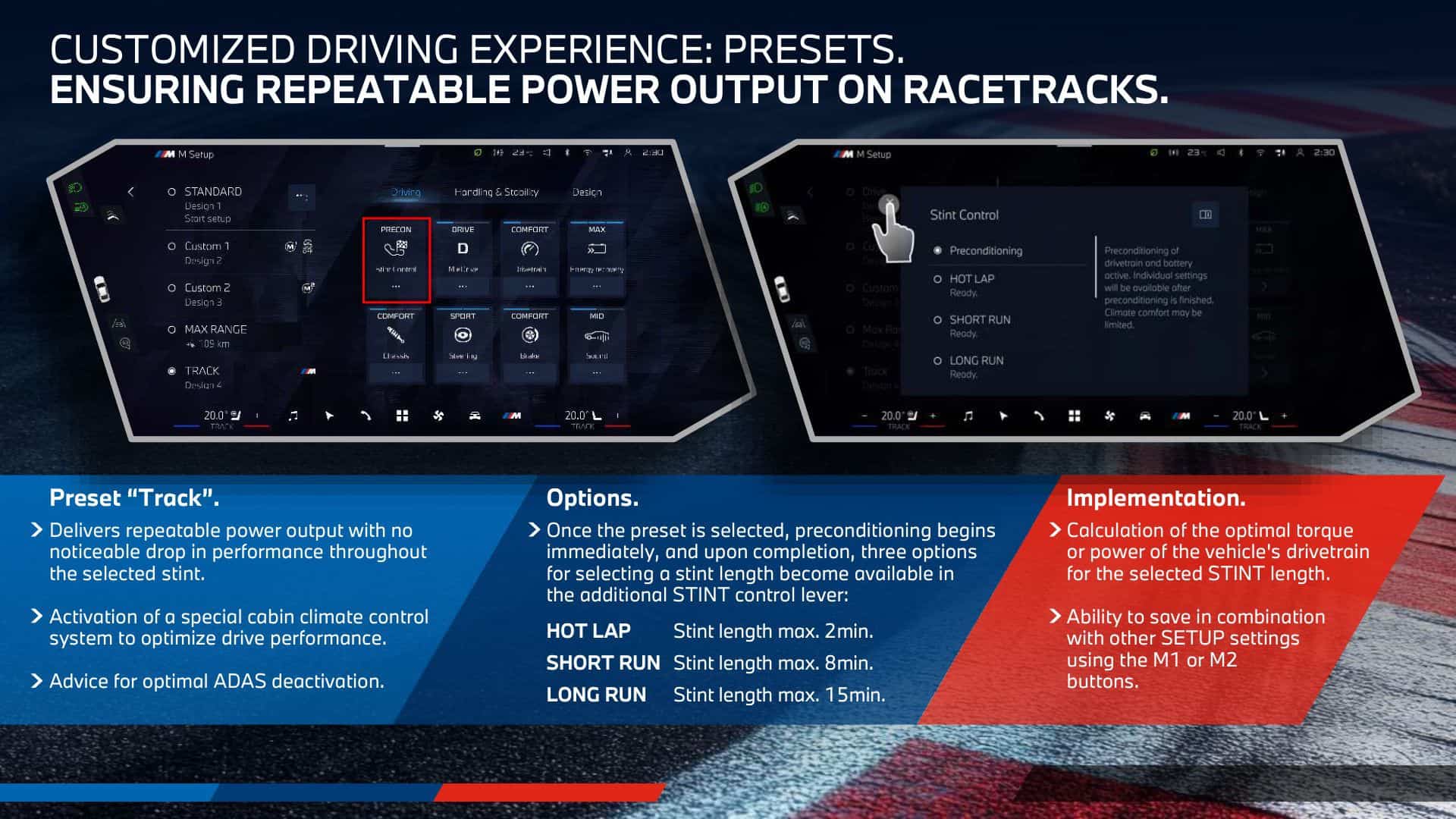
BMW’s answer to the question every EV track day raises is a preset called Track. Brunn said the goal was to make the car easy for an owner to use on a circuit, so they don’t have to guess whether the battery is too hot or too cold before heading out. Selecting Track starts preconditioning the battery immediately. Once it finishes, the driver picks one of three stint lengths:
- Hot Lap: up to two minutes
- Short Run: up to eight minutes
- Long Run: up to 15 minutes
How long preconditioning takes depends heavily on the battery’s starting condition, BMW told BMWBLOG after the event, and the company will publish times later. Brunn said a two-minute Hot Lap needs much less preparation than a 15-minute Long Run. What preconditioning actually does also depends on the weather. On a 25 to 35 degree Celsius (77 to 95 degree Fahrenheit) day, it usually means cooling the battery down. For an early-morning session after the car sat outside overnight, the pack may already be at the right temperature.
The car then calculates how much torque and power it can sustain for the chosen stint, so output stays the same from the first lap to the last instead of fading as the battery heats up. “There’s no degradation,” Bentenrieder said. Track also turns down cabin cooling slightly to give the battery more cooling capacity, though Brunn said the shift is small and nobody will be sweating in the cabin. The preset also suggests which driver assistance systems to switch off, and it can be saved to the M1 or M2 buttons along with the rest of a setup.
The longer runs need a well-charged battery. BMW engineers said Track wants at least 80 percent state of charge for a long stint, while a shorter stint can be selected with less. At Miramas, the cars went from 100 percent to about 60 percent over 10 laps of the Circuit de Provence, and the team recharged them between sessions. Run past 15 minutes and the battery will eventually run down, Brunn said, and how quickly depends on whether you’re driving at 80 percent of the car’s potential or flat out on sticky tires. His point was that the balance between battery size and power output is good enough that a driver won’t do one lap and then wait two hours.
Regeneration puts some of that energy back. BMW says recovered energy effectively powers about one lap in three, or roughly 30 percent, depending on the track layout. Bentenrieder’s rule of thumb for Miramas was that three laps earn you a fourth. On a mountain road driven hard, BMW says regen can recover up to half of the energy spent.
Why BMW M Made The Battery Part Of The Chassis
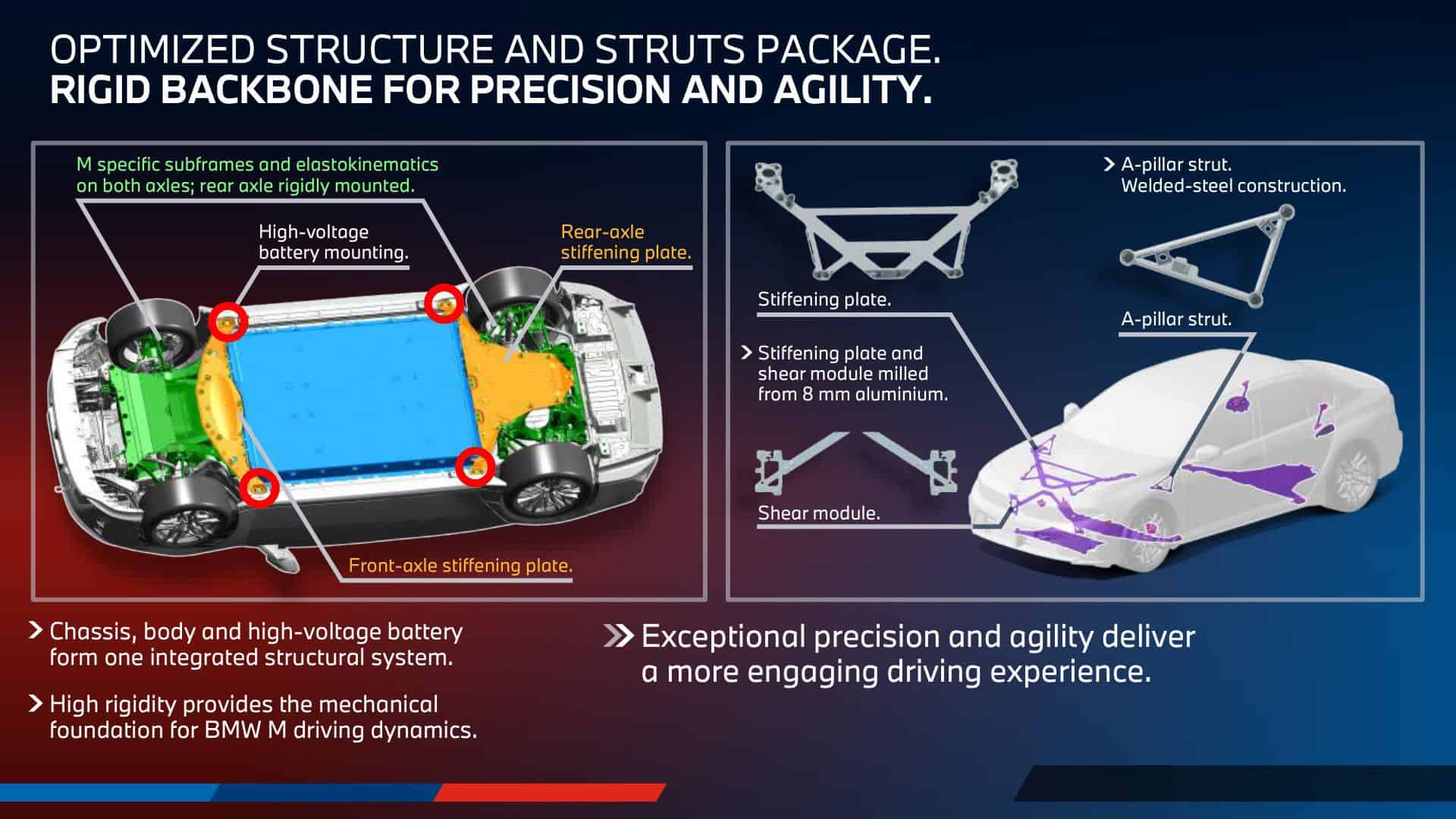
Brunn’s case for the structure is straightforward: if the body flexes, the dampers can’t do their job. BMW M treats the body, chassis and battery as one structural unit. The battery housing bolts to the body at its outer edges, like the i3’s, but BMW M also uses the lower section of the housing as a shear plate. Extra mounting points at the corners of the pack tie it to stiffening plates that connect to the front and rear axle carriers, which gives the car a stiff, closed structure across the entire floor.
At the front, there are two stiffening plates, and the second one connects the chassis, the battery and the body. At the rear, there’s a separate rear-axle stiffening plate. The stiffening plate and shear module are milled from 8-mm aluminum, and both axles get M-specific mountings for the electric drive units. Nearly all of the bracing is aluminum, with one exception: a part just below the fender, where there wasn’t room for anything but steel.
Up top, the spring and damper loads were so high that BMW M designed its own top mounts, and once those were in, it found that adding struts to carry the loads further into the body helped too. A welded-steel strut carries loads from each front shock tower into the A-pillar. “You have no weak spots,” Brunn said. “You try and spread the load in the whole body.”
None of this hardware ends up on a regular i3. To attach the M3-specific parts without burdening the i3 with brackets it doesn’t need, BMW added four weld-on pickup points that robots attach in a dedicated area of the plant, only on M3 bodies. Small parts such as ride-height sensors and ABS wheel-speed sensors are shared, because making M3 versions wouldn’t make sense.
Brunn said the stiff structure also sped up development. Detailed bolt calculations kept the fasteners from working loose on track, and because the body didn’t flex, the chassis team could start tuning the dampers without first fixing the structure.
BMW still won’t say what the car weighs. Its own presentation does acknowledge “the higher vehicle weight of a high-performance BEV,” and Brunn didn’t pretend otherwise: “Everyone hates weight.”
The Suspension, Steering And Brakes Are M3-Specific
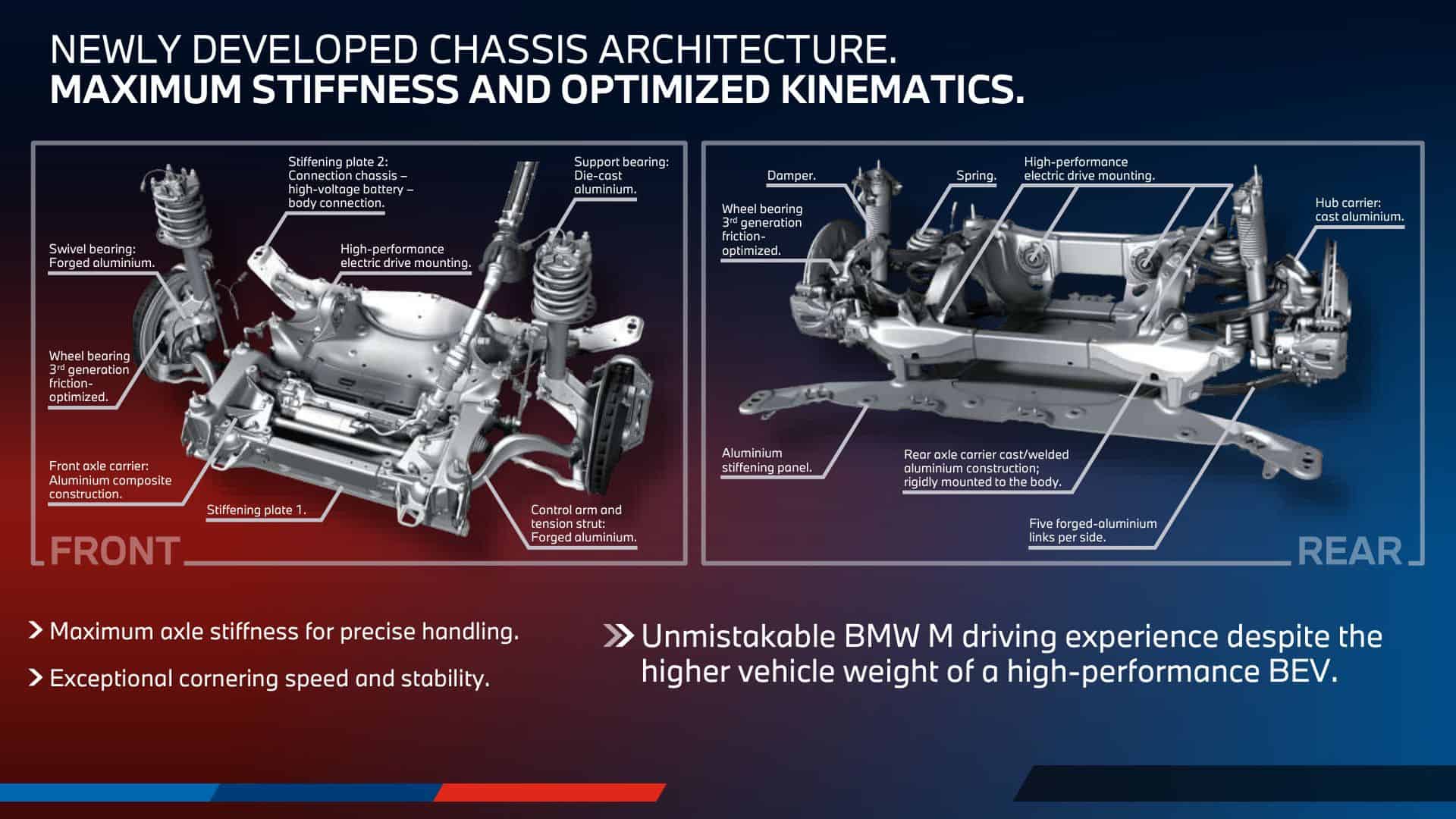
“It’s not just a car where you put an M badge on,” Brunn said of the chassis hardware. Both axles use designs BMW has run before, but packaging them around electric drive units with far more torque, and very different dimensions, than a straight-six, gearbox and rear differential was one of the project’s main jobs.
At the front, the swivel bearing, control arm and tension strut are forged aluminum, the support bearing is die-cast aluminum, and the front axle carrier is an aluminum composite structure. At the rear, there are five forged-aluminum links per side, cast-aluminum hub carriers and a cast and welded aluminum axle carrier bolted rigidly to the body. Both axles use M-specific subframes and elastokinematics, the tuning of the bushings that decides how the wheels move under load, and both get third-generation, friction-optimized wheel bearings.
The front motors created a problem the G80 M3 never had to this degree. With this much torque at the front wheels, the kinematics had to be worked out to keep torque steer away while keeping the wheel movements and steering feedback right. Brunn said the team learned a lot when the G80 M3 went from rear-wheel drive to M xDrive, but going from a combustion engine to a high-power electric drive was “quite a big step again.”
The dampers are entirely new hardware, not the adaptive M suspension used on the i3, and the springs are progressive and stiffer, though BMW didn’t share rates. Brunn was candid about the ride: it doesn’t float like a 5 Series or 7 Series, and he said it shouldn’t, but sharp bumps don’t come through as hard impacts and the body stays controlled. He drove test cars for a while on a back road near his home with a lot of vertical movement before coming to Miramas. Bentenrieder said BMW does much of its testing in downtown Munich traffic, and that a drive with his family two weeks earlier was “no problem.”
Steering uses an M-specific ratio and a stiff steering column, but the harder work was in software. With motors driving the front wheels, the steering system has to pass through what the tires are doing while filtering out disturbances from the drivetrain, and that meant going through every software component in the steering system as well. “That was an issue that took us quite some time to get right,” Brunn said.
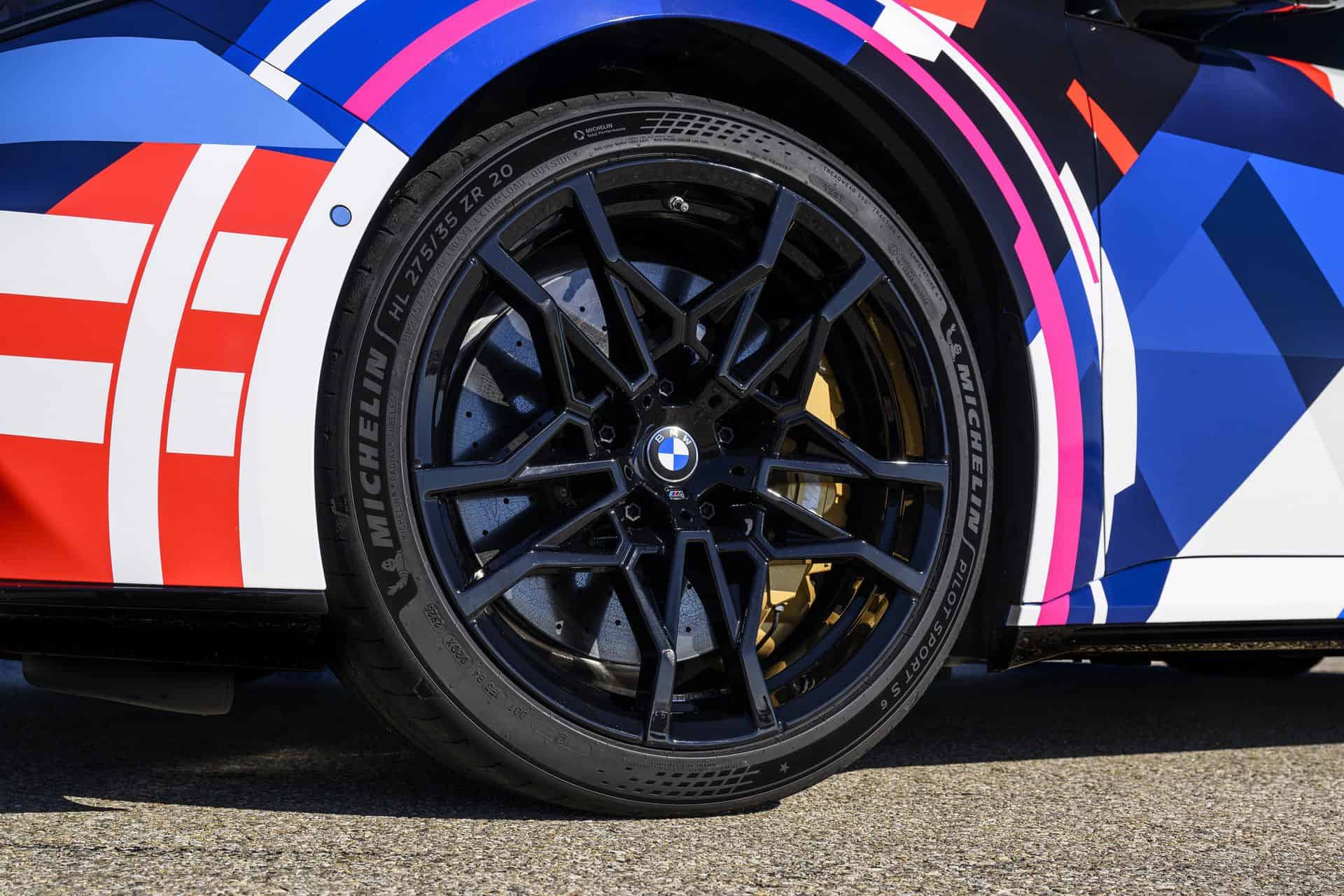
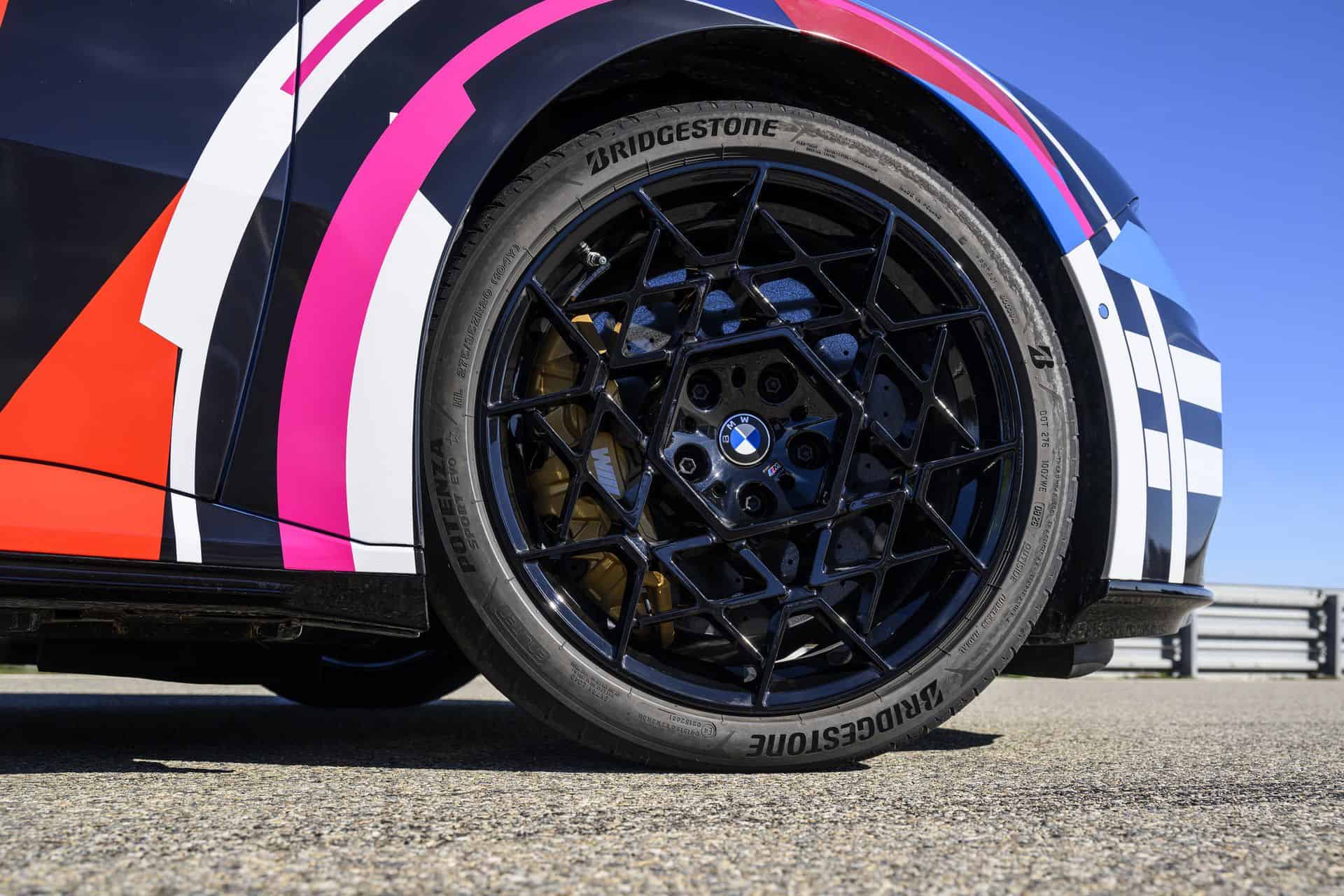
The brakes come in M Compound and M Carbon ceramic versions. Because the motors can regenerate up to 540 kW, the brake and drivetrain engineers had to size the system together, something that never came up on combustion M cars with little or no regeneration. Brunn said the goal was brakes “as big as required, but as small as possible,” and he admitted the result is smaller than you’d expect from the car’s power and weight. Philipp Schmitt, who works on vehicle dynamics and driver assistance systems at BMW M, told BMWBLOG after the event that regeneration helps keep the brakes light: the brake system weighs slightly less than the one on the current M3. BMW will release disc sizes later.
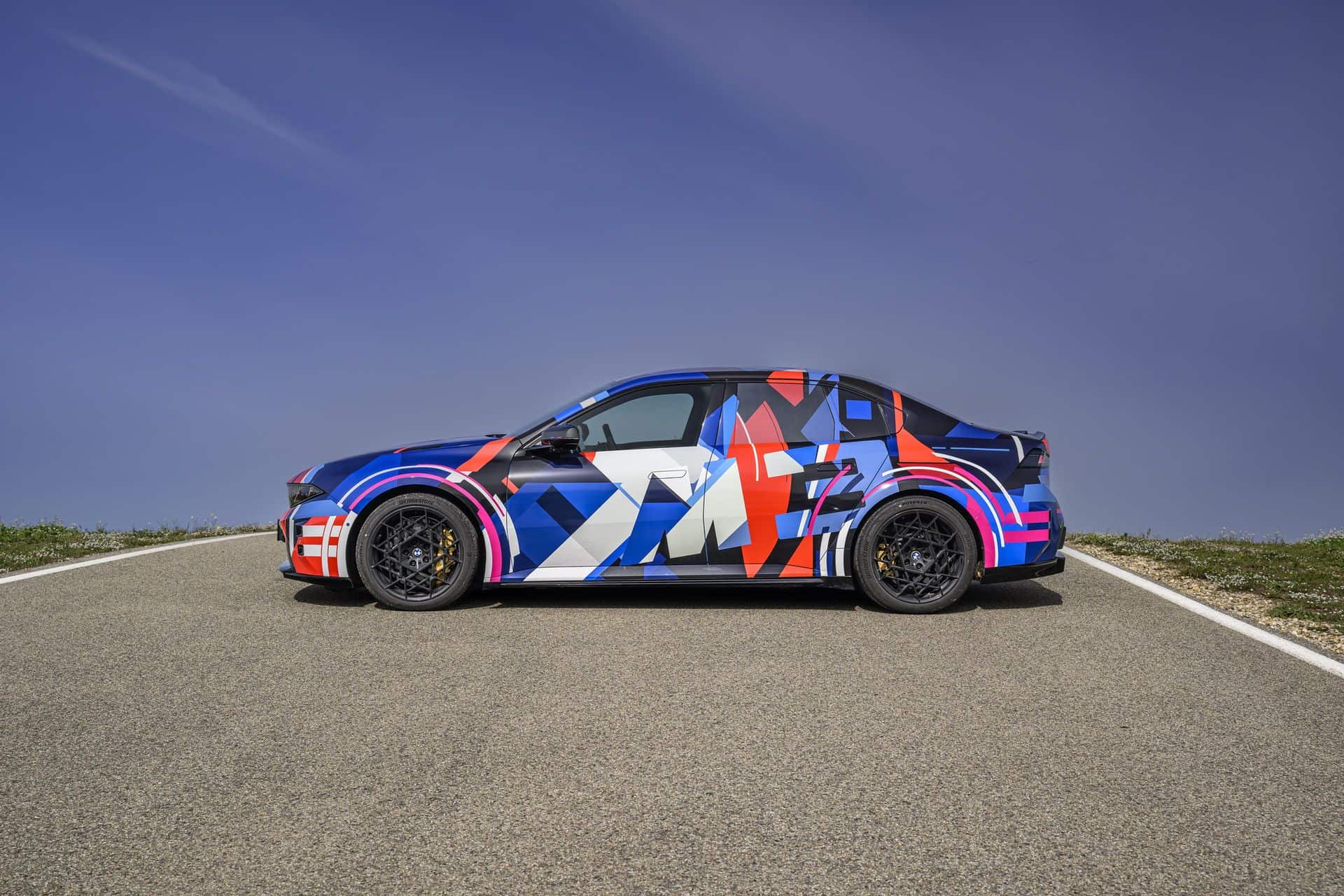
The tires are staggered. The prototypes we drove at Miramas ran 275/35R20 tires at the front and 295/35R20 at the rear. For comparison, the G80 M3 Competition runs 275/35R19 front and 285/30R20 rear tires. The electric car keeps the same front width and goes 10 mm wider at the rear.
A Central Computer Now Runs Powertrain And Chassis Together
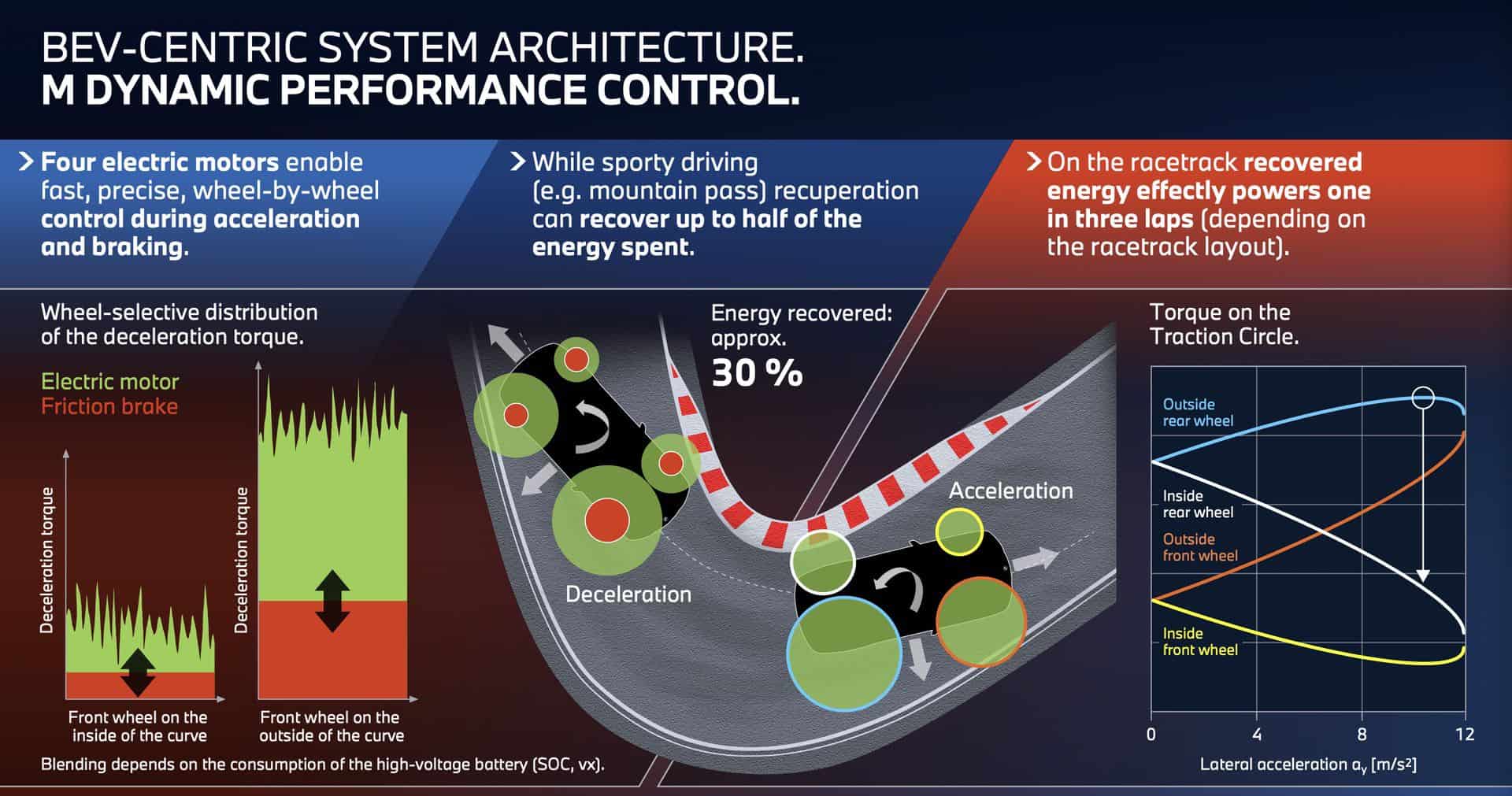
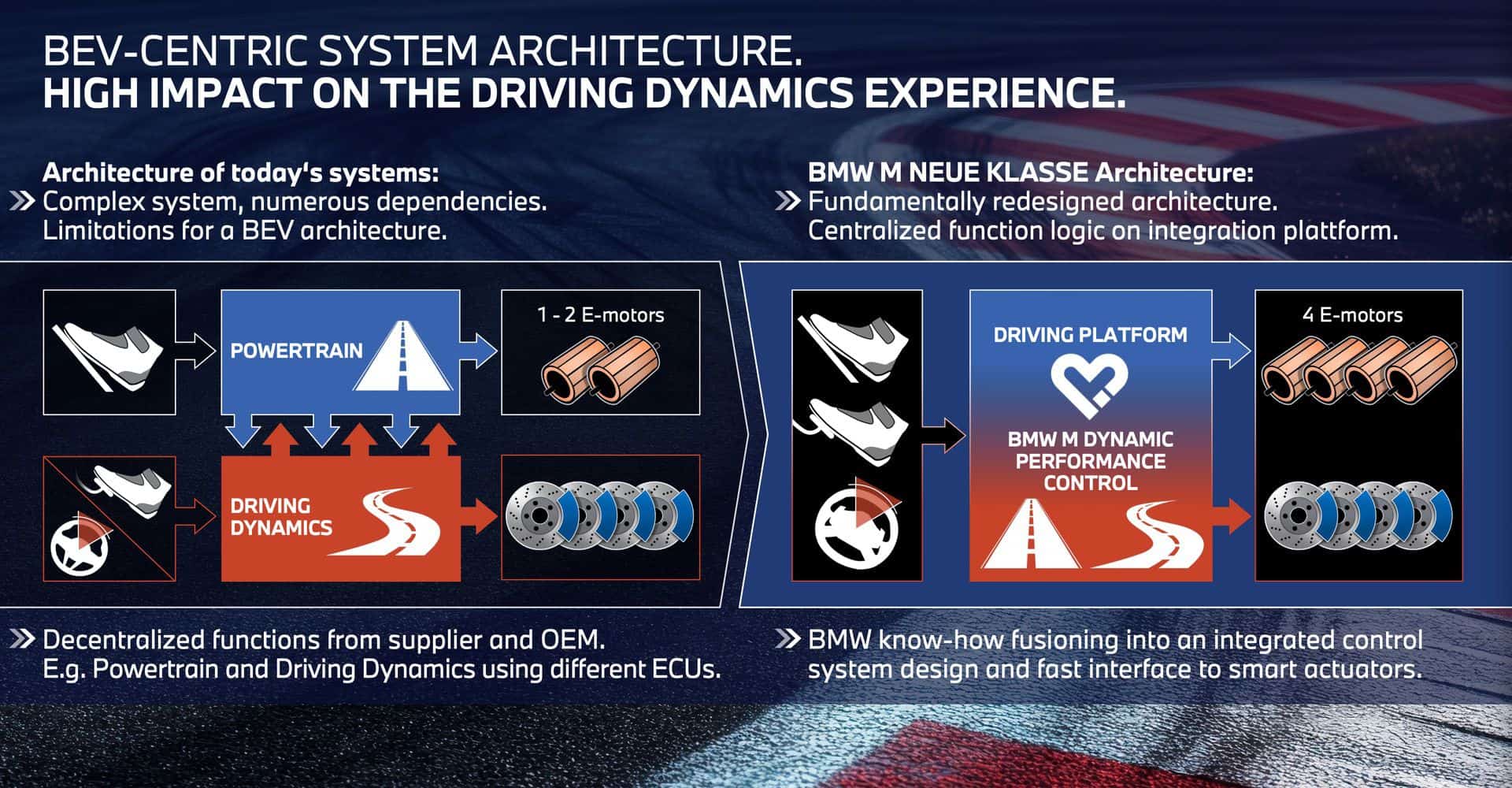
Erler walked us through the control architecture underneath. In current cars, powertrain and chassis functions run on separate control units, often from different suppliers, which talk to each other over CAN or Ethernet in 10- to 20-millisecond cycles and react to each other. Neue Klasse replaces that with a single driving platform, the “Heart of Joy,” and the M3 runs BMW M’s own software on it, called M Dynamic Performance Control.
It works in one-millisecond cycles and treats the four motors and the friction brakes as “smart actuators”: the central computer decides what each wheel should do, and the hardware carries it out. Each motor can change its torque in about a millisecond. BMW lists several other benefits on its slides: less complexity, shorter development times, faster updates, and a design that scales across different drivetrain layouts and performance levels.
Braking shows what that speed buys. BMW told BMWBLOG that the system always gives regenerative braking priority, to recover as much energy as possible. The motors supply up to 540 kW of braking power, the friction brakes add force only when the driver asks for more than that, and the fast ABS control runs through the electric motors. Braking force is also distributed wheel by wheel. In a corner, the outside front wheel does most of the work, and BMW’s chart shows that it is also the wheel where the friction brake takes the largest share. On the inside front wheel, nearly all of the braking is electric. How BMW blends regen and friction braking depends on the battery’s state of charge and the car’s speed, and Erler said the handover is designed to be imperceptible, with the same pedal feel when the battery is cold.
Acceleration works the same way in reverse. BMW’s chart of drive torque against lateral acceleration shows that, with no cornering load, both rear wheels get the same, larger share and both fronts get the same, smaller share. As lateral acceleration builds, torque moves to the outside of the car: the outside rear wheel rises to the highest share, the outside front wheel climbs steeply, the inside rear drops sharply, and the inside front falls off a little. That’s torque vectoring across both axles, done with motor torque alone rather than brakes or clutches.
With maximum regeneration selected, lifting off the accelerator alone slows the car at up to about 0.4 g. Because the regen limit is a power figure, the braking force the motors can supply on their own shrinks as speed rises, which is why Erler said the split between regen and friction braking depends on how fast the car is going. In a hard stop from high speed, the friction brakes join in sooner than they do in a slow corner.
What Are M eDrive’s Six Stages, And Why Did BMW Add Them?
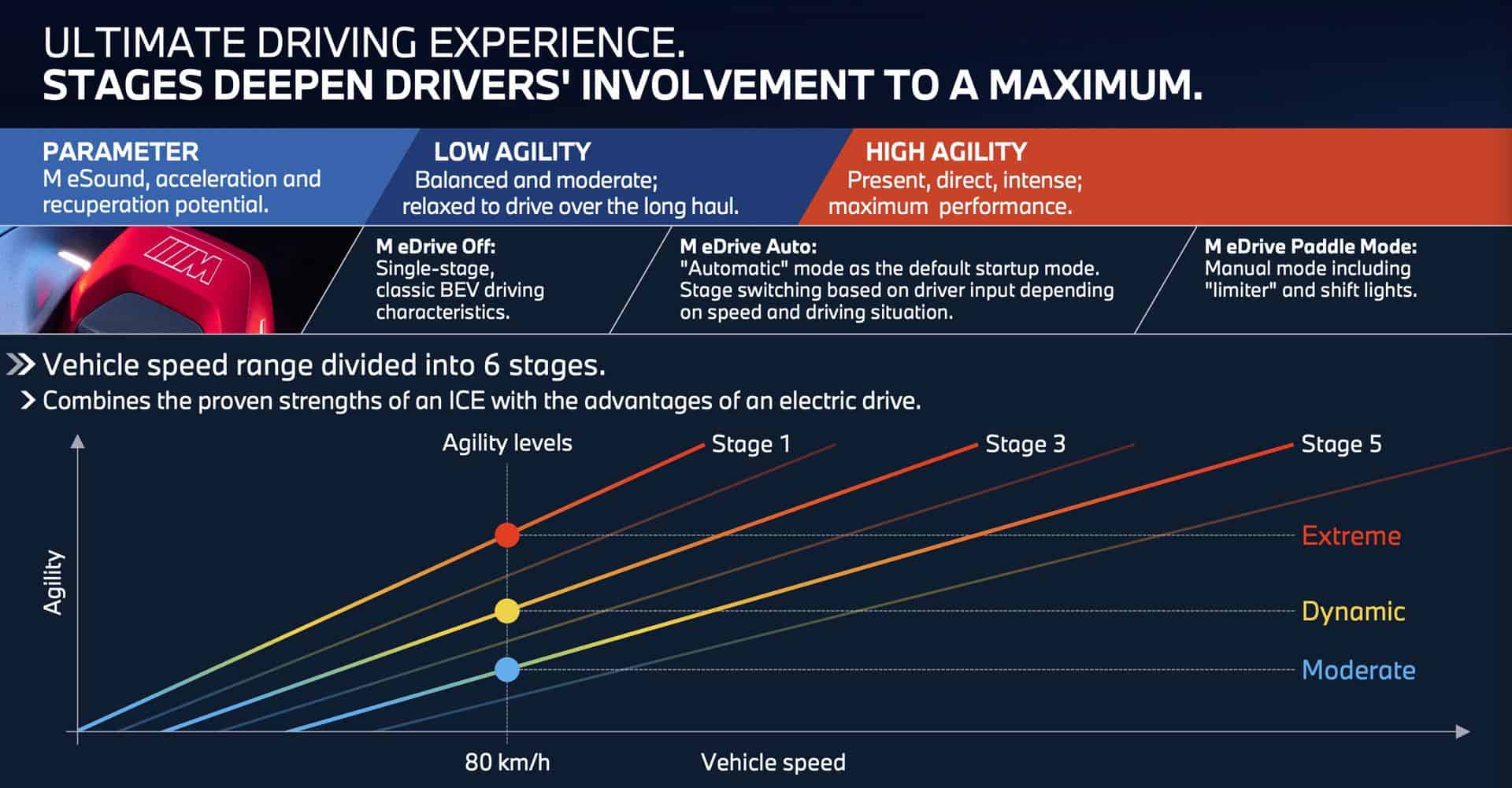
“It’s always an M car, so it should feel like an M car. It should drive like an M car,” Erler said, and M eDrive is how BMW M is trying to make that happen without a gearbox. The system divides the car’s speed range into six stages. Within each one, a value BMW calls Agility rises with speed, shown on an Agility meter in the head-up display that fills up as you accelerate. The stage determines throttle response, how much power is available at the lower end of that stage, how strongly the car regenerates when you lift off, and how the M eSound behaves.
BMW’s own chart shows how it works. Each stage is a line that starts at zero Agility and climbs as speed rises. Stage 1 climbs steepest and tops out at the lowest speed, and each higher stage climbs more gently and covers a wider speed range. At 80 km/h (50 mph), Stage 1 puts the car at its Extreme agility level, Stage 3 at Dynamic and Stage 5 at Moderate.
“80 kilometers per hour is not the same for every driving situation,” Erler said. On a highway with the family on board, you’d cruise at that speed in Stage 5 or 6. On a mountain road, you might be in Stage 1 or 2 at the same speed, with sharper throttle response and a more aggressive sound.
BMW stresses that it isn’t a fake gearbox. At the top of any stage, the full output of the motors is available, there’s no simulated lag between shifts, and Erler said 0-100 km/h (0-62 mph) acceleration is the same with M eDrive on or off. The power reduction only happens at lower Agility within a stage, to make the car easier to drive smoothly. Launch control is engaged with the brake and accelerator pressed, and the driver then pulls both shift paddles to confirm. It upshifts automatically through the stages in every mode. In D, the single-stage mode, the launch runs in one stage.
The reason for all of this is response time. Erler said a V8’s throttle can take 150 to 200 milliseconds to open, while the M3’s motors react in about a millisecond. A single calibration that works in traffic would have to filter away much of that response, and BMW didn’t want that: “We do not want to have a lame car,” Erler said. Stages let BMW keep the sharp response at the top of each stage and soften it at the bottom. The calibration also had to stop the car from bucking, the effect where an overly sensitive throttle jolts the car and moves the driver’s foot on the pedal.
There are three modes. Auto S is the default: get in, press the brake, pull the M toggle and the car is in Auto S, picking stages based on driver input, speed and the driving situation. Pull a paddle and the car switches to Manual S, where it stays in the chosen stage, with shift lights and a hard limiter at the top of each one. A long pull on a paddle returns to Auto S. D gives conventional single-stage EV behavior, where the car responds the same way at a given speed, for drivers who don’t want stages at all.
Regeneration strength isn’t adjustable with the paddles. Brunn said the team discussed it but decided that regen isn’t something drivers change constantly, so it lives in the M Setup menu and the paddles are reserved for stages. Regeneration does change with the stage, though, the way a lower gear gives more engine braking in a combustion car: lift off in a low stage and the car slows harder than in Stage 5 or 6.
The M eSound follows the stages too. At low Agility, it’s bassier and more relaxed. As Agility rises, it gets more aggressive, and Erler said it also gives the driver a sense of speed, which helps judge how fast you’re carrying into a corner. The interior sound can be set to Mid, Max or Off, but the exterior sound can’t be disabled because of regulations.
BMW lets owners combine almost any settings, including Manual S with the sound off. In that case, the car upshifts automatically at the limit, since the driver can no longer hear it coming. With the sound on in Manual S, the car stays on the limiter until you shift. Brunn argued that the sound does real work. On a slippery road, a driver might sit in a high stage to keep torque low, and when the surface turns grippier, the sound tells them when to shift down without looking at the cluster.
Steering Wheel Buttons, M Setup Menus And The Miramas Presets
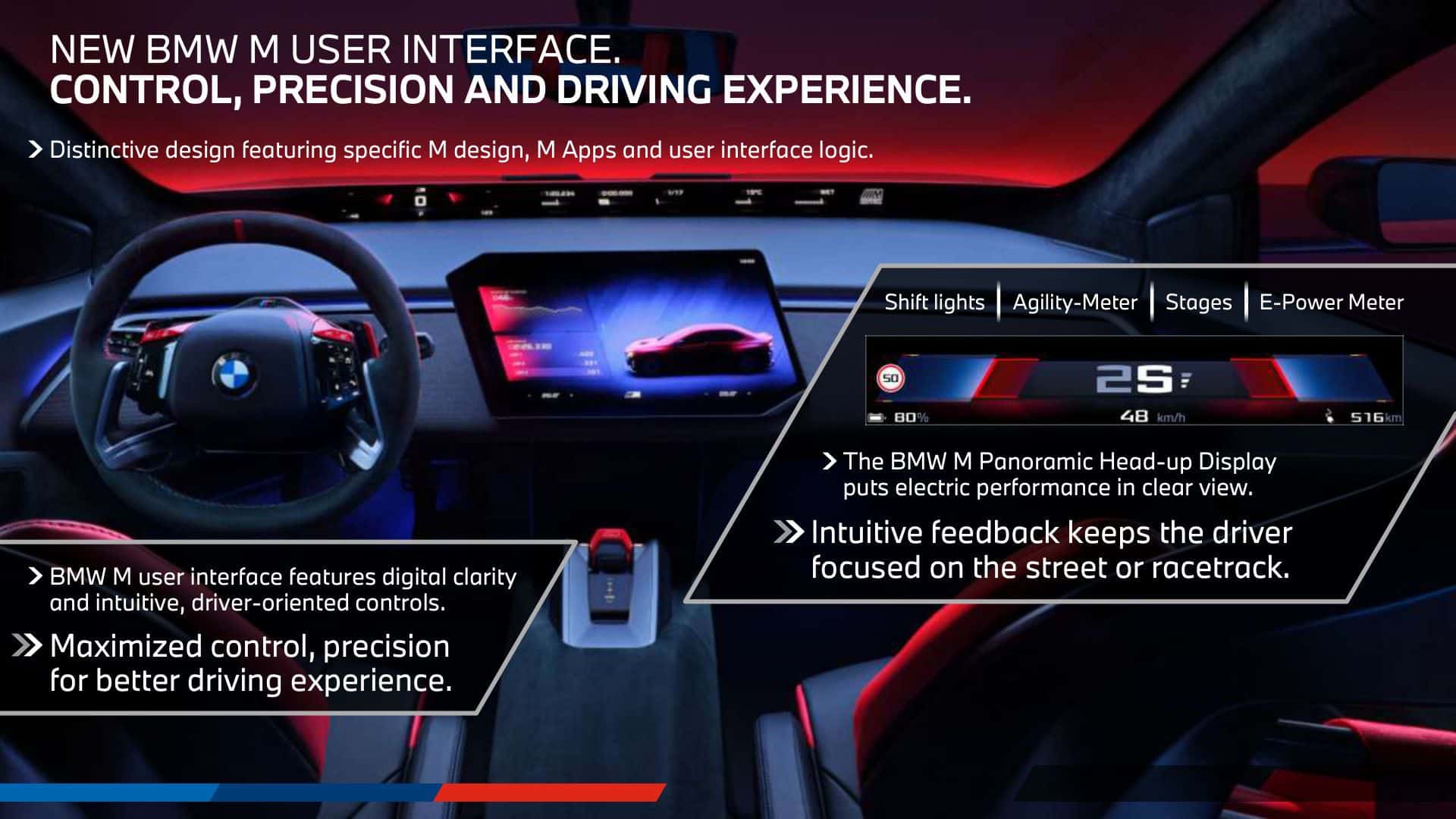
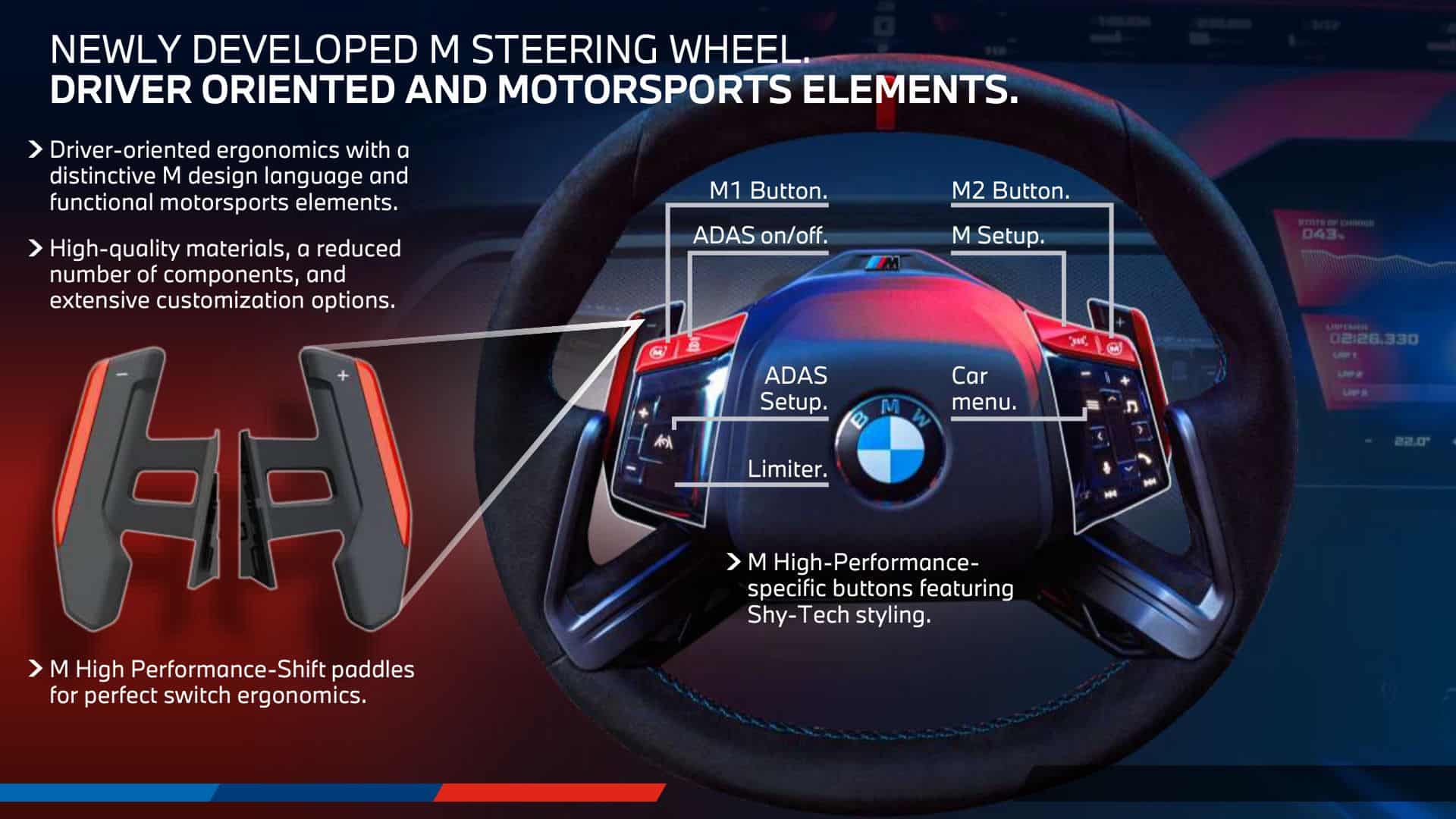
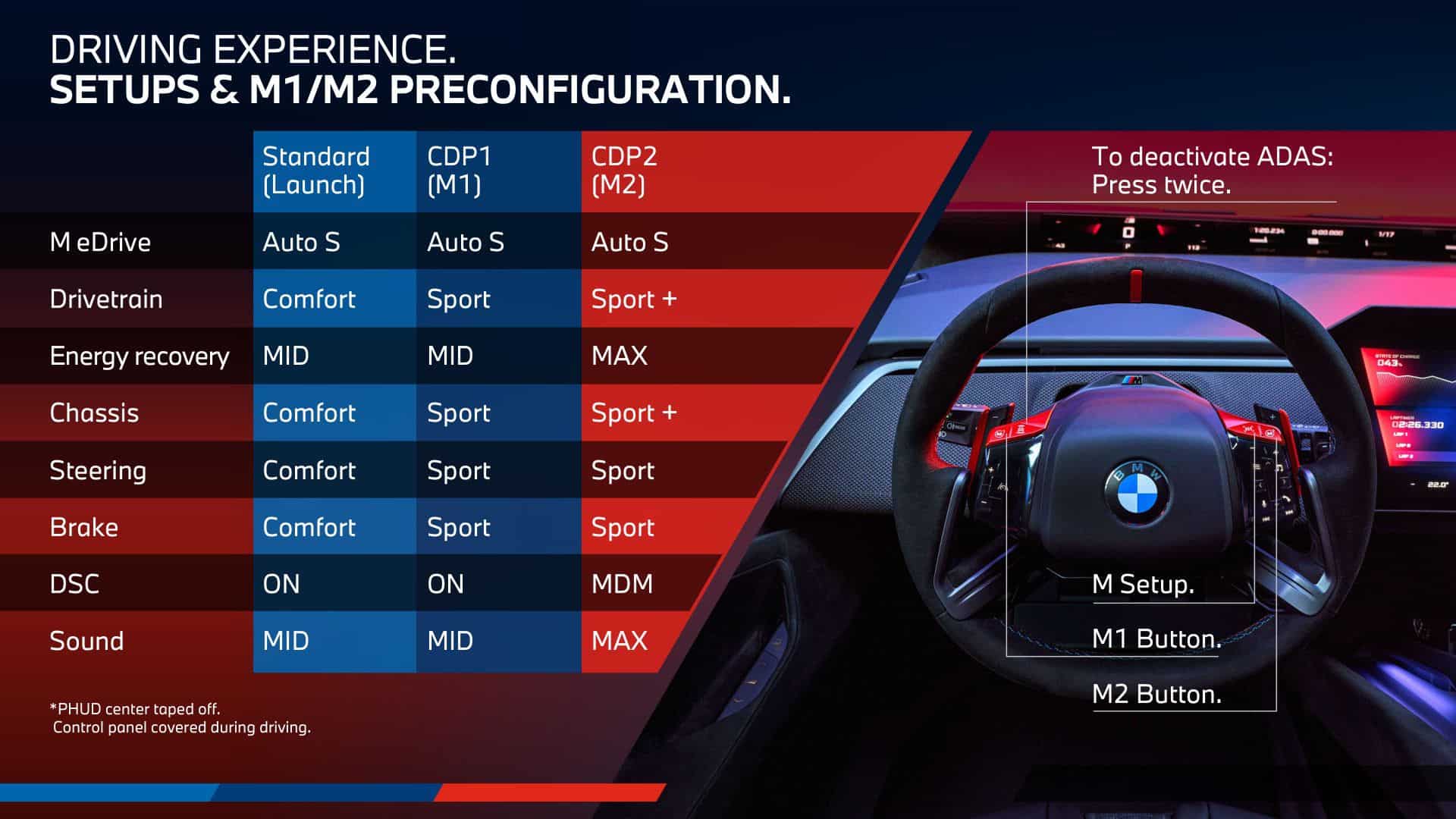
Brunn said the idea behind the interior was simple: in a car this fast, the driver should be looking at the road, not reading gauges or digging through menus. The M3 gets M-specific apps and a modified display layout, and its own steering wheel built on a motorsport logic, with everything a driver adjusts often placed on the wheel. The cruise control, limiter, phone and audio buttons carry over from the i3, while the M-specific buttons use what BMW calls Shy-Tech styling. The M1 and M2 buttons return, and the M Setup button moves from the center console to the wheel.
Next to it is an ADAS button. Press it once and a menu opens on the center screen to choose which assistance systems to disable. Press it twice and your chosen systems switch off while driving, within what regulations allow. Hold it at a standstill and everything that can legally be disabled turns off. Brunn said the two-press option exists because drivers forget to turn things off before setting out, and nobody wants to stop just to do it.
The BMW M Panoramic Head-up Display shows shift lights, the Agility meter, the current stage and an E-Power meter showing available power, alongside speed, state of charge and the selected regeneration level.
M Setup opens as a full page on the center screen, where each setting toggles through its options with a tap. The menu covers:
- M eDrive: Auto S, Manual S or D
- Drivetrain: Comfort, Sport or Sport Plus, which changes accelerator pedal mapping and response, sound character, shift strategy and front-axle decoupling
- Energy recovery: Min, Mid or Max, setting how much the car slows using only the accelerator, plus creep on or off
- Sound: Mid (focused on comfort), Max or Off
- Chassis: Comfort, Sport (which BMW recommends for the Nürburgring Nordschleife) or Sport Plus (for Grand Prix circuits)
- Steering: Comfort or Sport
- Brake: Comfort, with pedal travel tuned for easy modulation, or Sport, with shorter pedal travel for the deceleration achieved
The Drivetrain setting does more than sharpen the throttle. In Comfort, the stage strategy favors quiet, relaxed driving; in Sport Plus, the car stays in a stage that always has the right response for accelerating out of a corner. Setups can be named, saved and assigned to M1 or M2.
For our drive, BMW loaded its own presets, which give a good idea of how the engineers set the car up:
- Standard (at startup): Auto S, Comfort drivetrain, Mid energy recovery, Comfort chassis, steering and brakes, DSC on, Mid sound
- M1: Auto S, Sport drivetrain, Mid energy recovery, Sport chassis, steering and brakes, DSC on, Mid sound
- M2: Auto S, Sport Plus drivetrain, Max energy recovery, Sport Plus chassis, Sport steering and brakes, M Dynamic Mode, Max sound
New M Seats, Natural Fiber And The Smaller Details
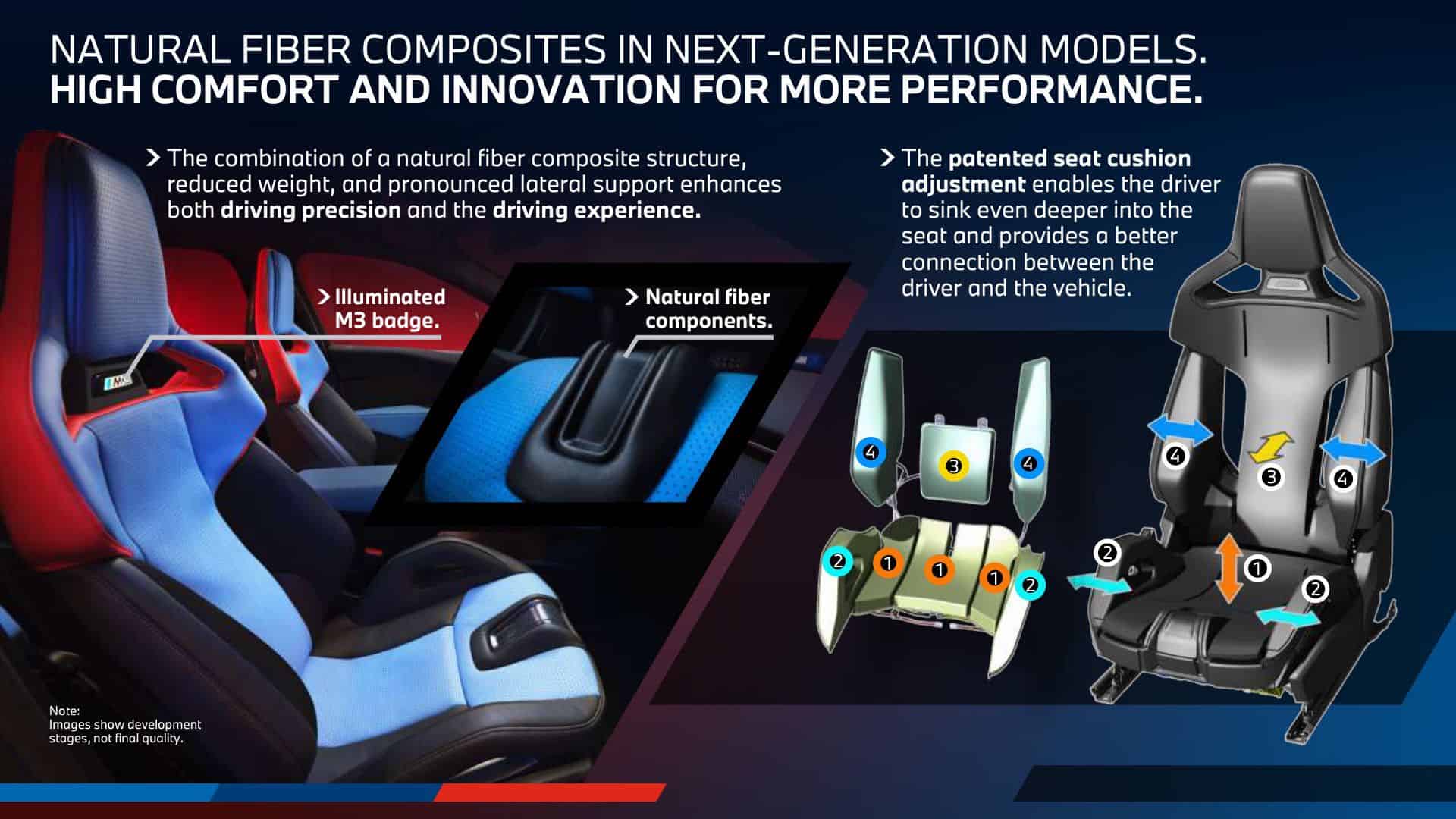
The seats replace the M Carbon buckets, with a structure made from natural fiber composite instead of carbon fiber, an illuminated M3 badge and pronounced side bolsters. They also add a patented cushion adjustment that lets the driver sit deeper in the seat and fit the cushion and side support to their body. BMW said the seats will be offered in different versions and color schemes.
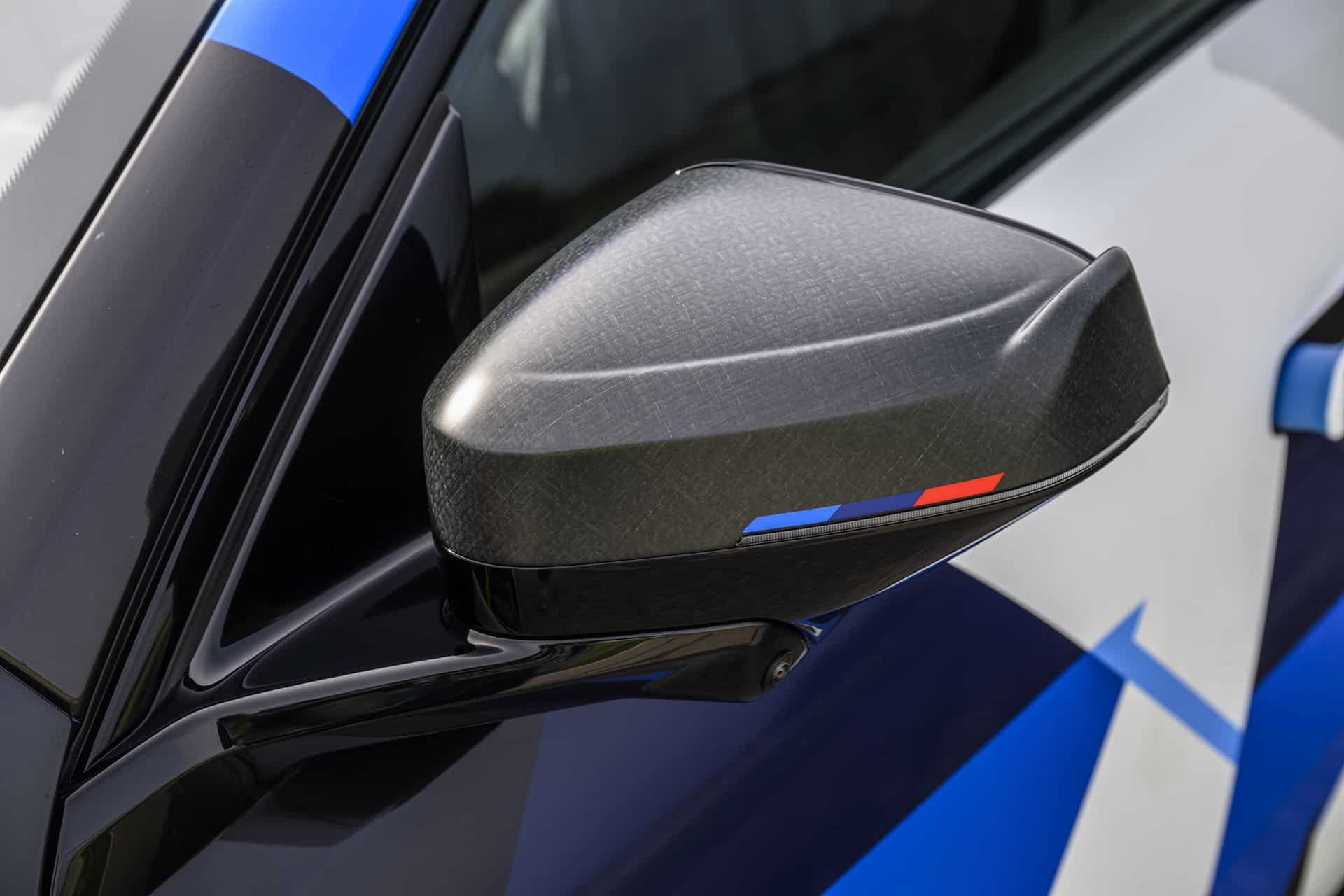
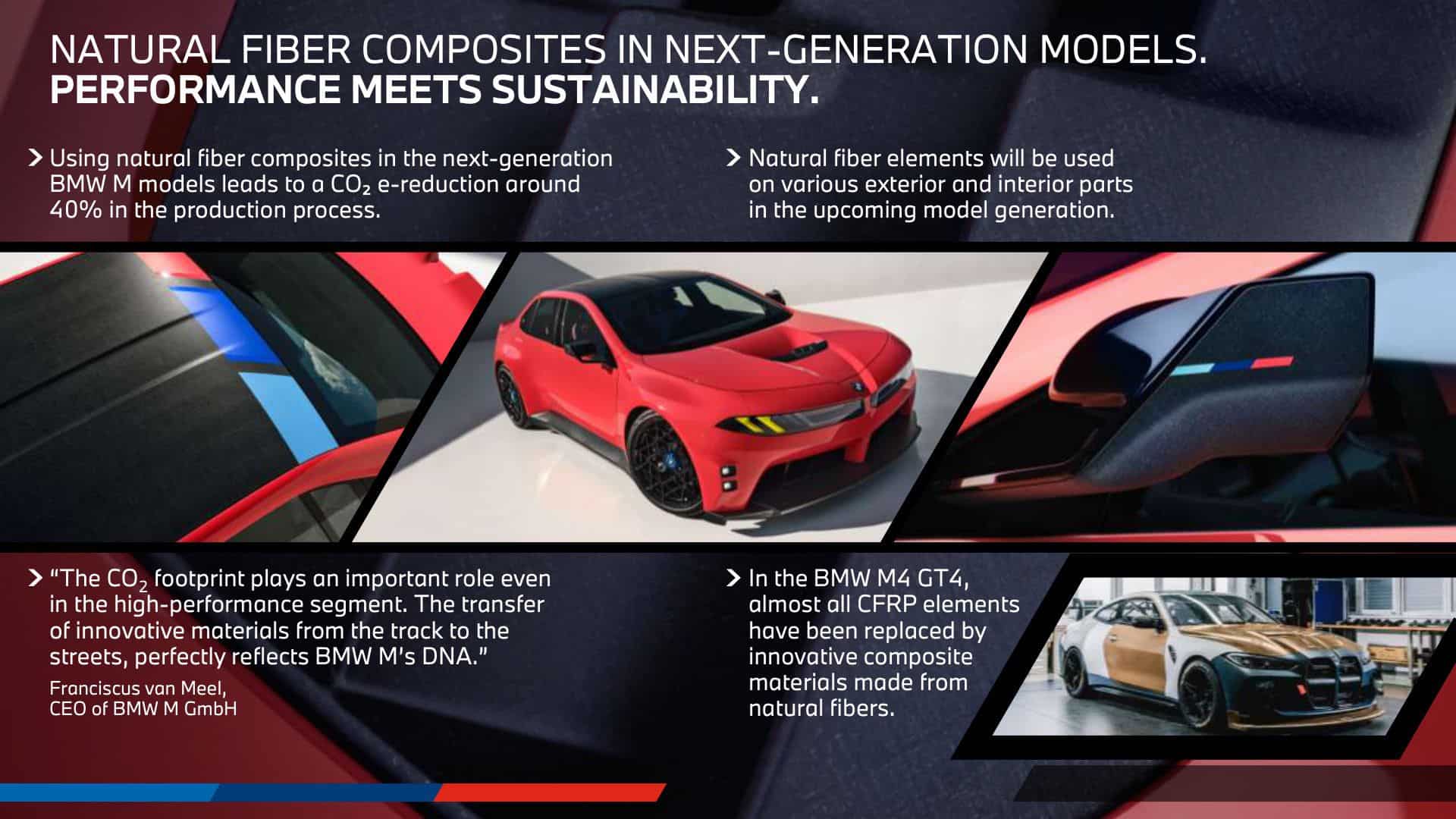
Natural fiber parts also appear elsewhere inside and outside the car. BMW M already uses the material in place of almost all carbon fiber parts on the M4 GT4 race car. BMW says it cuts CO2 emissions in production by about 40 percent compared with carbon fiber, and Brunn said it has similar properties in the places BMW uses it.
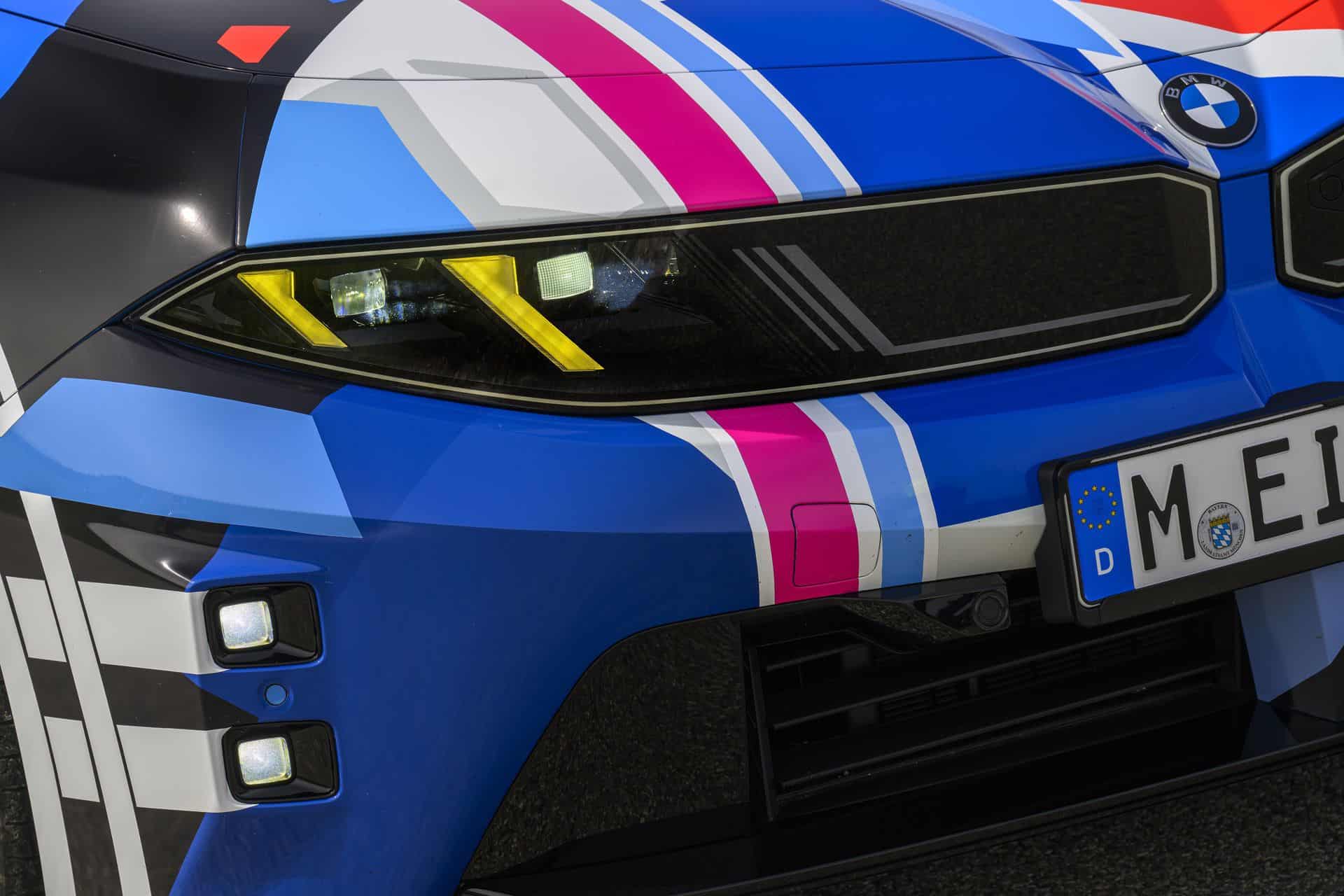
A few smaller details came up in the slides as well. BMW lists M Yellow lights and track lights among the M3’s signature features, though it didn’t explain the track lights. And BMW describes the M eDrive technology as “Made in Garching,” the Munich suburb where BMW M develops its cars.
Could A Lighter Rear-Wheel-Drive Electric M3 Follow Later?
Four motors is the configuration BMW M is launching with, but Brunn didn’t rule out a rear-wheel-drive version. “I’m not saying we’re not going to do it ever, but you lose a lot of recuperation,” he said. Dropping the front motors would cut a significant amount of weight, he admitted, but the brakes would have to grow to make up for the lost regeneration, and some of the control the four-motor layout gives the M3 would go with them.
So the plan, in Brunn’s words, is four motors at the start of production, “and then we will see what happens.”
Electric BMW M3 Technical Specifications At A Glance
- Drivetrain: four electric motors, two per axle in sport drive units, each with its own single-speed gearbox; 3-level inverters; front axle decoupling
- Output: about 838 hp (625 kW) and 1,200 Nm (885 lb-ft) combined
- Front axle: about 644 hp (480 kW) and 540 Nm (398 lb-ft)
- Rear axle: about 751 hp (560 kW) and 1,000 Nm (738 lb-ft)
- Battery: Gen6, about 100 kWh, M-specific “design to performance” cells, double-sided cell cooling, bolted to both axle carriers
- Charging: 420 kW peak DC, about 350 km (217 miles) in 10 minutes [TK: confirm test cycle, likely WLTP]
- Range: about 650 km (404 miles) WLTP, about 300 miles EPA
- Regeneration: up to 540 kW, with the friction brakes adding force above that; up to about 0.4 g on lift-off
- Control: M Dynamic Performance Control on the Heart of Joy platform, one-millisecond cycles
- Front suspension: forged-aluminum swivel bearing, control arm and tension strut; aluminum composite axle carrier
- Rear suspension: five forged-aluminum links per side; cast-aluminum hub carriers; cast and welded aluminum axle carrier, rigidly mounted
- Brakes: M Compound or M Carbon ceramic; system weighs slightly less than the current M3’s; disc sizes to be announced
- Tires: staggered; drive cars on 275/35R20 front and 295/35R20 rear, display cars on 275/35R20 front and 295/30R21 rear
- Weight: not announced