Article Summary
- Broad Arrow will auction the one-off W10-powered E39 M5 on October 9 in Knokke-Heist, Belgium, with an estimate of €250,000 to €350,000.
- The experimental 5.0-liter W10 makes 473 hp and 437 lb-ft, 79 hp and 68 lb-ft more than the stock S62 V8, and the car keeps its six-speed manual.
- Piëch had the engine built off the books in 1999 and drove the car himself on temporary plates; only three W10 engines exist.
The Volkswagen W10-powered E39 M5 is going to auction. Broad Arrow will offer the one-off prototype at its Zoute Concours Auction on October 9 at Approach Golf in Knokke-Heist, Belgium, with an estimate of €250,000 to €350,000, roughly $285,000 to $400,000. When we covered the car in March 2025, it was reportedly for sale at around $500,000. The auction estimate is quite a bit lower.
A Stock-Looking E39 With A Prototype Engine
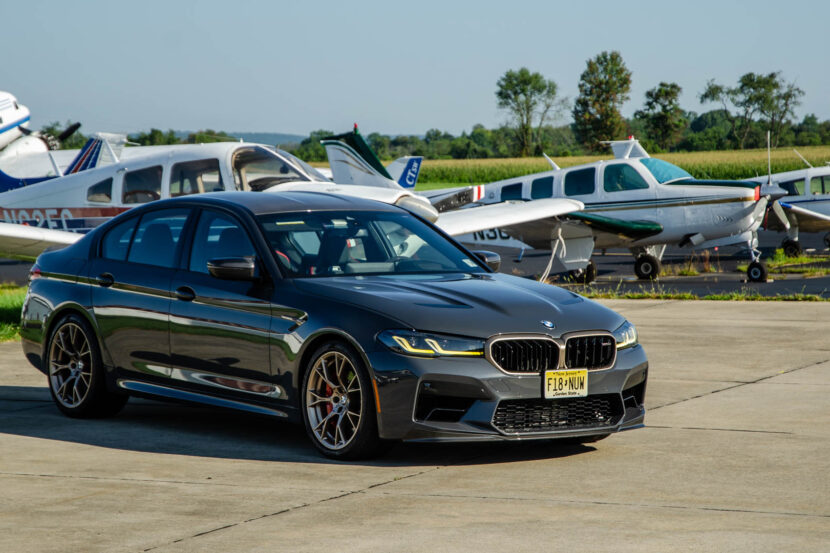
The car is a 2000 model-year M5 in Carbon Black Metallic over black leather, chassis number WBSDE91040GJ16436. From the outside it looks stock, and most of the cabin is too, down to the factory car phone in the center armrest. The changes show up in the instruments. The BMW cluster has been replaced by a Stack racing dash with no odometer, which means the car’s mileage can’t be determined. A set of extra gauges sits on the center console.
The S62 V8 is gone. In its place is an experimental, naturally aspirated all-aluminum W10 of about 5.0 liters. Broad Arrow lists it at 473 hp and 437 lb-ft, which is 79 hp and 68 lb-ft more than the factory 4.9-liter V8. The six-speed manual stayed. ABS, traction control and stability control are all disabled, and the engine runs on its own standalone ECU. The intake ducting, ignition system and coolant expansion tank were all made for the car.
The power figure is lower than the one we reported last year. In 2025, a dyno run showed 480 hp, which we treated as a wheel figure and translated to roughly 530 hp at the crank. Broad Arrow’s 473 hp suggests the dyno number was already close to crank output, so our estimate was too optimistic. It still beats every factory E39 M5 by a wide margin. It falls a little short of BMW’s own ten-cylinder M5, the E60 with the 500-hp S85 V10.
Piëch’s Off-The-Books Project
According to Broad Arrow, Piëch told his engineers in 1999 to build a W10 for a high-performance sedan. Neither Volkswagen nor Audi had an M5 rival at the time, so the engine went into an E39 instead of a Volkswagen Group car. The program ran outside Volkswagen’s official R&D department on Piëch’s instructions. The current owner says it cost nearly €2 million, which matches the figure we reported in 2025.
For years, the story went that Piëch drove the car to work every day. Broad Arrow’s version is more modest: it says Piëch drove the M5 himself on temporary plates during its secret development and testing. The missing odometer means nobody can say how far he took it.
Only Three W10 Engines Were Built
Sabine Willeke led the engineering team behind the project. She told Broad Arrow that only three W10 engines were ever built:
- One remains in Germany.
- One is displayed alongside the M5.
- One powers the car.
No other W10 went into a road car, and Volkswagen never returned to the configuration after the program ended. That mostly fits what we wrote in 2025. At the time, a second engine had turned up in Germany with a Volkswagen mechanic, and the third was believed to be in a private collection. Broad Arrow’s listing now places that third engine next to the car.
The current owner bought the M5 about a decade ago through contacts in the engineering world. He registered it in Slovakia and drives it rather than keeping it in storage. The car has no certificate of conformity, which the next owner will have to deal with before registering it anywhere else.
What It’s Worth
Last year we described the roughly $500,000 asking price as an insane number, but we also said a buyer would be paying for a story. The auction estimate now puts a lower number on that story. Broad Arrow has an engineer who led the program on record and a clearer picture of where all three engines ended up. It also has a more believable account of how much Piëch actually drove the car, which is still the detail most likely to decide the final bid.