Article Summary
- BMW celebrates 40 years of the M3 with a special exhibition featuring the ultra-rare M3 E46 Strassenversion.
- Only 10 cars were ever made but seven were subsequently crushed. The remaining three are not in private hands as BMW owns them all.
- The unicorn M3 E46 had a V8 race car engine: the naturally aspirated P60B40.
Yours truly isn’t the only one turning 40 this year. The original M3 (E30) went on sale in 1986, and it’s no surprise that BMW is celebrating the milestone. While there have been plenty of limited-run special editions over the past four decades, the GTR Strassenversion tops them all. Officially, 10 were made, but only three have survived the test of time.
BMW crushed seven development prototypes and kept the three production-ready cars in its fleet. The street-legal M3 GTR was unveiled in 2001 with an eye-watering €250,000 sticker price. Legend has it that none of the surviving cars are in private hands. One of the three remaining examples was recently taken out of storage for a special exhibition in France.

The M3 GTR Strassenversion Is The Most Exotic M3 Of Them All
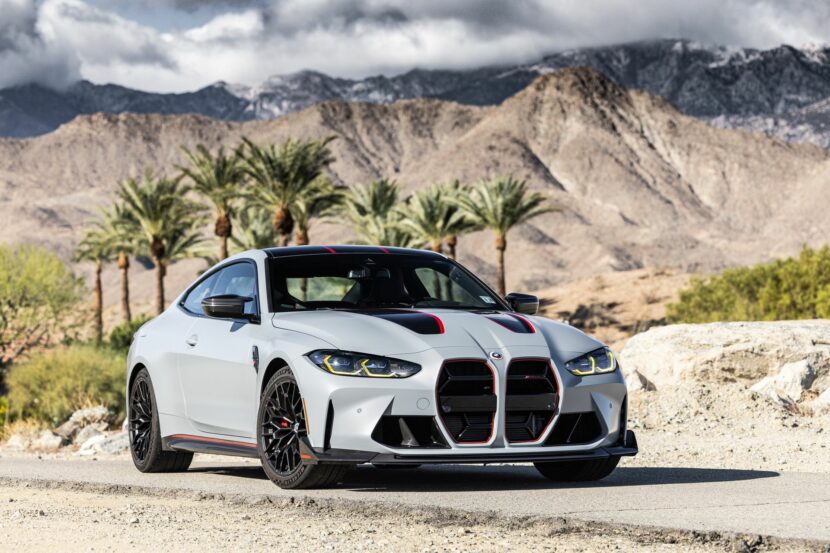
Rarer than hen’s teeth, the M3 GTR Strassenversion made the trip to Paris, where the unobtanium E46 was displayed alongside three other generations. The M3 E30, M3 GT E36, and M3 Competition xDrive G80 were all there to highlight the anniversary. All four shared the spotlight under the glass roof of the Grand Palais. The exhibit marking 40 years of the M3 is part of a collaboration with Tour Auto, with BMW serving as an official partner of the event’s 35th edition this year.
The road-legal M3 GTR was even more desirable than the CSL, and not just because of its flat-plane-crank V8 engine. The naturally aspirated 4.0-liter unit, lifted straight from the race car, was paired with a six-speed manual gearbox rather than the CSL’s SMG. In Strassenversion form, the P60B40 produced 346 hp and 365 Nm (269 lb-ft).
Beyond the different engine and gearbox, the GTR also shed about 35 kg (77 lbs). In the end, it tipped the scales at just 1,350 kg (2,976 lbs). The weight savings came from removing the rear seats, air conditioning, and even the radio. BMW also made greater use of carbon fiber to strip away as much unnecessary mass as possible. It’s safe to say it had all the ingredients of a true homologation special.


Another BMW M Model With A Race Car’s Engine Is Unlikely To Happen
Given today’s strict emissions regulations, it’s hard to imagine BMW will ever fit a true race-car engine to a road-legal production model again. For the same reason, naturally aspirated engines are steadily becoming a thing of the past. At the same time, a V8 in an M3 is highly unlikely to return, so your only option is an E90/E91/E92 with the S65. Unmolested, low-mileage examples don’t come cheap, as evidenced by a 725-mile coupe that recently fetched over $200,000 on Bring a Trailer.
Silver lining? We can at least take comfort in knowing another generation of the M3 with an inline-six is on the way. The G84 is expected to arrive in 2028, about a year after the fully electric M3 ZA0.