Article Summary
- The i3 has 420 liters of trunk space, compared with 450 liters in the gas 3 Series.
- The M350's quad exhaust tips are a first for the 3 Series, and its M yellow lights can't be ordered on the i3.
- The i3's flat rear floor suits a middle passenger better, while the M350's lower floor gives the outer seats a more natural knee angle.
From the front, you would struggle to tell the new BMW i3 from the new BMW M350 xDrive. I spent time with both cars side by side, and the differences only show up when you walk around them, open the doors and sit in the back. The i3 rides on BMW’s Neue Klasse EV architecture, while the gas G50 3 Series uses an updated version of the outgoing car’s CLAR platform. That split explains nearly every design difference between them.
The Front Ends Differ Only In M Details

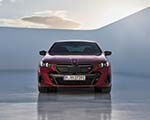
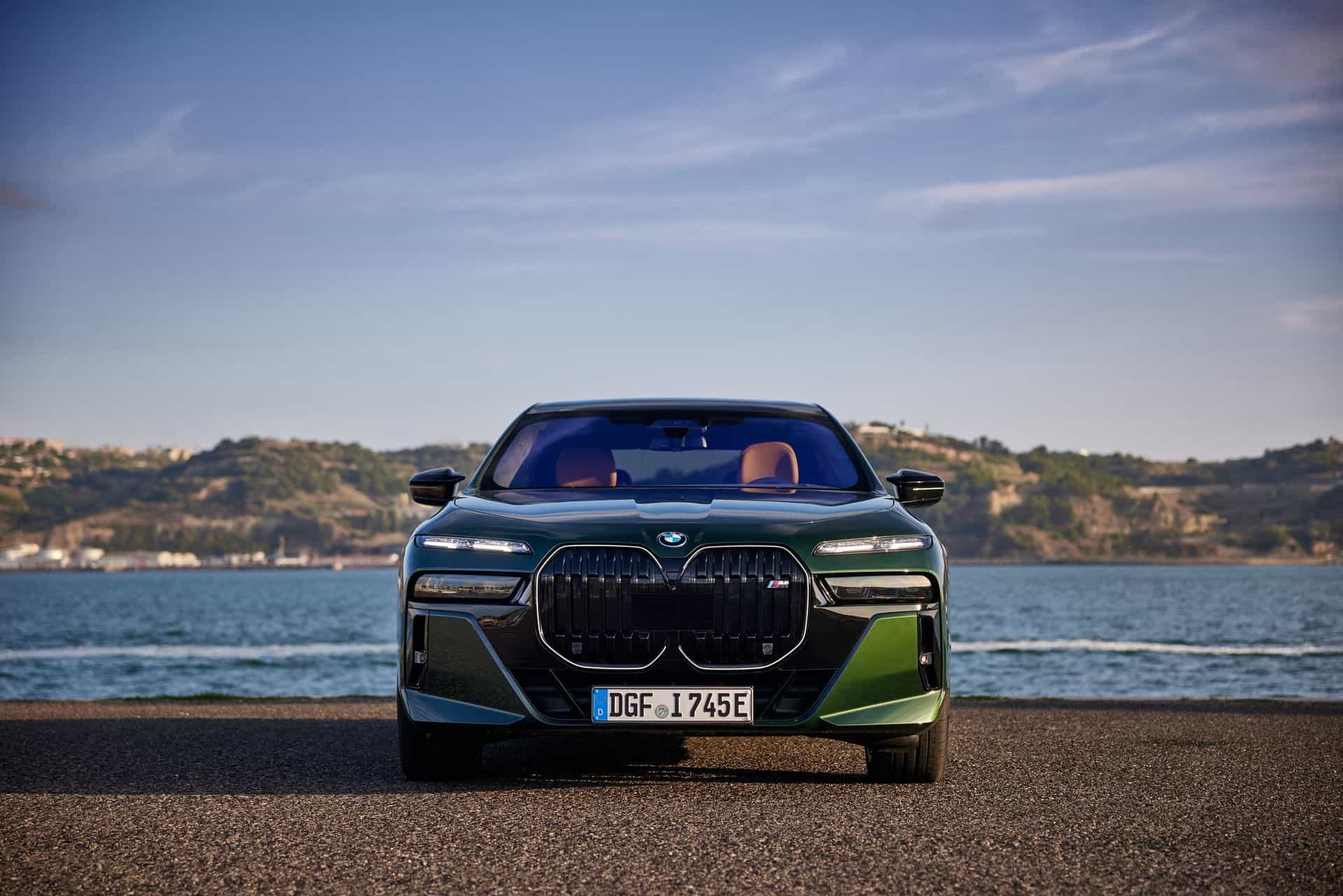
Both cars wear the same Neue Klasse face: the slim, digital-looking kidney grille flanked by horizontal lights. The M350 adds three things. First are the M yellow lights, which are exclusive to the M Performance model; you can’t option them on a 330 or an i3 50, but you can get them on the i3 M60 xDrive. Second, the M350 gets M stripes across the fascia: one wide stripe and two thinner ones that line up with the headlights. Third, it gets an M badge. But again, the i3 M60 will get the same signature elements.
The geometry at the front is nearly the same between the two different 3 Series models.
Side Profile Shows Where The Platforms Split

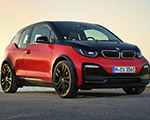
The side view is where the two cars separate. The i3 sits taller and wider, and its wheelbase is 17 mm (0.67 inches) longer. With no engine up front, it doesn’t need a long hood, so the front overhang is shorter and the car looks stubbier. The rear overhang is shorter too.
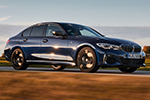
The M350 has the classic long-hood sedan shape because the B58 3.0-liter inline-six has to fit under the hood. It also sits lower, since there’s no battery pack in the floor, and its rear overhang sticks out a bit further. Despite looking more compact, the i3 is actually 6 mm shorter overall: 4,759 mm versus 4,765 mm for the gas 3 Series. For proportions, I prefer the M350. Most people won’t notice the difference in traffic, but once you do, you can’t stop seeing it.
The shorter overhangs cost the i3 trunk space. It has 420 liters, compared with 450 liters in the gas car. The i3 makes up for part of that with a frunk of 31 liters. We also noticed that the gas 3 Series has regular window seals, while the i3 hides them for a cleaner flank. Wheel sizes differ too: the i3 runs 19 to 21 inches, and the gas car runs 18 to 20.
Quad Exhaust Pipes Are A 3 Series First

The rear design is shared, so the differences come down to the M Performance trim. The M350 gets a trunk spoiler, Shadowline smoked taillights that contrast with the slim light bars, and a noticeably more aggressive diffuser. It also has quad exhaust tips, the first ever on a 3 Series. That was expected after the X1 and X2 got the same treatment.
Both cars use BMW’s new badging, with the “3” larger than the digits after it. Overall, the i3’s tail is cleaner and uses fewer blacked-out elements. The i3 M60 xDrive borrows the M350’s spoiler and diffuser. On the road, the easiest giveaway will be the charging flap versus the fuel door.
How Different Are The i3 And M350 Cabins?

They’re closer inside than outside. Both have the same driver-oriented center screen and the Panoramic Vision display across the base of the windshield. The biggest visual difference is on the dashboard of the M350: an extra housing for the head-up display.
The i3 I sat in used standard seats and a more traditional finish on the drive selector. Its center console has extra storage where a transmission tunnel would normally be. The M350 came with M Sport seats, which are standard on that model and have an illuminated M in the backrest. They have deeper bolsters and a bucket-seat look. It also had the crystal glass controls, which give the cabin a more upscale feel than the blacked-out finish in the i3 I saw. The M350 adds M graphics on the Panoramic display and a red 12 o’clock marker on the steering wheel, where the regular 3 Series has a black one.
Both cars offer the same steering wheel choices: a two-spoke design with spokes at 12 and 6 o’clock, or the M Sport wheel with spokes at 4 and 8 o’clock. Both cars I saw had the glass roof.
Rear Seat Space Favors Each Car Differently
I’m about 6-foot-2, and I had plenty of headroom and shoulder room in both. The i3 gives your knees a little more room thanks to the longer wheelbase. However, the battery pack under the cabin raises the floor, so your knees sit higher, and the angle is less comfortable over time. The i3’s flat floor and a cutout in the middle of the bench make it the better car for a third passenger in the back.
The M350’s lower floor gives a more natural seating position for the two outer passengers. The fixed glass roof, rather than a sliding sunroof, frees up headroom. The transmission tunnel is still there, though, and the middle seat has no cutout, so the i3 is the better choice if you regularly carry three people in the back.
Performance And Range Put The Cars Apart
The M350 xDrive has 437 hp and does 0-100 km/h in 4.1 seconds, making it the quickest version of the new 3 Series for now. It also gets BMW’s new rear-wheel-drive Drift Moment feature. The i3 50 xDrive has 463 hp and goes from 0 to 100 km/h in 4.7 seconds. The MSRP of the BMW M350 xDrive is $65,900, while the i3 50 xDrive is 62,850.
US sales of the gas 3 Series start in the first quarter of 2027, while pre-orders of the BMW i3 started today.
If you’ve followed the Neue Klasse since the concept, it’s odd to see that the gas car ends up looking more traditional. The i3 is the cleaner design and the more practical back seat. The M350 has the better proportions, the quad pipes and an engine you can hear. Put a badge over the tailpipes and most people wouldn’t know which was which. BMW designed it that way on purpose, so you choose a 3 Series by powertrain rather than by looks.