Article Summary
- BMW has been testing a new measure to cut CO2 emissions and reduce range anxiety in big trucks that support its supply chain logistics.
- DHL's Scania hybrid truck completed long-distance traveling between Berlin and Munich as well as short trips within Munich.
- Helped by a small combustion engine serving as a generator, the truck has nearly 500 miles of range.
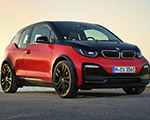
Although the 2011 Chevrolet Volt is widely considered the first production car with range-extender technology, BMW wasn’t far behind. The i3 REx arrived just a couple of years later, making it an early adopter of the drivetrain before Nissan and several Chinese brands embraced it. The German luxury automaker has since abandoned the gas engine serving as a range extender, but it’s now making an unexpected return. Well, sort of.
It’s not the new iX3 electric crossover pictured here that has a combustion engine; it’s the Scania truck next to it. Operated by DHL, the lorry, as the British say, recently underwent a multi-week pilot project within BMW Group’s logistics operations. The aim? Reduce CO2 emissions while alleviating the range anxiety drivers would otherwise face on longer journeys.
BMW says the “patented vehicle concept” featured a compact combustion engine producing 120 kilowatts, or about 161 horsepower. Much like in the gone-but-not-forgotten i3 hatchback, the ICE didn’t drive the wheels because there was no mechanical connection. Instead, it functioned purely as a generator to recharge the battery when necessary.

The Combustion Engine Replaced One Of The Battery Modules
To make room for the engine, one of the battery modules had to be removed. For reference, the standard electric truck carries a massive 416-kWh pack. The battery juices up an electric motor rated at a continuous output of 308 horsepower, peaking at 396 horsepower. Over several weeks, the experimental truck successfully completed long-distance trips between Berlin and Munich. It covered approximately 600 kilometers (373 miles) without stopping to refuel or recharge.
The journey started at the DHL parcel center near Berlin and ended in Unterschleißheim, a town in Upper Bavaria within the Munich district. For most of the route, the truck relied solely on battery power. Only a small portion involved the use of the range-extending gas engine. In addition, the workhorse handled daily routes around Munich, covering distances ranging from single-digit kilometers to 380 km (236 miles).
The hybrid truck can travel up to 800 kilometers (497 miles), although the figure varies depending on factors such as the route and payload. Tests have shown it can operate 80-90% of the time without burning any fuel. The gas-engine generator provides peace of mind for the remaining 10-20%.
A New Range-Extending BMW? It Might Not Be Necessary
Some reports claim the next-generation X5 (G65) could bring back the range extender, but our sources say BMW hasn’t approved it yet. The company is keeping all options open, but it may ultimately prove unnecessary given the impressive range offered by Gen6 batteries for Neue Klasse EVs. The new iX3 delivers up to 805 kilometers (WLTP) or 434 miles (EPA) on a single charge. The iX5, debuting this summer, will certainly be heavier but still deliver excellent range. If a recent report is to be believed, the massive 148-kWh battery pack should have the antidote to range anxiety.