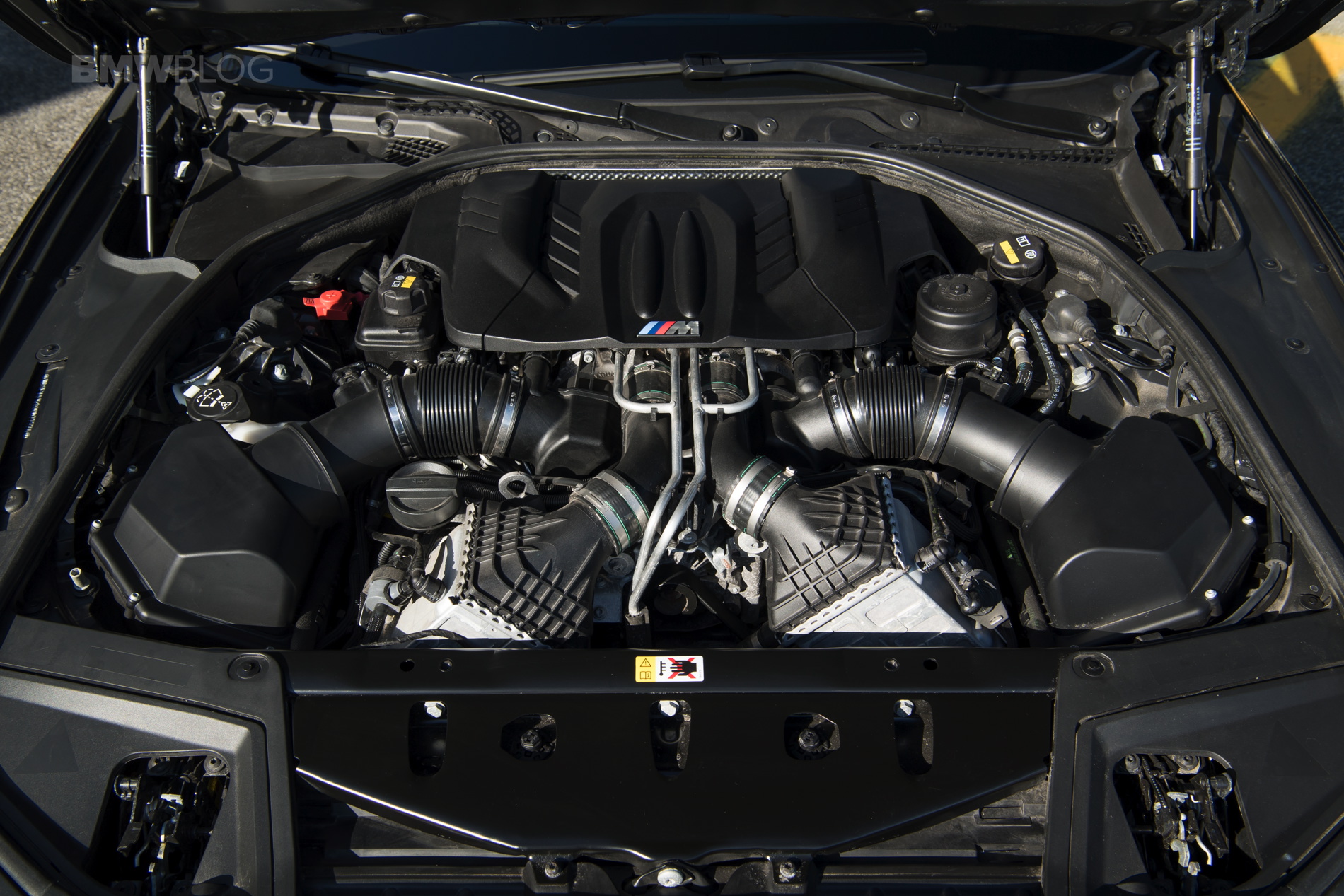
Beneath an aluminum cover sits BMW M’s latest engine revision. Designated the S63tu (technical update), this V8 represents an evolution of the S63 previously employed in the X5 M and X6 M. The fundamental architecture remains unchanged—both versions feature a 90° twin-turbocharged, twin-scroll V8 with BMW’s cross-bank exhaust headers, variable valve timing on intake and exhaust, and direct fuel injection.
The differences emerge in specific components and calibration. The F10 M5’s S63tu incorporates a higher compression ratio of 10:1 compared to its predecessor. BMW classified it as a “newly developed” engine due to the extent of modifications.
Technical Revisions
New pistons enable the increased compression ratio. Boost pressure decreases slightly by 0.1 bar, while larger intercoolers expand cooling capacity. The turbochargers themselves are new units with larger turbine diameters. The valvetrain introduces Valvetronic variable valve lift on the intake side, while throttle bodies function primarily as limp-home fallback systems. BMW comprehensively revised the electronic engine management system to support a 7,200 rpm redline.
Power and Efficiency Trade-offs
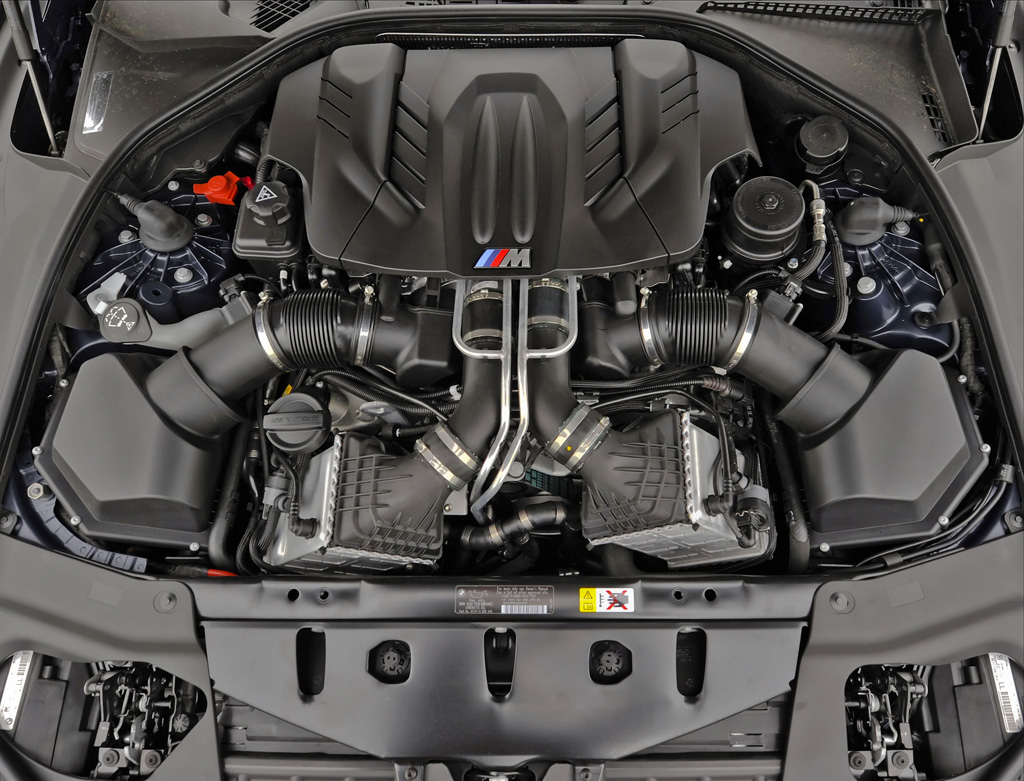
The S63tu produces 560 horsepower and 553 lb-ft of torque—a gain of just five horsepower over the X5 M and X6 M. This modest increase reflects BMW M’s stated prioritization of efficiency and drivability over peak output. BMW engineers could theoretically extract additional power, but M’s philosophy extends beyond headline figures.
Compared to the naturally aspirated E60 M5 generation, efficiency improvements are significant. Per BMW’s official press materials for the F10 M5 launch, the new model achieved approximately 30% lower fuel consumption while producing around 10% more power and 30% additional torque versus its predecessor. On the EU test cycle, the F10 M5 recorded 9.9 liters per 100 kilometers (approximately 28.5 mpg) with CO₂ emissions of 232 g/km under EU5 standards. Note: These figures are from BMW’s official launch documentation and represent EU test cycle results. Real-world consumption will vary based on driving conditions, driving style, and vehicle configuration.
Thermal Management and Compact Layout
The S63tu places both turbos and catalytic converters within the V of the cylinder banks—a compact design that creates thermal challenges. Consequently, BMW developed an extensive cooling system featuring large intercoolers and an aerodynamic front-end design to direct adequate airflow to radiators and engine components.
This compact turbo placement benefits throttle response. By reducing the distance from exhaust valves to turbo turbine blades, exhaust gases reach the turbine more quickly, building intake boost faster than conventional turbo installations. This design reduces—though does not eliminate—the delay between throttle input and turbo spool-up that typically characterizes turbocharged engines.
Cross-Bank Exhaust Design
BMW’s patented cross-bank exhaust manifold distributes exhaust pulses evenly across both turbos. Each cylinder bank contributes to one scroll of each turbo, ensuring both scroll elements receive consistent exhaust flow across the RPM range. This design contributes to audible characteristics distinct from conventional turbocharged V8s.
Torque Characteristics
The S63tu delivers full torque from 1,500 rpm, with 100% of available torque accessible low in the rev range. Peak torque holds until 5,750 rpm before gradually decreasing toward the 7,200 rpm redline. At lower RPMs the engine produces an estimated 400+ lb-ft, reflecting the broad nature of the torque curve.
Compared to the naturally aspirated E60 M5 V10—which peaked at 507 horsepower at 7,750 rpm (redline: 8,250 rpm) and required approximately 6,100 rpm for peak torque—the S63tu’s torque delivery is dramatically lower in the RPM range. The turbocharged engine’s broad, flat torque plateau from 1,500 to 5,750 rpm represents a fundamental shift in power delivery character. While redline drops approximately 1,000 rpm from the V10 era, usable power and torque are available across a much wider RPM window.
On-Track Impressions
During testing, the S63tu’s throttle response proved responsive compared to other turbocharged performance engines. The low-end torque delivery enables aggressive acceleration from moderate speeds. In comparison to BMW’s X6 M—which shares the same engine family—the M5 demonstrates quicker power delivery characteristics, particularly in mid-range acceleration scenarios.
The engine’s broad torque plateau supports varied driving styles, from sustained highway acceleration to dynamic road courses. Only in higher gears does any lag become perceptible between throttle application and acceleration response.
Engineering Philosophy
The S63tu represents modern performance engineering that prioritizes broad usability and efficiency alongside peak power. The engine achieves these goals through extensive component revision and electronic calibration rather than displacement or boost increases.
BMW M provided additional testing and performance data through track evaluations and comprehensive first drive reviews conducted at launch.
Technical Specifications Summary
- Engine: 4.4L Twin-Turbocharged V8
- Compression Ratio: 10:1
- Horsepower: 560 hp
- Torque: 553 lb-ft (available from 1,500 rpm)
- Redline: 7,200 rpm
- Fuel Efficiency (EU cycle): 9.9 L/100km (approx. 28.5 mpg)
- Emissions: 232 g/km CO₂ (EU5)
(Photos Credit: Daniel Kraus, Shawn Molnar)