Article Summary
- All 20 BMW Art Cars — from Alexander Calder's 1975 3.0 CSL to Julie Mehretu's 2024 M Hybrid V8 — reunited at BMW Welt for the collection's 50th anniversary.
- Artists ranged from Warhol and Lichtenstein to Aboriginal painter Michael Nelson Jagamara and Ndebele muralist Esther Mahlangu, each reinterpreting a BMW in their own visual language.
- Only a handful of the 20 cars ever actually raced — most were built strictly as exhibition pieces and have never touched a road or track.
The story of BMW Art Cars began in 1975. French auctioneer and racing driver Hervé Poulain and BMW Motorsport Director Jochen Neerpasch came up with an unusual idea: ask a prominent artist to turn a BMW race car into a work of art, and then race it. American sculptor Alexander Calder created the first Art Car, a BMW 3.0 CSL that Poulain entered in that year’s 24 Hours of Le Mans.
What began as a one-off experiment became a long-running collaboration between BMW and some of the world’s best-known contemporary artists, including Andy Warhol, Roy Lichtenstein, David Hockney, Jenny Holzer and Jeff Koons. Some Art Cars raced at Le Mans, Daytona and elsewhere, while others were road cars, prototypes or experimental works created solely for display.
For the collection’s 50th anniversary, the cars traveled around the world before all twenty came together at BMW Welt in Munich, where they are displayed until August 31, 2026. As luck would have it, I was traveling through Bavaria when the cars were on display. That gave me a rare opportunity to see all these cars together, photograph them, and learn their stories.
So, in order, here are all 20 BMW Art Cars and the stories behind them.
Car #1: Alexander Calder – 1975 BMW 3.0 CSL

Alexander Calder (1898-1976) was an American sculptor and one of the most influential artists of the 20th century. Interestingly, Calder originally trained as a mechanical engineer before turning to art, eventually becoming famous for his mobiles, lightweight abstract sculptures designed to move with air currents or electric motors.
The idea wasn’t originally to create an Art Car collection at all. French auctioneer and racing driver Hervé Poulain wanted an artist to design a livery for his race car, which was an idea he developed with BMW Motorsport Director Jochen Neerpasch. Poulain approached the 77-year-old Calder, who covered the dramatic BMW 3.0 CSL in large areas of red, yellow, blue, black and white. For an artist famous for making sculptures move, the race car effectively became a 430-horsepower sculpture.
And it actually raced! Poulain shared the #93 BMW with the great Sam Posey and Frenchman Jean Guichet at the 1975 24 Hours of Le Mans, where the brightly colored CSL became a favorite of both the art and motorsports press. Unfortunately, the car lasted only seven hours before a defective driveshaft ended its race. It never competed again, but the experiment proved successful enough that BMW did it again the following year – beginning what would become the BMW Art Car Collection.
Car #2: Frank Stella – 1976 BMW 3.0 CSL

Frank Stella (1936-2024) was an American artist born in Malden, Massachusetts. He became famous remarkably young: his minimalist “Black Paintings” helped earn him a solo exhibition at New York’s Museum of Modern Art when he was just 23. Stella later moved beyond those stark early works into colorful abstract paintings, reliefs and sculpture, with an increasing interest in three-dimensional forms. He was also an enthusiastic motorsports fan, making BMW’s invitation to create the second Art Car particularly appropriate.
For his BMW 3.0 CSL, Stella returned to the black-and-white geometry of his earlier work, but found inspiration in the car itself. He covered the body with a precise grid resembling oversized graph paper or an engineering drawing, then added sweeping lines that followed and emphasized the CSL’s shape. Applying the design took hundreds of hours. Stella described it simply: “My design is like a blueprint transferred onto the bodywork.” The result was essentially a technical drawing wrapped around a race car, turning the CSL’s complex three-dimensional body into part of the artwork.
This particular CSL had a turbocharged 3.2-liter six-cylinder engine that produced 750 horsepower. Stella’s Art Car competed in the 1976 24 Hours of Le Mans with Brian Redman and Peter Gregg, but technical problems prevented it from finishing. It raced again later that year at the Dijon 6 Hours with Formula One drivers Ronnie Peterson and Gunnar Nilsson, where mechanical problems once again ended its race.
Car #3: Roy Lichtenstein – 1977 BMW 320 Group 5

Roy Lichtenstein (1923-1997) was an American artist and one of the founders of the Pop Art movement. He became famous in the 1960s for paintings inspired by comic books and advertising, using bold outlines, bright colors and enlarged Ben-Day dots that mimicked the inexpensive printing process used in newspapers and comics.
For the third Art Car, Lichtenstein wanted his BMW to depict the journey it was about to take. The sweeping lines along the body represent the road, while areas of blue and green suggest the passing landscape. The doors show the sun rising on one side and setting on the other, a reference to the day-and-night cycle of the 24 Hours of Le Mans. His signature Ben-Day dots add another sense of movement, allowing the stationary car to suggest speed and changing scenery before it even moves. As Lichtenstein explained, “I wanted the lines I painted to be a depiction of the road, showing the car where to go.”
Unlike its two predecessors, the third Art Car brought home a trophy. The BMW 320 Group 5 was powered by a 2.0-liter four-cylinder engine producing 300 horsepower. After being unveiled as an artwork at the Centre Pompidou in Paris, the #50 BMW went directly to the 1977 24 Hours of Le Mans, where Hervé Poulain and Marcel Mignot drove it to ninth place overall and first in its class.
Car #4: Andy Warhol – 1979 BMW M1

Andy Warhol (1928-1987) was one of the defining figures of Pop Art and one of the most influential artists of the modern era. His New York studio, The Factory, became a gathering place for artists, musicians and actors, while his portraits of figures such as Marilyn Monroe, Elvis Presley and Mao Zedong, along with his screen prints of everyday consumer products, blurred the line between advertising, popular culture and fine art. By the late 1970s, Warhol was already one of the most recognizable artists in the world.
For the fourth Art Car, Warhol did something different from the artists before him: he painted the car himself. Using broad brushstrokes, he covered the Giugiaro-designed BMW M1 in just 28 minutes, leaving the brush marks and textures plainly visible. His idea was to depict speed itself. As Warhol explained, if a car is moving fast enough, its contours and colors begin to blur. Hervé Poulain watched him work and later compared the process to a live dance performance. The result was less like a carefully applied graphic design and more like an original Warhol painting wrapped around one of BMW’s most exotic cars.
And this, arguably the most iconic of all BMW Art Cars, delivered on the racetrack as well. The Group 4 M1 used a 3.5-liter inline-six producing 470 horsepower. Wearing number 76, Warhol’s Art Car raced once, at the 1979 24 Hours of Le Mans, driven by Manfred Winkelhock, Hervé Poulain and Marcel Mignot. It finished an impressive sixth overall and second in its class, making it one of the most successful BMW Art Cars ever to compete.
Car #5: Ernst Fuchs – 1982 BMW 635CSi

Ernst Fuchs (1930-2015) was an Austrian painter, sculptor, architect and musician who helped found the Vienna School of Fantastic Realism in the late 1940s. His work frequently combined religious, mystical and allegorical imagery, often creating surreal, dreamlike scenes. He occasionally referred to himself as “Feuerfuchs,” or “fire fox,” a nickname that would become particularly appropriate for his BMW.
Fuchs titled his Art Car “Fire Fox on a Hare Hunt.” Reds and yellows blaze across the dark 635CSi, while a green hare appears on the hood, seemingly leaping through a sea of flames. Fuchs saw the car as more than transportation, describing it as a magical object representing power and transcendence as well as a place onto which ideas could be projected. The imagery combined mythology, speed and spiritual symbolism, turning the elegant BMW coupe into what BMW describes as a “flaming, motorised allegory of euphoria.” As Fuchs put it, “A machine should not be made to look better. It has its own aesthetics.”
The fifth Art Car also represented a major break with the four that came before it. The 635CSi was the first BMW Art Car based on a production vehicle, rather than a race car. Fuchs’s 635CSi was created solely as an exhibition piece and has never been driven.
Car #6: Robert Rauschenberg – 1986 BMW 635CSi

Robert Rauschenberg (1925-2008) was an American artist whose work helped pave the way for Pop Art. Born in Port Arthur, Texas, he studied art in Kansas City and Paris before developing a style that deliberately blurred the boundaries between painting, photography and everyday objects.
Rauschenberg turned his BMW 635CSi into a rolling collage of art history, photography and everyday culture. He became the first BMW Art Car artist to incorporate the work of other artists, using photographic techniques to transfer the images onto the car. Bronzino’s Portrait of a Young Man appears on the left side, while a painting by Jean-Auguste-Dominique Ingres appears on the right. Even the wheels became part of the artwork, carrying photographs of antique plates. Rauschenberg then mixed these historic works with his own photographs of trees and swamp grasses, which BMW describes as a subtle reference to the environmental impact of automobiles. His idea was simple but ambitious: “Drivable museums would be great. This car is a dream come true to me.”
Underneath all of that art was another production BMW 635CSi. Rauschenberg liked the fact that, aside from the artwork, it looked like a normal production car of the era, something that could have been sitting in any parking lot in 1986. That fit perfectly with his lifelong interest in bringing art into everyday life. Ironically, though, this particular 635CSi never became the “drivable museum” he imagined: like Fuchs’s Art Car before it, it was created solely for exhibition.
Car #7: Michael Nelson Jagamara – 1989 BMW M3 Group A

Michael Nelson Jagamara (1949-2020) was one of Australia’s leading Aboriginal artists. He learned his craft from his grandfather and, by the mid-1980s, had joined the Papunya Tula Aboriginal art collective, becoming one of its most prominent voices. His 1984 painting Five Stories is regarded as a seminal Australian artwork. Jagamara also designed an enormous eight-meter mosaic for the Sydney Opera House and another for Australia’s Parliament House in Canberra, a work later featured on the Australian five-dollar banknote.
Jagamara was one of two Australian artists invited to create BMW Art Cars in 1989. Over the course of nearly four weeks, he painted the M3 entirely by hand, covering it with Aboriginal Dreamtime animals, tracks and stories. The images include water, a kangaroo and an opossum, creating what Jagamara described as “a landscape like you’d see from a plane.” When the car was finished, he signed the driver’s side using the style of writing he had learned as a child at a missionary school in Australia’s Northern Territory. The result connected one of BMW’s most recognizable modern race cars with the culture and history of Aboriginal Australians.
Unlike the previous two Art Cars, this M3 had already lived a serious racing life before becoming a work of art. Tony Longhurst drove this Group A car to victory in the 1987 Australian AMSCAR Championship, and it was later raced by the Mobil1 team with multiple Australian champion Peter Brock behind the wheel in 1988. Only after its racing career ended was the M3 handed over to Jagamara to begin its second life as BMW Art Car #7.
Car #8: Ken Done – 1989 BMW M3 Group A

Ken Done (born 1940) is an Australian artist whose bright colors and expressive style are heavily influenced by his homeland. Born in Sydney, he began studying at the National Art School at just 14. His vivid, energetic work made him one of Australia’s best-known artists, and in 1988 he was commissioned to design the Australian and United Nations pavilions for World Expo 88 in Brisbane.
For his Art Car, Done knew from the beginning that he wanted the BMW M3 to look unmistakably Australian. He drew inspiration from the country’s colorful natural world, particularly parrots and parrotfish, because he saw them sharing two characteristics with the M3: beauty and speed. The brightly colored shapes flow along the body as if they are already in motion. As Done explained, “I wanted to give the car something of that feeling, of things that look beautiful when they move.” He even based the design partly on the parrots he saw each morning, noting that even while standing still, they looked as if they were about to move very fast.
Like Jagamara’s Art Car, Done’s 2.3-liter, 300-horsepower M3 had already earned its credentials on the racetrack before becoming art. The car came from BMW Australia’s motorsports operation and was raced by the JPS-BMW team in 1987, with Jim Richards driving it to victory in the Australian Touring Car Championship. The following year, the retired race car was handed over to Done and transformed from a championship-winning M3 into BMW Art Car #8.
Car #9: Matazo Kayama – 1990 BMW 535i

Matazo Kayama (1927-2004) was a Japanese artist and a leading figure in Nihonga, a style of painting that combines traditional Japanese artistic techniques with more contemporary forms of expression. Born in Kyoto, Kayama studied both painting and traditional Japanese art and first exhibited his work in 1949. Beyond painting, he decorated temples, designed interiors, and created jewelry and other works in metal.
For his BMW 535i, Kayama drew inspiration from three recurring subjects in traditional Japanese art: snow, the moon and cherry blossoms. He began with the car’s silver body and added delicate blue shading using modern airbrushing, then combined this with the traditional Japanese techniques of kirigane and arare. These involved applying extremely thin pieces of silver, gold and aluminum leaf to the bodywork. The result is an unusual combination of old and new, with traditional Japanese materials and techniques applied to a modern German automobile. Interestingly, Kayama said that covering the car actually made him appreciate its original shape more: “I became most aware of the clear lines of the BMW, once the car was completely covered with the colorful design.”
Kayama’s BMW was never intended to be driven on the road. This allowed Kayama to use the delicate metal-leaf techniques that would hardly have been practical on a car being blasted down the Mulsanne Straight.
Car #10: César Manrique – 1990 BMW 730i

César Manrique (1919-1992) was a Spanish artist, sculptor, designer and architect whose work was closely tied to the natural environment. A pioneer of environmental art, he was particularly passionate about protecting his native island of Lanzarote, helping turn it into a model for sustainable development. His work ranged from painting and sculpture to architecture and the design of public spaces, often combining modern technology and abstract art with the surrounding landscape.
That relationship between nature and machinery became the inspiration for Manrique’s BMW 730i. Drawing particularly from birds in flight, he covered the large sedan with sweeping areas of red, blue, green and purple intended to suggest movement and lightness. The flowing shapes deliberately work against the size and solidity of the 7 Series, creating the impression that the car is moving even while standing still. Manrique said he wanted the shape of the car to create the impression that it was “gliding effortlessly through space,” combining the ideas of speed and aerodynamics in a single object.
Like Kayama’s 535i immediately before it, however, Manrique’s 7 Series was created solely as an exhibition piece. It has never been driven, meaning all that visual speed and motion has spent its life standing still.
Car #11: A.R. Penck – 1991 BMW Z1

A.R. Penck (1939-2017) was the working name of Ralf Winkler, a self-taught German artist born in Dresden. He held his first exhibition at just seventeen years old, and during the 1960s developed the pictogram-like style that would become his signature. His simple figures were inspired by sources as varied as Picasso, Rembrandt, prehistoric cave paintings, cybernetics and mathematics. Penck’s goal was to develop a universal visual language that could communicate across cultures and time, and his work eventually appeared in major museums throughout Europe, Japan and the United States.
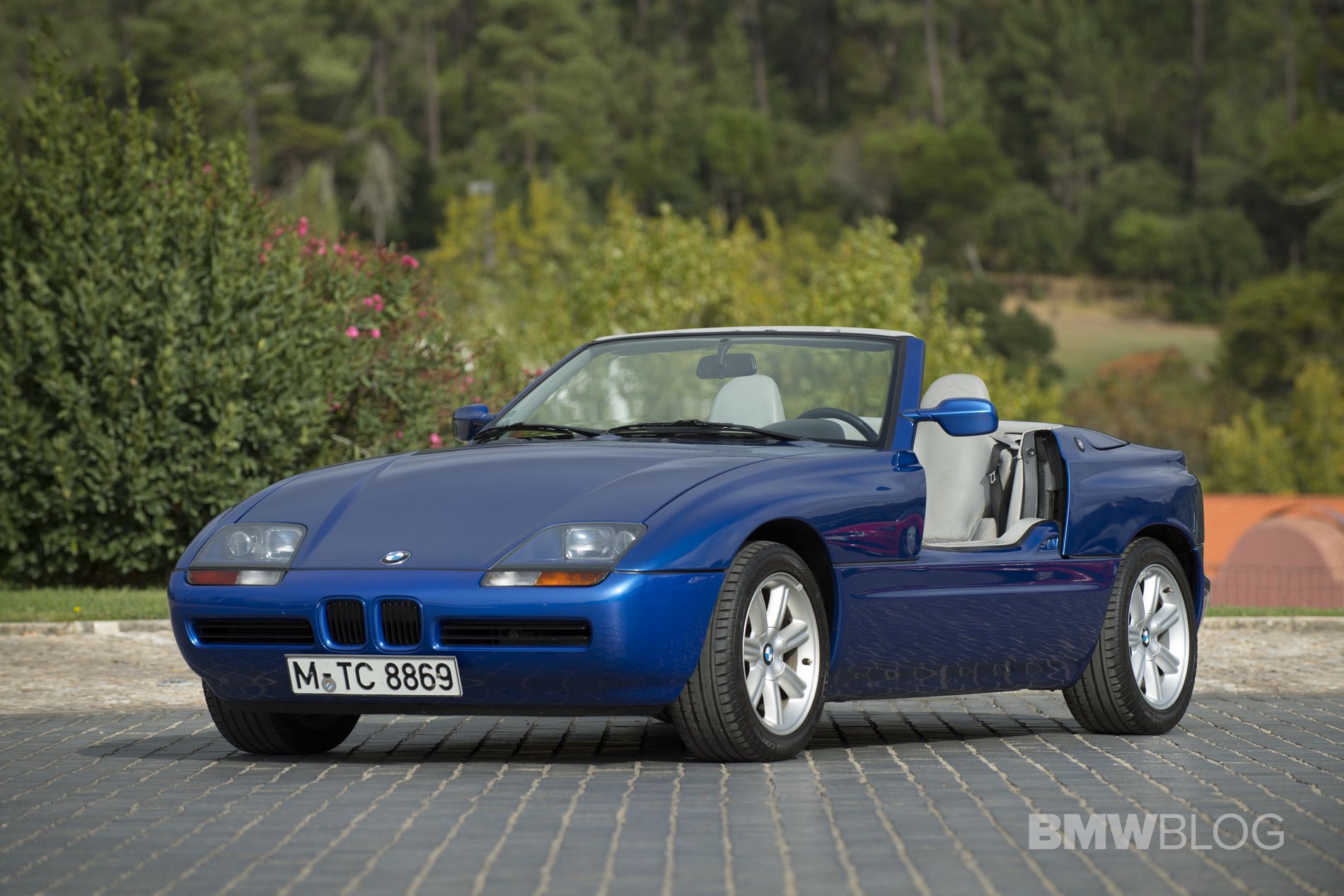
Penck considered the BMW Z1 a work of art before he even touched it, seeing creativity and imagination in the work of its designers and engineers. Rather than hide that design, he used it as the foundation for his own visual language, covering the red roadster with bold black figures and symbols reminiscent of prehistoric cave paintings. Those seemingly simple markings actually carry meanings: a matchstick-like figure represents humanity, an eye symbolizes an all-seeing eye, and a snake stands for the natural world. Penck combined and repeated the symbols across the Z1 in numerous ways, creating what he described as “art on art, art on technology.”
The choice of car was especially fitting. The Z1 was itself one of BMW’s more unconventional creations, and Penck specifically drew inspiration from its design when developing his artwork. Like the several Art Cars immediately before it, Penck’s Z1 was created strictly as an exhibition piece.
Car #12: Esther Mahlangu – 1991 BMW 525i

Esther Mahlangu (born 1935) is a South African artist and one of the leading practitioners of traditional Ndebele painting. She learned the technique from her mother, continuing a tradition in which the distinctive geometric murals are created by women and used to decorate the façades of homes. Mahlangu later brought that visual language to an international audience, with her work exhibited at institutions including the British Museum and Centre Pompidou.
For her BMW 525i, Mahlangu transferred those traditional Ndebele patterns onto a completely different kind of surface: a modern automobile. Before starting on the Art Car itself, she practiced by painting the door of another BMW to get a feel for the unfamiliar medium. Once she began, she transformed the entire 525i in just one week, covering it with the vivid geometric patterns normally seen on South African homes. As Mahlangu explained, “The patterns I used in the BMW design bring together our heritage and the modernity of the car.” She also became both the first woman and the first African artist to create a BMW Art Car.
Beneath the artwork was a BMW 525i. Mahlangu’s BMW was created strictly for exhibition and has never been driven on the road. In this case, though, that seems almost appropriate: the car’s significance lies less in what it could do mechanically and more in the collision of two very different worlds, traditional Ndebele house painting and a contemporary German luxury sedan.
Car #13: Sandro Chia – 1992 BMW M3 GTR

Sandro Chia (born 1946) is an Italian artist from Florence and one of the leading figures of the Italian Transavantgarde movement. Growing up surrounded by the art and architecture of the Renaissance helped shape his work, but Chia developed a much more playful and expressive style of figurative painting. He considers artists ranging from Renaissance masters Mantegna and Giorgione to Picasso, de Chirico and Carrà among his major influences.
Chia originally prepared sketches for his BMW, but apparently the car had other ideas. He later recalled that the M3’s bodywork seemed to be calling “Paint me, paint me!” So Chia threw out his sketches and simply started painting, covering the car with intense colors and numerous faces until virtually none of the original bodywork remained untouched. The faces were deliberate: Chia viewed the automobile as a coveted object within society and wanted the car to reflect the people looking at it, almost like a mirror. There was also some pressure involved. Chia admitted that creating a BMW Art Car was particularly challenging because artists he admired, including Warhol and Lichtenstein, had already done it before him.
And the canvas BMW gave him was considerably more serious than the sedans used for the previous few Art Cars. BMW identifies it as an M3 GTR prototype 3 Series touring car, powered by a 3.0-liter inline-six producing 325 horsepower and capable of 310 km/h (193 mph). Despite those specifications, however, Chia’s M3 never got to demonstrate them in competition, as Art Car #13 was created solely for exhibition.
Car #14: David Hockney – 1995 BMW 850CSi

David Hockney (1937-2026) was a British artist and one of the most influential figures in contemporary art. Born in Bradford, England, he graduated from London’s Royal College of Art in 1962 and soon became part of the city’s Swinging Sixties art scene. Throughout his career, Hockney was fascinated by light, color, perspective and movement, all of which would find their way onto his BMW.
Rather than simply decorate the outside of the 850CSi, Hockney decided to turn the car inside out. He approached the bodywork almost like an X-ray, painting stylized mechanical components on the hood and the outline of the driver on the door. He even included his dachshund, Stanley, sitting in the back seat. Areas of green sweeping across the body represent the passing landscape, blending what is happening inside the automobile with the outside world moving past it. “I thought it would be a good idea to show the car as if one could see inside,” Hockney explained.
And BMW gave Hockney a particularly interesting automobile to dissect, an 850CSi. Despite the considerable performance underneath Hockney’s imaginary X-ray, Art Car #14 was intended solely for exhibition and has never been driven on the road. So while Hockney showed us the engine, driver, dog and scenery, none of them ever actually went anywhere.
Car #15: Jenny Holzer – 1999 BMW V12 LMR

Jenny Holzer (born 1950) is an American conceptual artist best known for using words rather than traditional images as her primary form of expression. After studying art and printmaking in Ohio, she moved to New York in 1977 and began anonymously posting short, provocative statements around Lower Manhattan as part of her Truisms series. Her work later appeared on everything from benches and T-shirts to enormous electronic signs, including a 1982 display in Times Square. The messages can sound like advertising slogans, political statements or bits of uncomfortable wisdom, often leaving the viewer to decide exactly what they mean.
Naturally, Holzer covered her BMW with words. Six messages appear across the V12 LMR, including “THE UNATTAINABLE IS INVARIABLY ATTRACTIVE,” “LACK OF CHARISMA CAN BE FATAL,” and, most prominently, “PROTECT ME FROM WHAT I WANT.” The last one is particularly appropriate on a 580-horsepower Le Mans prototype. Holzer used reflective chrome lettering and phosphorescent paint so the words would remain part of the artwork throughout a 24-hour race: during the day the lettering reflects the sky, while at night it emits the daylight it absorbed, glowing BMW blue. Holzer said she chose the texts to make people “laugh or maybe be a little anxious.”
And unlike the previous several Art Cars, this one returned the project to its racing roots. The BMW V12 LMR was powered by a 6.0-liter V12 producing 580 horsepower. Holzer’s car participated in qualifying for the 1999 24 Hours of Le Mans, but did not compete in the race itself. Another BMW V12 LMR certainly did: Joachim Winkelhock, Pierluigi Martini and Yannick Dalmas drove it to overall victory at Le Mans, giving BMW one of the biggest motorsports victories in its history.
Car #16: Olafur Eliasson – 2007 BMW H2R

Olafur Eliasson (born 1967) is an Icelandic-Danish artist known for large-scale installations that use light, water, mist, movement and other natural phenomena to change the way viewers experience a space. Born in Copenhagen to Icelandic parents, he became internationally known for works such as The Weather Project, a 2003 installation at London’s Tate Modern that filled its enormous Turbine Hall with an artificial sun, mist and mirrors. Much of Eliasson’s work asks viewers to think about their relationship with the natural world, making him an interesting choice for BMW’s most environmentally focused Art Car to that point.
Eliasson did not paint the car. In fact, he removed the body entirely and replaced it with two layers of reflective wire mesh, which were then covered with several layers of ice. The finished sculpture weighed roughly two tons and was illuminated from within, transforming an aerodynamic high-speed prototype into something that appeared literally frozen in time. The contrast was deliberate: a machine designed around speed and mobility was rendered completely immobile, while the ice introduced ideas about sustainability, impermanence and the automobile’s environmental impact. As Eliasson put it, “Mobility in space implies friction: not only wind resistance, but also social, physical, and political friction.”
And underneath all that ice was one of the strangest cars BMW had built. The H2R was a hydrogen-powered research prototype with a 286-horsepower V12. Rather than using a fuel cell to generate electricity, its engine burned hydrogen, and the H2R set nine records for hydrogen-combustion vehicles during testing at BMW’s Miramas proving ground in France.
Car #17: Jeff Koons – 2010 BMW M3 GT2

Jeff Koons (born 1955) is an American artist and one of the most successful figures associated with the Neo-Pop movement. Born in York, Pennsylvania, he studied at the Maryland Institute College of Art and, somewhat unusually for a future art-world superstar, spent several years working as a Wall Street broker. By the mid-1980s, Koons had become known for transforming ordinary objects and familiar images into meticulously finished works of art, often reproducing them in unexpected materials. Koons is also an avid driver, making a race car a particularly natural fit for his work.
Koons wanted the M3 GT2 to look fast even when it was standing still. Inspired by motorsports imagery, he covered the car in vivid streaks of color that sweep rearward across the body, while graphic explosions at the back represent the power of the engine. He selected 20 different Pantone colors, reproduced using digital printing, and BMW even had to search for an exceptionally bright white vinyl to serve as the background. As he explained, “These race cars are like life, they are brimming with power and enormous energy.”
And unlike many of the Art Cars before it, this one was very much built to race. The M3 GT2’s 4.0-liter V8 produced 500 horsepower with its required air restrictor. Just ten days after its unveiling at the Centre Pompidou in Paris, Art Car #17 lined up for the 2010 24 Hours of Le Mans. It wore number 79, a deliberate tribute to Warhol’s 1979 M1, and was driven by Andy Priaulx, Dirk Müller and Dirk Werner. Unfortunately, history didn’t repeat itself: while Warhol’s M1 finished sixth overall, Koons’s BMW suffered technical problems and retired after only five hours.
Car #18: Cao Fei – 2016 BMW M6 GT3

Cao Fei (born 1978) is a Chinese contemporary artist whose work blends photography, film, video and 3D animation to create entire virtual worlds. Born in Guangzhou, she draws inspiration from popular culture, Surrealism and documentary filmmaking, often using technology to explore the rapid social changes taking place in China. Given that background, it makes sense that Cao would approach the idea of an Art Car very differently from the artists who came before her.
In fact, the car itself is almost completely carbon black. That’s because Cao’s creation was the first digital BMW Art Car, combining three separate elements: the physical M6 GT3, a six-minute film about a spiritual time traveler journeying through the past, present and future, and an augmented-reality installation. Viewed through a phone app, colorful streams of light appear to swirl around and above the otherwise black race car, creating artwork that doesn’t physically exist on its body at all. The concept reflected both the rapid pace of technological change in China and the relationship between tradition and modernity.
The M6 GT3’s 4.4-liter V8 produced up to 585 horsepower. After the Art Car’s 2017 public debut in Beijing, Augusto Farfus drove it to fourth place at the FIA GT World Cup in Macau that November. Farfus was already part of BMW Art Car history: earlier that same year, he had driven John Baldessari’s Art Car #19 to eighth place at the 24 Hours of Daytona.
Car #19: John Baldessari – 2016 BMW M6 GTLM
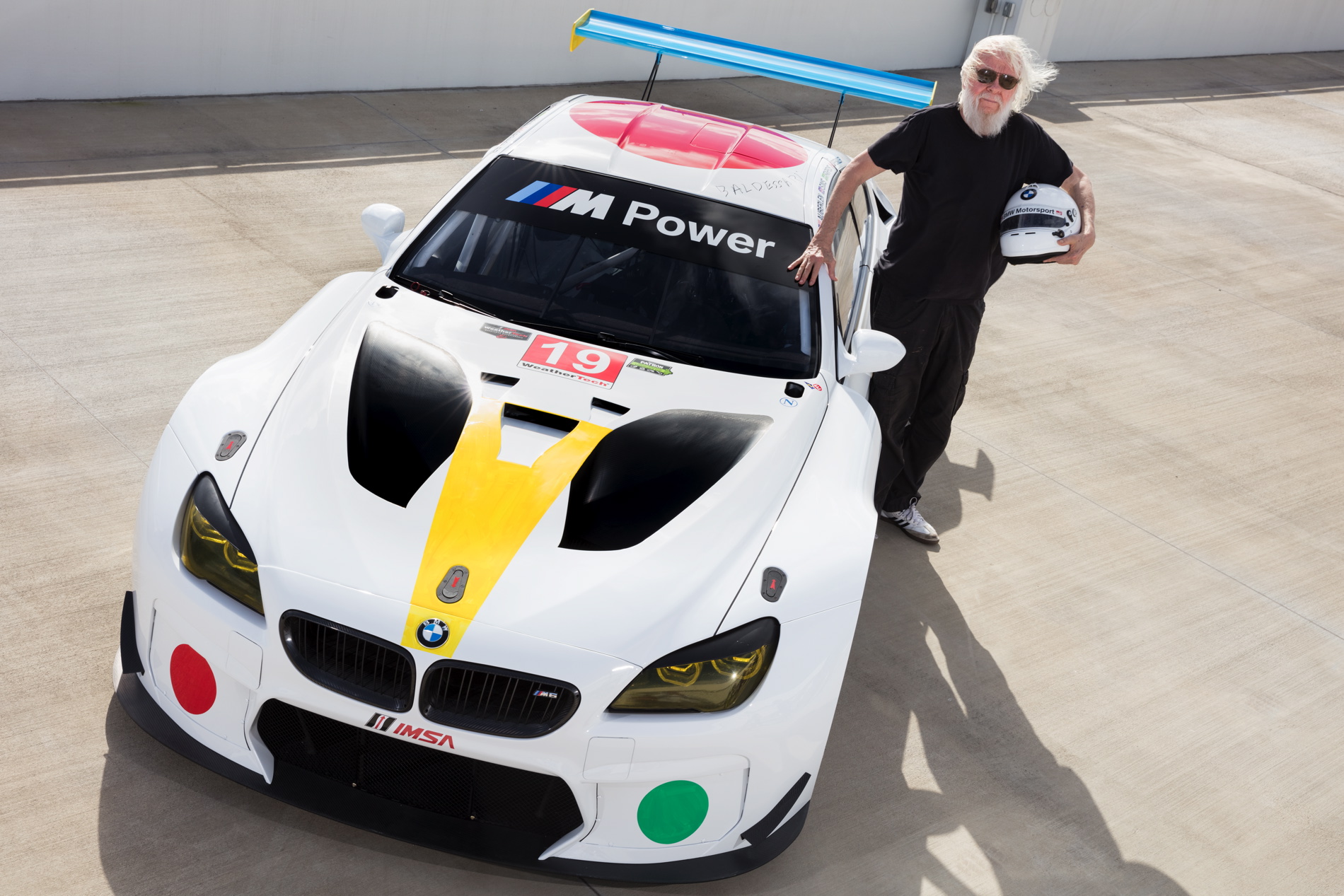
John Baldessari (1931-2020) was an American conceptual artist and one of the most influential figures in modern American art. Based in Southern California, he worked across photography, film, writing and performance, often playing with the way people interpret images and words. But he was perhaps best known for taking photographs and covering people’s faces with brightly colored dots, something he joked might ultimately be his legacy: “the guy who puts dots over people’s faces.”
Baldessari’s M6 GTLM is decorated with red, yellow, blue and green shapes, including a large green dot on the passenger-side door. But the most obvious element is the enormous word “FAST” written along the driver’s side. There isn’t much hidden meaning there: Baldessari said it was an “energetic reminder” to the driver and team because he still wanted the car to finish first. The deliberately simple treatment was very much the point. As Baldessari explained, it was “the fastest artwork I ever created!”
And unlike most artworks with the word FAST written across the side, this one could back it up. The M6 GTLM’s 4.4-liter V8 produced up to 585 horsepower. After being unveiled at Art Basel Miami Beach in November 2016, it competed in the 2017 24 Hours of Daytona, driven by Bill Auberlen, Alexander Sims, Augusto Farfus and Bruno Spengler. It finished eighth in the GTLM class, making Baldessari’s M6 the third BMW Art Car to finish a 24-hour race, following Lichtenstein’s 320 and Warhol’s M1.
Car #20: Julie Mehretu – 2024 BMW M Hybrid V8

Julie Mehretu (born 1970) is an Ethiopian-born American artist who moved to the United States with her family when she was seven and now lives and works in New York City. Her abstract works combine painting, drawing and printmaking, using densely layered forms to explore contemporary experiences and their connections to historical events.
For the 20th Art Car, Mehretu transformed BMW’s M Hybrid V8 endurance racer using imagery derived from one of her own monumental paintings. Rather than treating the car as a separate canvas, her concept effectively allowed the racing prototype to pass through the painting, wrapping its complex surfaces in the work’s characteristic layers of color, marks and blurred forms. The result looks particularly appropriate on a race car: what appears almost chaotic while standing still becomes a mass of color and motion at speed.
Art Car #20 went straight back to where the whole story began: the 24 Hours of Le Mans. After premiering at the Centre Pompidou in Paris on May 21, 2024, the M Hybrid V8 competed at Le Mans on June 15 with Robin Frijns, Sheldon van der Linde and René Rast. A driver error forced the car out after roughly five hours, but that wasn’t quite the end of its race. The team was able to get the Art Car back on track one final time for a lap of honor, crossing the finish line 24 hours after the race began. Fifty years after Hervé Poulain’s idea put Alexander Calder’s painted 3.0 CSL on the grid at Le Mans, the newest BMW Art Car had brought the collection full circle.
Art in Motion

What began in 1975 as an unusual idea to turn a BMW race car into a work of art, and then actually race it, became a 50-year collaboration between BMW and some of the world’s most prominent contemporary artists. The 20 cars couldn’t be more different. Yet they all explore essentially the same intersection of art, automobiles, technology and movement.
Perhaps the only disappointing part of the collection is that so many of these cars were never actually driven. There’s something wonderfully absurd about sending a priceless work by Andy Warhol or Roy Lichtenstein down the Mulsanne Straight at racing speed, and something slightly sad about creating an Art Car for it to spend its entire life standing still. The original concept wasn’t simply art on a BMW. The car, its movement and even the race itself were part of the art.
That’s also what made seeing all 20 together at BMW Welt so special. Normally spread across exhibitions and collections around the world, for a brief period they were all in one place, telling their complete story. Fifty years of automotive design, motorsport, and contemporary art, lined up together in Munich.
And after seeing them all, I think Hervé Poulain and Jochen Neerpasch had it right the first time: paint the car, then go race it.